

The ASTM C1549 standard, “Standard test method for determining near ambient temperature solar reflectivity using a portable solar reflectometer,” developed by the American Society for Testing and Materials (ASTM), describes a test method for determining the solar reflectivity of flat opaque materials in a laboratory or in the field using a commercial portable solar reflectometer. The purpose of this method is to obtain the necessary solar reflectivity data to evaluate temperatures and heat flows on surfaces exposed to solar radiation.
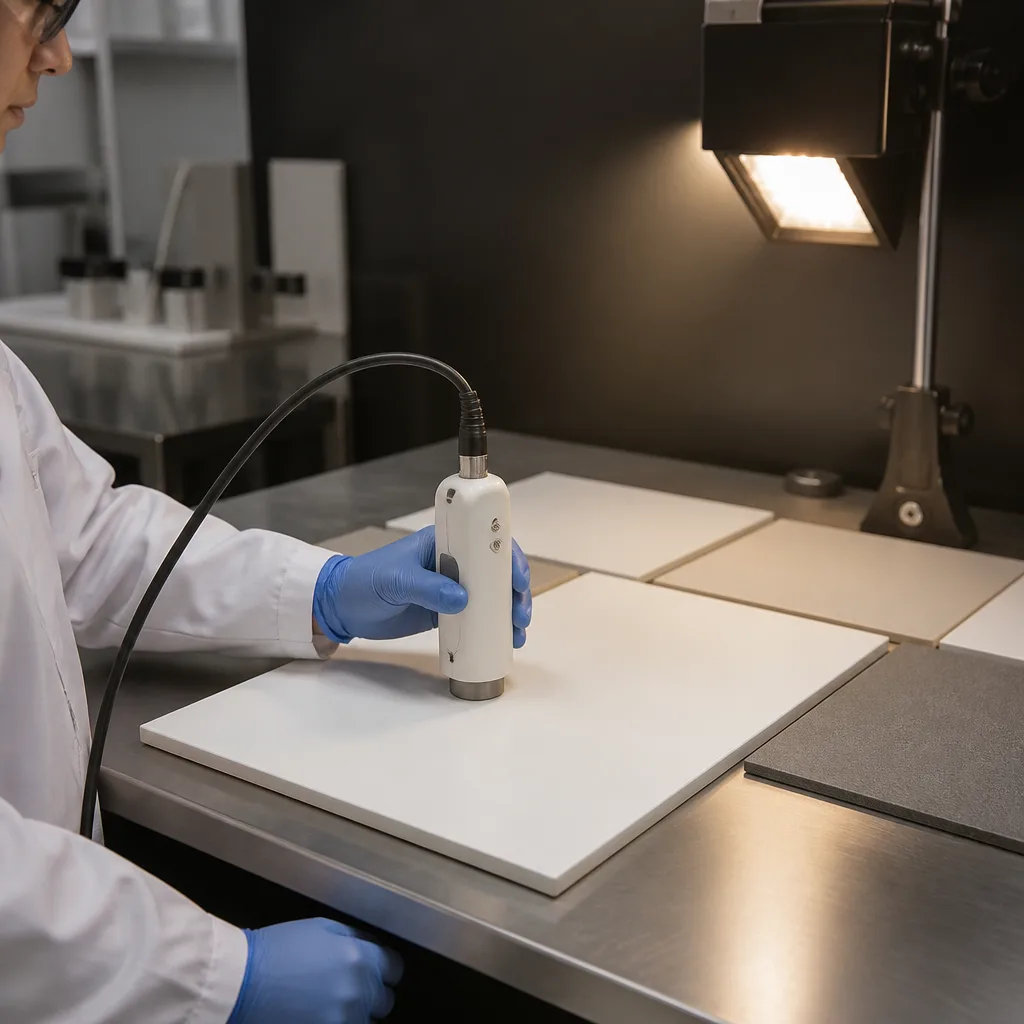
This test method does not replace the ASTM E903 standard test method, which measures solar reflectance in the wavelength range of 250 nm to 2500 nm using integrated spheres. The portable solar reflectometer is calibrated using samples with known solar reflectance properties to determine solar reflectance from measurements at four wavelengths in the solar spectrum (380 nm, 500 nm, 650 nm, and 1220 nm). This technique is supported by comparing the reflectometer measurements with those obtained using the ASTM E903 standard test method. This test method is applicable to material samples with both specular and diffuse optical properties. It is particularly suitable for measuring the solar reflectance of opaque materials.
The temperatures of opaque surfaces exposed to sunlight are generally higher than the surrounding air temperatures. In the case of roofs or walls surrounding air-conditioned areas, heat flow inwards increases. Similarly, in the case of equipment or storage containers exposed to sunlight, operating temperatures typically increase. The extent to which sunlight affects surface temperatures depends on the solar reflectance coefficient (SRC) of the exposed surface. A SRC of 1,0 (100% reflectance) has no effect on surface temperature, while a SRC of 0 (no reflection, complete absorption) provides maximum effect. Coatings with specific SRCs are used to alter the temperature of surfaces exposed to sunlight. Coatings and surface treatments are usually specified in terms of their SRC. To achieve the expected thermal performance, the initial (clear) SRC must be maintained throughout the life of the coating or treatment.
This testing method provides a tool for periodically testing surfaces in the field or laboratory. With this method, changes in solar reflectivity caused by aging and exposure, or both, are monitored. This test method is used to measure the solar reflectivity of a flat, opaque surface. The accuracy of averaging several measurements generally depends on the variability of reflectivity on the surface being tested.
In short, the ASTM C1549 standard provides a practical method for assessing how much solar radiation a surface reflects using a portable solar reflector, making it suitable for both laboratory and field measurements.
Solar reflectivity is one of the most important thermal properties of roofing materials, siding, pavements, and other building products exposed to sunlight. Materials with high solar reflectivity absorb less solar energy, which helps to lower surface temperatures and improve energy efficiency.
The primary goal of the ASTM C1549 standard is to provide a standardized method for measuring the solar reflectivity of opaque materials using portable equipment. The objectives of this standard are:
Solar reflectivity is the amount of incoming solar energy that a surface reflects. Solar reflectivity is expressed as a range of values:
For example, the solar reflectivity rates of some materials are as follows:
Higher solar reflectivity generally leads to the following:
The ASTM C1549 standard applies to:
This method can be applied in the following locations:
In principle, the ASTM C1549 standard test method uses a portable solar reflectometer. This device,
A reflectometer measures at four wavelengths that represent the solar spectrum:
These measurements are combined to estimate the total solar reflectance of the material.
The basic equipment used in the tests includes:
Calibration is essential before testing to obtain accurate and repeatable results.
In general, the testing process follows these steps:
Since natural surface variations can affect the results, multiple readings are recommended.
The ASTM C1549 standard is widely used in the following areas:
The ASTM C1549 standard is widely used by:
The ASTM C1549 standard is often used in conjunction with the following complementary standards:
For many years, our organization, with its competent and experienced team, has been understanding the needs of its clients, providing the advanced testing services they require, and assisting them in the establishment, implementation, and improvement of management systems. Within this framework, we also provide testing services in accordance with the ASTM C1549 standard.
To get an appointment, to get more detailed information or to request an evaluation, you can ask us to fill in our form and reach you.

