

The European standard “EN 13722 Furniture - Assessment of surface gloss” describes a test method for assessing the surface gloss of furniture surfaces using three reflectometer geometries, 20, 60 or 85 degrees. This method is applicable to all hard surfaces of finished products, regardless of the material, with the exception of coatings on leather and fabrics.
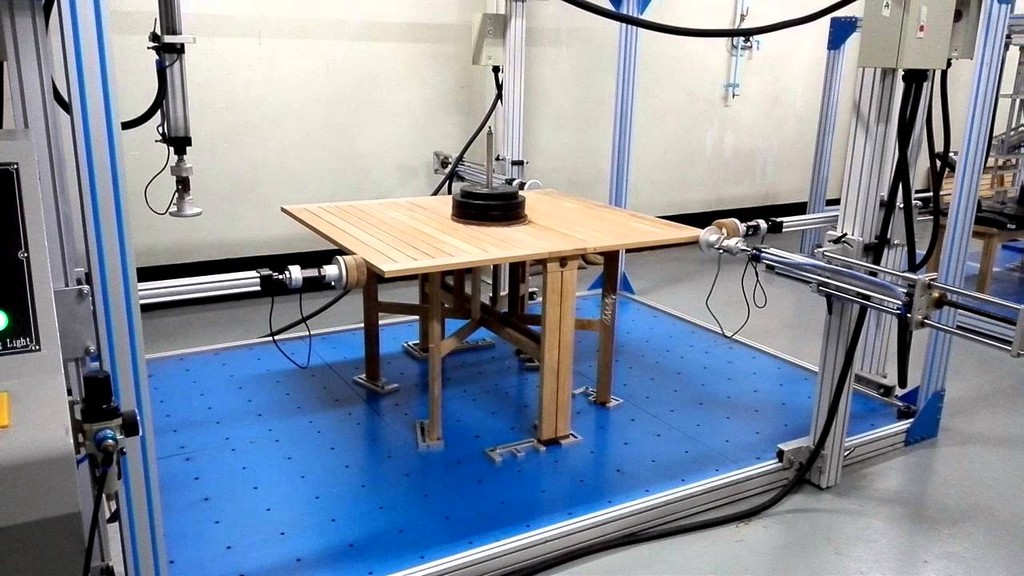
This test is intended to be performed on finished furniture, but may also be performed on test panels that are finished in the same manner as the finished product, made of the same material, and of a size sufficient to meet the requirements of the test.
This test method is not applicable to coatings on some metallic paints and pearlescent coatings.
For the purposes of this standard, the following terms and definitions apply:
When performing the test, in principle, the specular gloss of the test unit or test panel should be measured in various directions using a gloss meter with the specified geometry.
In these tests, a gloss meter is used, as defined in the standard “ISO 2813 Paints and varnishes - Determination of gloss value at 20, 60 and 85 degrees”.
The test unit or test panel shall be stored at a temperature of at least 15 degrees and not more than 30 degrees with free access to air for at least four weeks. The test unit or test panel shall be kept in a room free from direct light exposure. Conditioning shall begin one week prior to testing and shall be carried out in an environment of 23 degrees plus/minus 2 degrees and 50 percent plus/minus 5 percent relative humidity. Conditioning may be part of the above four weeks. The test surface shall be cleaned with a soft, clean, lint-free cloth prior to testing. The test surface shall be substantially flat and of sufficient size to allow measurements to be taken.
Before performing any tests, the gloss meter should be calibrated according to the ISO 2813 standard or the gloss meter manufacturer's instructions. Calibration should be performed at the beginning of each operating period and at intervals short enough to maintain the accuracy of the gloss meter according to the manufacturer's instructions. To define the specular gloss scale, polished black glass with a refractive index of 1.567 is equal to a value of 20 for the geometries of 60, 85 and 100 degrees.
Measurements should be made using a gloss meter with the specified geometries and in accordance with the procedure described in the standard. First, the specular gloss is measured using the 60-degree geometry method. If the result is at least 70 units (high specular gloss), additional measurements are made using the 20-degree geometry method. The 20-degree geometry method, which uses a smaller receiver aperture, is designed to provide better discrimination of high specular gloss.
If the result is less than 10 units (low specular brightness), additional measurements are made using the 85-degree geometry method. The 85-degree geometry method, which uses a larger receiver aperture, is designed to provide better discrimination of low specular brightness. The same geometry should be used for all measurements in determining specular brightness on a test unit.
For textured or open-grained surfaces or other surfaces, four measurements are made using a gloss meter in the directions indicated in the standard. The result is expressed in gloss units. The average value of the four values is calculated. If the spread of the values exceeds 10 gloss units or 20 percent of the average value, the measurement is considered invalid and the procedure is repeated. If the result fails again, the specular surface gloss cannot be assessed.
Among the numerous tests, measurements, analyses and evaluation studies that our organization has carried out for businesses in various sectors, it also provides testing services defined in the “EN 13722 Furniture - Evaluation of surface gloss” standard with its trained and expert staff and advanced technological equipment.
To get an appointment, to get more detailed information or to request an evaluation, you can ask us to fill in our form and reach you.

