

The standard “EN ISO 899 Plastics - Determination of creep behavior”, which is based on a European standard and later published by the International Organization for Standardization (ISO), consists of the following subsections published under the same title:
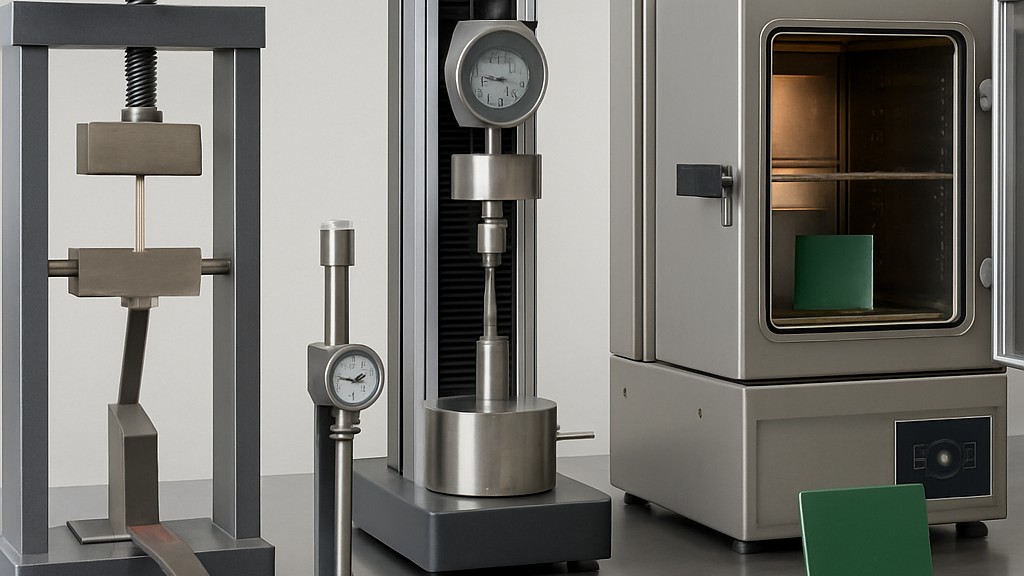
This method is intended to provide data for engineering design and research and development purposes. Data for engineering design purposes require the use of extensometers to measure the gauge length of the specimen. Data for research or quality control purposes may use the change in distance between grips (nominal extension).
Tensile creep can vary significantly depending on differences in specimen preparation, dimensions, and the test environment. The thermal history of the test specimen can also have profound effects on creep behavior. Consequently, when accurate comparative results are required, these factors must be carefully controlled. When tensile-creep properties are used for engineering-design purposes, the goal is to test plastic materials over a wide range of stresses, times, and environmental conditions.
Test specimens are conditioned as specified in the standard for the material being tested. If no information on conditioning is available, the most appropriate set of conditions specified in ISO 291 is used, unless otherwise agreed upon by the parties involved. Creep behavior is influenced not only by the thermal history of the tested specimen but also by the temperature and (where applicable) humidity used in conditioning. If the specimen is not in moisture equilibrium, creep is affected as follows: a specimen that is too dry will produce additional stress due to water absorption during testing, and a specimen that is too moist will shrink due to water desorption.
Unless otherwise agreed upon by the parties involved, for example, for testing at high or low temperatures, the test shall be conducted in the same atmosphere used for conditioning. The temperature change throughout the test period shall remain within plus or minus 2 degrees.
This method is suitable for use with rigid and semi-rigid unreinforced, filled, and fiber-reinforced plastic materials in the form of dumbbell-shaped test specimens, either directly molded or machined from sheets or molded articles. This method may not be suitable for certain fiber-reinforced materials due to differences in fiber orientation.
This method is intended to provide data for engineering design and research and development purposes. Data for engineering design purposes require the use of extensometers to measure the gauge length of the specimen. The change in distance between grips (nominal elongation) can be used for research or quality control purposes.
Flexural creep can vary significantly depending on differences in specimen preparation and dimensions, as well as the test environment. The thermal history of the test specimen can also have profound effects on creep behavior. Consequently, when accurate comparative results are required, these factors must be carefully controlled.
If flexural creep properties are to be used for engineering design purposes, plastic materials must be tested over a wide range of stresses, times, and environmental conditions. This method may not be suitable for determining the flexural creep of rigid cellular plastics.
Test specimens are conditioned as specified in the standard for the material being tested. If no conditioning information is available, the most appropriate set of conditions specified in ISO 291 is used, unless otherwise agreed upon by the parties involved. Creep behavior is influenced not only by the thermal history of the tested specimen but also by the temperature and (where applicable) humidity used in conditioning.
Unless otherwise agreed upon by the parties involved, for example, for testing at high or low temperatures, the test shall be conducted in the same atmosphere used for conditioning. The temperature change throughout the test period shall remain within plus or minus 2 degrees.
In short, the ISO 899 standard is essential because it provides standardized, reliable methods for measuring the dynamic mechanical properties of materials, such as stiffness, damping, and elasticity, when subjected to vibration. Engineers and designers need accurate dynamic property data to select suitable materials for applications involving vibration, such as automotive parts, aerospace components, or machines subjected to dynamic loads. Dynamic mechanical properties influence how materials behave under real-world operating conditions involving shock, vibration, or cyclic loading. ISO 899 helps predict durability, fatigue life, and noise/vibration behavior.
Our organization, which has been supporting businesses across all sectors for years through a wide range of testing, measurement, analysis, and evaluation activities, has a strong team of employees who closely follow global developments in science and technology and are constantly improving themselves. In this context, we also provide testing services in accordance with the EN ISO 899 Plastics - Determination of Creep Behavior standard.
To get an appointment, to get more detailed information or to request an evaluation, you can ask us to fill in our form and reach you.

