

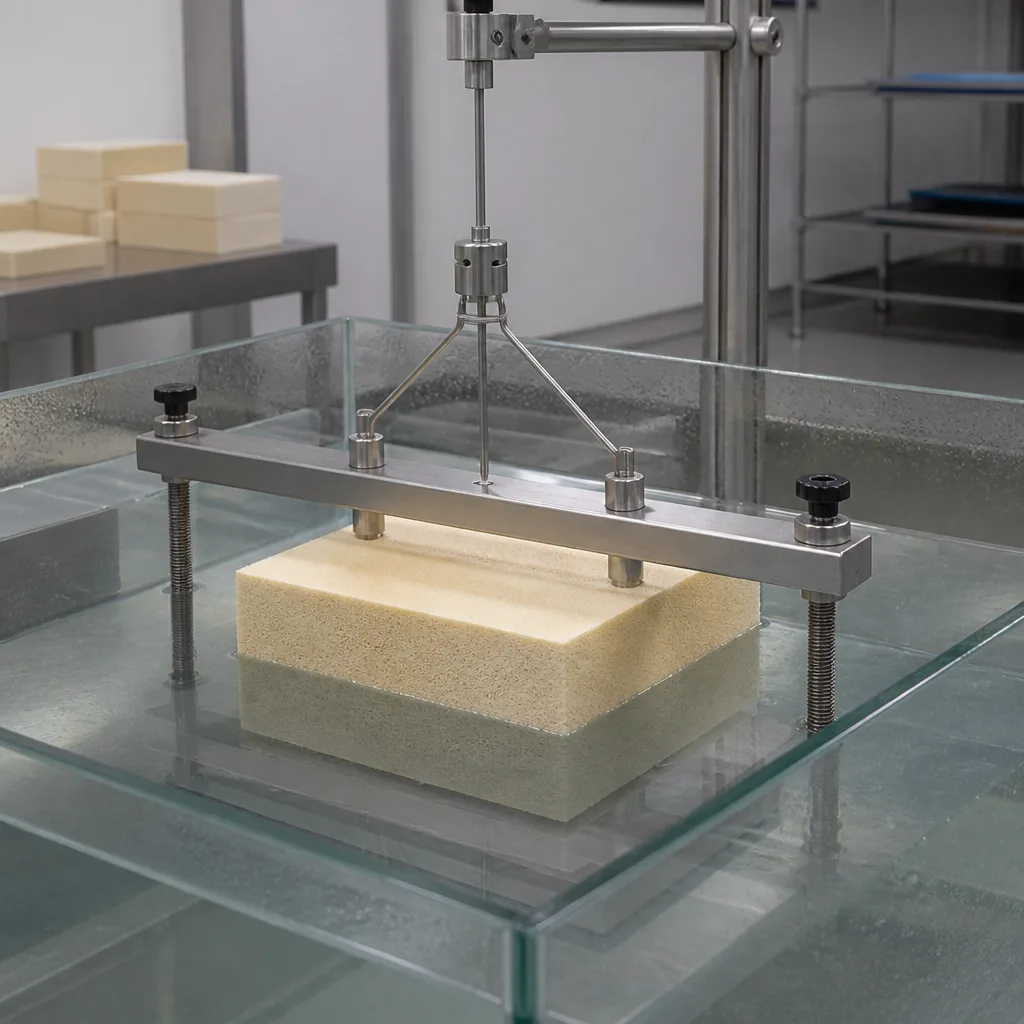
The ISO 2896 Rigid Cellular Plastics - Determination of Water Absorption standard, published by the International Organization for Standardization (ISO), describes a method for determining the water absorption of rigid cellular plastics by measuring the buoyancy force on a test sample after immersion in 50 mm of water for 4 days. This standard includes corrections to account for any changes in the sample volume, as well as the volume of water in the cut-face cells of the sample. Water absorption is expressed as the average of the percentage increase in volume relative to the original volume for several samples.
The method described is designed for use in quality control and product specification.
In principle, a material's water absorption capacity is determined by measuring the buoyant force acting on a sample immersed in distilled water for a specific period of time.
At least three samples must be tested. Samples must have a volume of at least 500 cm³ , a nominal length of 150 mm, and a nominal width of 150 mm. For materials produced and sold with natural or laminated surfaces, the thickness must be as manufactured. For materials thicker than 75 mm and without a surface coating, the material must be cut to a thickness of 75 mm for testing. The distance between two surfaces should not vary by more than 1% (parallelism tolerance). The surfaces of the samples must be smooth and dust-free. Samples should be dried in a dryer at room temperature until the average of two consecutive weighings, taken at least 12 hours apart, does not differ by more than 1%.
The testing process essentially follows these steps:
In short, the ISO 2896 standard includes a method for determining the water absorption properties of rigid cellular plastics. These materials are lightweight foams with a closed or partially closed cell structure, commonly used for thermal insulation, flotation, packaging, and structural applications. Examples include rigid polyurethane (PUR), polyisocyanurate (PIR), polystyrene (EPS/XPS), and phenolic foams.
Water absorption is a critical property, as moisture ingress can significantly affect a foam's thermal performance, dimensional stability, mechanical strength, and long-term durability.
The ISO 2896 standard defines laboratory procedures for measuring how much water a rigid cellular plastic absorbs when exposed to water under specific conditions. This standard generally covers the following:
The result is usually expressed as follows:
Water absorption is calculated from the difference between dry and wet masses, according to the formula given in the standard.
The ISO 2896 standard is considered important for the following reasons:
This standard helps predict long-term service behavior.
The data from the ISO 2896 standard is frequently referenced by other standards and technical specifications.
This standard is widely used in the following areas:
The advantages of using the ISO 2896 standard are as follows:
In conclusion, the ISO 2896 standard provides a standardized method for evaluating the water absorption behavior of rigid cellular plastics, a crucial factor affecting insulation efficiency and service life. By measuring moisture absorption, manufacturers can optimize foam formulations, and end-users can select materials suitable for challenging environmental conditions.
In industries where moisture resistance is essential, the ISO 2896 standard is a fundamental quality and performance benchmark.
For many years, our organization, with its competent and experienced staff, has been understanding the needs of its clients, providing the advanced testing services they require, and assisting them in the establishment, implementation, and improvement of management systems. Within this framework, we also provide testing services compliant with the ISO 2896 standard.
To get an appointment, to get more detailed information or to request an evaluation, you can ask us to fill in our form and reach you.

