ISO 14242 Implants for Surgery - Wear of Total Hip Joint Prostheses
The standard “ISO 14242 Implants for surgery - Wear of total hip joint prostheses” developed by the International Organization for Standardization (ISO) consists of a number of substandards under the same title:
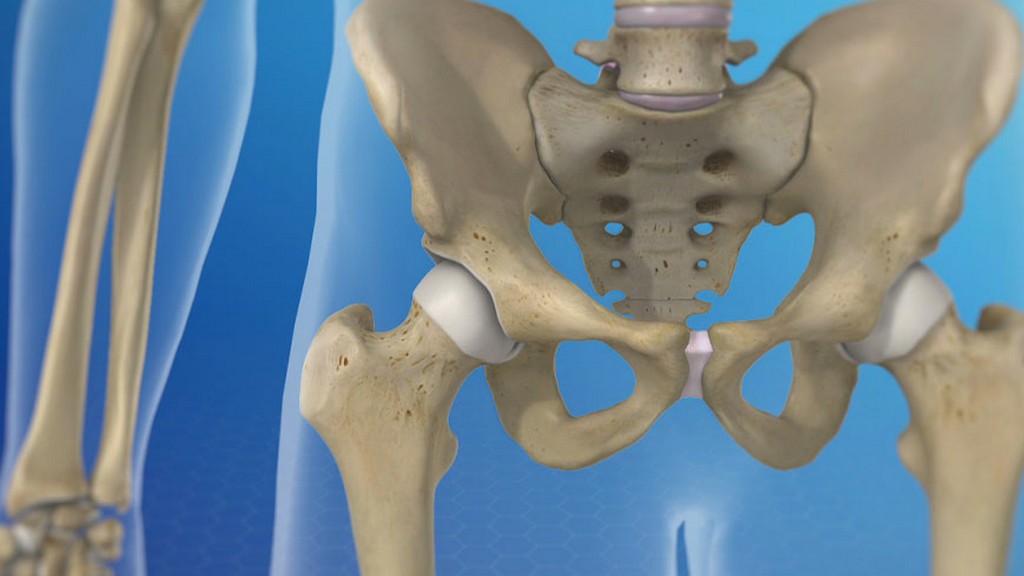
- “ISO 14242-1 Part 1: Loading and displacement parameters for wear testing machines and corresponding environmental conditions for testing”. This standard describes the relative angular motion between articulating components, the pattern of applied force, test speed and duration, specimen configuration and the test environment to be used in wear testing of total hip joint prostheses. The femoral and acetabular components of a test specimen are placed in position in their normal configuration. The test apparatus transmits a specified time-varying force between the components together with specified relative angular displacements. If polymers are the subject of investigation, a control specimen is subjected to the same time-varying force to determine the creep of the test specimen or the amount of mass change due to fluid transfer. The test takes place in a controlled environment simulating physiological conditions.
- “ISO 14242-2 Part 2: Measurement methods”. This standard describes methods for the assessment of wear of the acetabular component of total hip joint prostheses using gravimetric techniques and changes in the dimensional form of components tested in accordance with ISO 14242-1 or ISO 14242-3. Some investigators have experienced problems with organic deposits affecting the measurement results, particularly in hard/hard combinations. Specific precautions are not included in this standard, but the cleaning techniques adopted are intended to be appropriate for the soils produced. The test specimen is immersed in a lubricant. It is repeatedly removed from the lubricant, cleaned, dried and weighed until a constant rate of fluid absorption is achieved. The test specimen is then assessed for wear by testing for loss of mass in a knee-hip simulator. A loaded, unarticulated control specimen is designed to provide fluid absorption and is subjected to the same procedure for reference purposes.
- “ISO 14242-3 Part 3: Loading and displacement parameters for orbital bearing type wear testing machines and corresponding environmental conditions for testing” In this standard, In orbital bearing-type wear testing of total hip joint prostheses, the relative angular motion between the articulating components, the pattern of applied force, the speed and duration of testing, the specimen configuration, and the test environment to be used are described. The femoral and acetabular components of a test specimen are placed in position in their normal configuration, and the apparatus transmits a specified time-dependent force between the components together with specified relative angular displacements. A control specimen is subjected to the same time-dependent force to determine the creep of the test specimen or the amount of mass change due to fluid transfer, if polymers are the subject of investigation. Testing takes place in a controlled environment simulating physiological conditions.
- “ISO 14242-4 Part 4: Testing of hip prostheses under changes in component positioning that directly cause edge loading”. This standard describes test conditions to simulate edge loading in hip prostheses due to steep acetabular cup inclination angle and dynamic separation conditions. This standard is used in conjunction with ISO 14242-1 or ISO 14242-3. The two test conditions are summarised in a table given in the standard. Examples for the evaluation of edge loading are included in the annex of the standard (Annex A). Lubricant and loaded wetting control samples specified in ISO 14242-1 or ISO 14242-3 are used.
Among the numerous tests, measurements, analyses and evaluation studies carried out for businesses in various sectors, our organization also provides testing services defined in the “ISO 14242 Implants for surgery - Wear of total hip joint prostheses” standard with its trained and expert staff and advanced technological equipment.



