

The ASTM D3167 Standard Test Method for Floating Roller Peel Resistance of Adhesives , developed by the American Society for Testing and Materials (ASTM) , describes a test method for determining the relative peel resistance of adhesive bonds between a rigid adhesive and a flexible adhesive when tested under specified preparation and test conditions.
A change in the thickness of the bonded materials generally affects the test values. Therefore, the thickness of the boards used to make the test specimens should be specified in the material specification. When no thickness is specified, flexible adhesives should be 0,63 mm thick, and rigid adhesives should be 1,63 mm thick.
This test method is used for acceptance and process control testing. It can be used as an alternative to the standard test method "ASTM D1781 Standard Test Method for Climbing Drum Peel Process for Adhesives" when it is not available. Because the peel angle is larger, this test method is considered more stringent.
ASTM D3167 is a standard test procedure for measuring the average peel strength, or force, of an adhesive and bonding material using a floating roller peel apparatus. This test can be used to compare adhesives or adhesive surface preparation procedures. Therefore, this standard is frequently used in product development and manufacturing procedures.
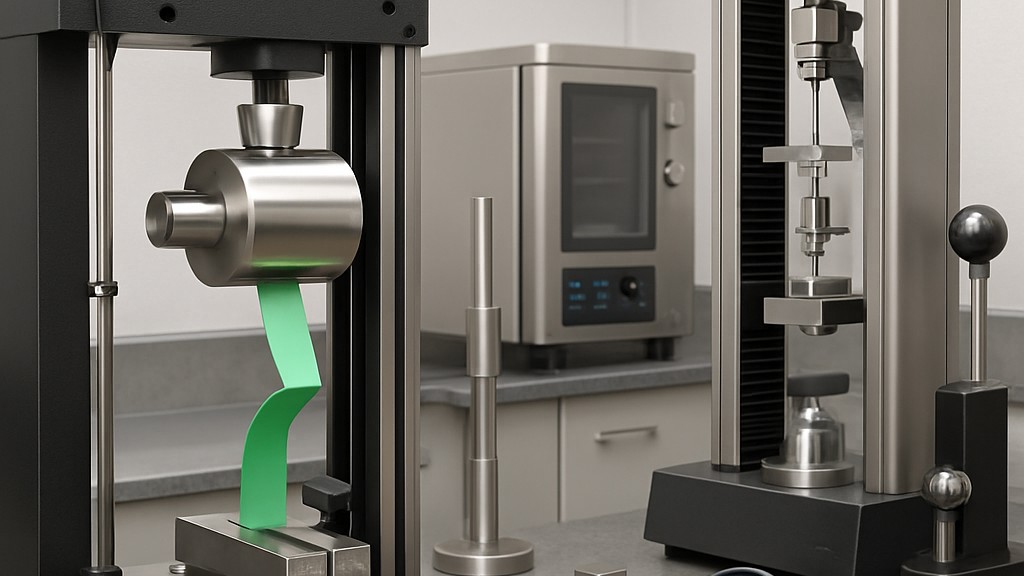
ASTM D3167 is particularly useful when the flexible adhesive is not flexible enough for a proper standard 90-degree or 180-degree peel test. In this standard, the flexible adhesive is bent around a rolling drum rather than around its own sharp bend radius.
For best results, according to ASTM D3167, samples should be 12,7 mm wide, rigid adhesive 20,3 cm long, and flexible adhesive 25,4 cm long. The extra 5,1 cm is used to wrap the flexible adhesive around the bending drum. This standard does not specify how many samples should be tested, but generally, several identical samples should be tested for each peel test.
The ASTM D3167 standard test procedure generally includes the following steps:
ASTM D3167 is a unique standard that bends a flexible adhesive around a floating drum apparatus measuring 2,5 cm in diameter. This test is a more gradual bend than the typical 90- or 180-degree peel test, facilitating smooth peel testing of a more rigid and flexible adhesive.
A peel tester is recommended for these tests. This device consists of a vertical load frame, an electromechanical actuator, a load cell, a test controller, test software, and peel grippers.
In high-risk fields like aerospace, automotive engineering, and composite manufacturing, adhesives are not just glue; they are the unsung heroes, holding structures together against vibration, temperature fluctuations, and relentless stress. The ASTM D3167 standard measures the peel strength of bonds between rigid and flexible materials, providing a reliable measure of adhesive performance under simulated real-world separation forces.
This method was developed to meet the demands of modern materials such as carbon fiber composites and advanced polymers. The ASTM D3167 standard emerged at a time when the aerospace and automotive industries were transitioning to lightweight designs where adhesives replaced welding and fasteners. Early bond failures (such as panel separation or laminate peeling) highlighted the need for a standard peel test capable of handling different materials: one rigid, such as metal or rigid composite, and the other flexible, such as film or rubber.
The scope of this standard is targeted: it evaluates relative peel resistance under controlled conditions and is ideal for acceptance testing, process validation, or comparing adhesives and surface preparations. Unlike simpler methods, the floating cylinder assembly of ASTM D3167 simulates a more aggressive 90-degree peel, making bonding more challenging and more suitable for high-performance applications. It is particularly valuable in situations where the flexible adhesive is not flexible enough for standard peel processes and serves as a bridge to more severe delamination scenarios.
Essentially, ASTM D3167 turns guesswork into data with a simple yet rigorous setup. Its goal is to reveal the true strength of an adhesive by measuring the average force required to separate bonded parts at a consistent 90-degree angle.
The strength of this method stems from the mechanics of the cylinder. It applies not only a tensile force but also a bending moment to the flexible layer, accelerating peel propagation for faster and more precise results. Advanced laboratories use specialized fixtures to ensure precision and often integrate software for automated analysis.
ASTM D3167 isn't just an academic standard; it's also part of the compliance process. Since its inception, this standard has reduced bonding failures in critical industries. Aerospace giants like Boeing claim to have reduced weight by up to 20 percent without compromising integrity by optimizing adhesives in wing skins and fuselages. Automotive engineers are using this standard to examine e-coatings and sealants, contributing to safer, lighter vehicles during the transition to electric vehicles.
Recent tests have shown that nanomaterials increase peel resistance by 50 percent, accelerating their adoption in sustainable composites. In quality control, premature degradation of properties saves money by preventing costly recalls.
Our organization, which has been serving for many years and meticulously following global developments in science and technology, employs a team of experienced professionals and a broad infrastructure to conduct testing, measurement, and analysis in a wide range of areas for businesses across all sectors. In this context, we also provide testing services in accordance with ASTM D3167 Standard Test Method for Floating Cylinder Peel Resistance of Adhesives.
To get an appointment, to get more detailed information or to request an evaluation, you can ask us to fill in our form and reach you.

