
EN ISO 6721 Plastics - Determination of Dynamic and Mechanical Properties

EN ISO 6721 Plastics - Determination of Dynamic and Mechanical Properties

The “EN ISO 6721 Plastics - Determination of dynamic mechanical properties” standard, developed by the International Organization for Standardization (ISO) and later published as a European standard within the scope of harmonization efforts, consists of the following sub-sections published under the same title:
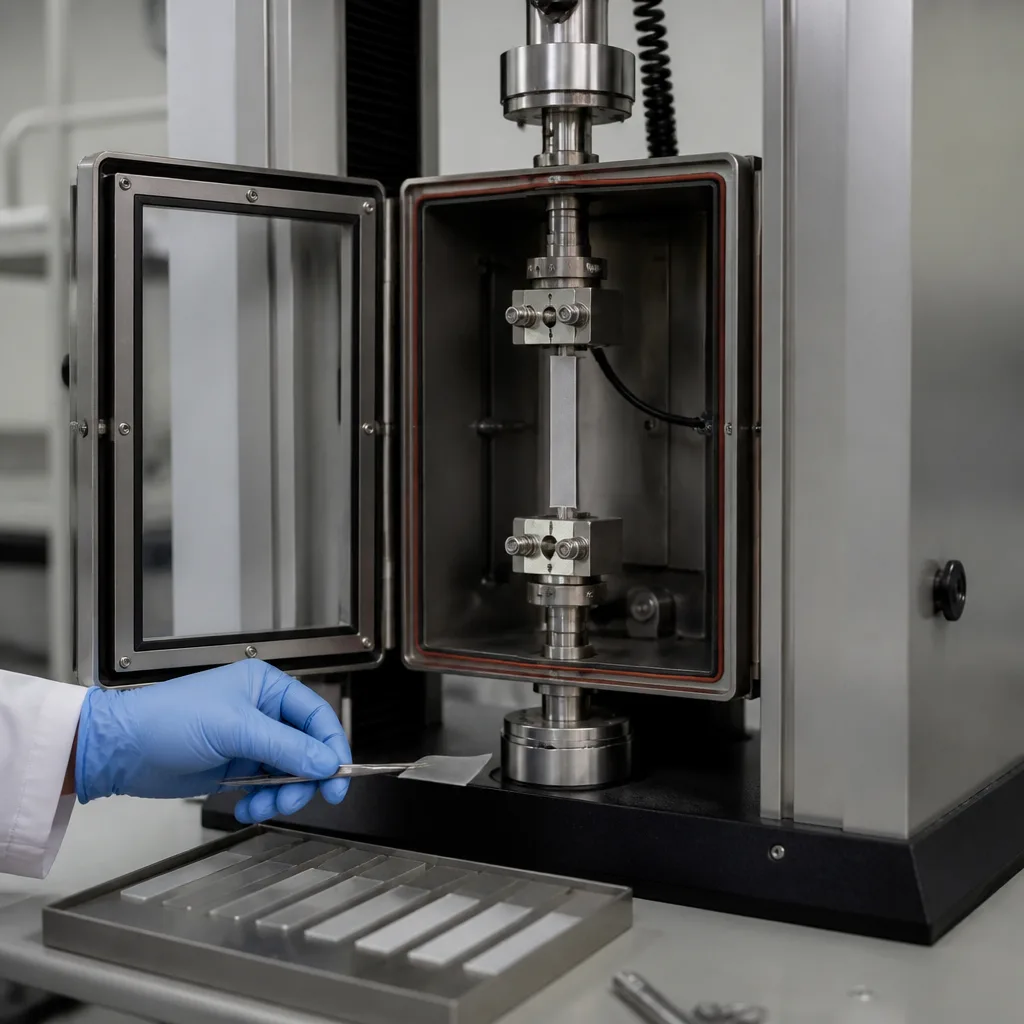
EN ISO 6721 Plastics - Determination of Dynamic and Mechanical Properties

  • The standard “EN ISO 6721-1 Part 1: General principles” describes methods for determining the dynamic mechanical properties of rigid plastics in the region of linear viscoelastic behavior. This standard specifies definitions and outlines general principles encompassing all aspects common to the individual test methods described in subsequent sections.

Different deformation modes can produce results that are not directly comparable. For example, tensile vibration causes a homogeneous stress throughout the entire thickness of the sample, while bending measurements are primarily influenced by the properties of the surface regions of the sample.

The values ​​obtained from bending test data are comparable to the values ​​obtained from tensile test data only at strain levels where the stress-strain relationship is linear and for samples with a homogeneous structure.

  • The standard “EN ISO 6721-2 Part 2: Torsion-pendulum method” describes two methods (A and B) for determining the linear dynamic mechanical properties of plastics, namely the storage and loss components of the torsional modulus, as a function of temperature for small deformations in the frequency range of 0,1 Hz to 10 Hz.

The temperature dependence of these properties, when measured over a sufficiently wide temperature range (e.g., between -50 degrees and +150 degrees for most commercially available plastics), provides information about the polymer's transition regions (e.g., glass transition and melt transition). It also provides information about the onset of plastic flow.

The two methods described are not applicable to asymmetric laminates (the EN ISO 6721-3 standard applies in this regard). The methods are not suitable for testing rubbers. The ISO 4664-2 standard applies in this regard.

  • The standard “EN ISO 6721-3 Part 3: Bending vibration - Resonance curve method” describes a bending-vibration method based on resonance curves for determining the bending complex modulus of homogeneous plastics and the damping properties of laminated plastics designed for acoustic insulation (e.g., systems consisting of a metal plate covered with a damping plastic layer or sandwich systems consisting of two metal plate layers with an intermediate plastic layer). For many purposes, it is useful to determine these properties as a function of temperature and frequency.
  • The standard “EN ISO 6721-4 Part 4: Tensile vibration - Non-resonant method” describes a forced, non-resonant method for determining the tensile complex modulus components of polymers, typically at frequencies ranging from 0,01 Hz to 100 Hz. Higher frequency measurements are possible, but significant errors in the measured dynamic properties are likely to occur. This method is suitable for measuring dynamic storage moduli in the range of 0,01 GPa to 5 GPa.

Although materials with modules outside this range can be investigated, the aim is to use alternative deformation modes for higher accuracy.

This method is particularly suitable for measuring loss factors and can therefore be easily used to study the variation of dynamic properties with temperature and frequency over a large portion of the glass-rubber relaxation region. The availability of data determined over wide ranges of both frequency and temperature allows for the derivation of master graphs showing dynamic properties over an extended frequency range at different temperatures, using frequency-temperature shifting procedures.

  • The standard “EN ISO 6721-5 Part 5: Bending vibration - Non-resonant method” describes a bending-based, non-resonant method for determining the bending complex modulus components of polymers, typically at frequencies ranging from 0,01 Hz to 100 Hz. Higher frequency measurements are possible, but significant errors in the measured dynamic properties are likely. This method is suitable for measuring dynamic storage moduli in the range of 10 MPa to 200 GPa.

Although materials with modulus lower than 10 MPa can be investigated, more accurate measurements of their dynamic-mechanical properties can be made using shear deformation modes.

This method is particularly suitable for measuring loss factors greater than 0,02 and can therefore be conveniently used to study the variation of dynamic properties with temperature and frequency over a large portion of the glass-rubber relaxation region. The availability of data determined over wide frequency and temperature ranges makes it possible to obtain master graphs showing dynamic properties over an extended frequency range at different temperatures using frequency/temperature shifting procedures.

  • The standard “EN ISO 6721-6 Part 6: Shear vibration - Non-resonant method” describes a forced, non-resonant method for determining the shear complex modulus components of polymers, typically at frequencies ranging from 0,01 Hz to 100 Hz. Higher frequency measurements are possible, but significant errors in the measured dynamic properties are likely to occur. This method is suitable for measuring dynamic storage moduli in the range of 0,1 MPa to 50 MPa.

Although materials with moduli greater than 50 MPa can be studied, more accurate measurements of dynamic shear properties can be obtained using the torsional deformation mode.

This method is particularly suitable for measuring loss factors greater than 0,02 and can therefore be conveniently used to study the variation of dynamic properties with temperature and frequency over a large portion of the glass-rubber relaxation region. The availability of data determined over wide frequency and temperature ranges allows for the acquisition of master graphs showing dynamic properties over an extended frequency range at different temperatures, using frequency/temperature shifting procedures.

  • The standard “EN ISO 6721-7 Part 7: Torsional vibration - Non-resonant method” describes a torsional-based, non-resonant method for determining the shear complex modulus components of solid polymers in rod or bar form, typically at frequencies ranging from 0,001 Hz to 100 Hz. Higher frequency measurements can be performed, but significant errors in the measured dynamic properties are likely to occur. This method is suitable for measuring dynamic storage moduli ranging from approximately 10 MPa, typical for hard rubbers, to approximately 10 GPa, representing fiber-reinforced plastics. Although materials with moduli lower than 10 MPa can be studied, more accurate measurements of their dynamic properties can be achieved using simple shear or torsional deformations of thin layers between parallel plates.

This method is particularly suitable for measuring loss factors greater than 0,02 and can therefore be conveniently used to study the variation of dynamic properties with temperature and frequency over a large portion of the glass-rubber relaxation region. The availability of data determined over wide ranges of both frequency and temperature allows for the derivation of master graphs showing dynamic properties over an extended frequency range at different temperatures, using frequency-temperature shifting procedures.

Although loss factors below 0,1 can be determined more accurately using a torsion pendulum, the method described in this standard allows for the coverage of a much wider and more continuous frequency range.

  • The standard “EN ISO 6721-8 Part 8: Longitudinal and transverse vibration - Wave propagation method” describes an ultrasonic wave propagation method for determining the storage components of the longitudinal complex modulus and shear complex modulus of polymers at discrete frequencies, typically in the range of 0,5 MHz to 5 MHz. This method is suitable for measuring materials with storage moduli in the range of 0,01 GPa to 200 GPa and loss factors below 0,1 at approximately 1 MHz. In materials with higher losses, significant errors in velocity measurement occur through waveform distortion, and these errors can only be reduced using procedures that fall outside the scope of this standard.

The method allows measurements to be taken on small samples, typically 50 mm x 20 mm x 5 mm, or on small areas of larger samples or plates. Therefore, it is possible to obtain information about the homogeneity or anisotropy of the modulus in a sample.

  • The standard “EN ISO 6721-9 Part 9: Tensile vibration - Pulse propagation method” describes a pulse propagation method for determining the storage component of the complex tensile modulus of polymers at discrete frequencies, typically in the range of 3 kHz to 10 kHz. This method is suitable for measuring materials with storage modulus in the range of 0,01 GPa to 200 GPa and loss factors below 0,1 at approximately 10 kHz. In materials with higher losses, significant errors in velocity measurement occur through amplitude reduction.

This method allows measurements on thin films or thin fibers and long samples, typically 300 mm x 5 mm x 0,1 mm bands or 300 mm x 0,1 mm (diameter) fibers. This method may not be suitable for cellular plastics, composite plastics, and multilayer products.

  • The standard “EN ISO 6721-10 Part 10: Complex shear viscosity using parallel plate oscillating rheometer” describes the general principles of a method for determining the dynamic rheological properties of polymer melts at angular frequencies typically ranging from 0,01 rad·s⁻¹ to 100 rad·s⁻¹ using an oscillating rheometer with a parallel plate geometry. Angular frequencies outside this range can also be used. This method is used to determine the values ​​of the following dynamic rheological properties: complex shear viscosity, dynamic shear viscosity, out-of-phase component of complex shear viscosity, complex shear modulus, shear loss modulus, and shear storage modulus. It is typically suitable for measuring complex shear viscosity values ​​up to approximately 10 MPa·s.

However, this standard is not currently in effect.

  • The standard “EN ISO 6721-11 Part 11: Glass Transition Temperature” covers the use of dynamic mechanical analysis procedures in temperature scanning mode to determine the glass transition temperature of plastics. It offers an alternative procedure to the use of differential scanning calorimetry for this measurement.

Dynamic mechanical analysis is used to determine the variation of the storage modulus, loss modulus, and loss factor as a function of temperature and frequency. From this data, a value for the glass transition temperature is determined. Many commercially available pieces of equipment utilize this technique and, in principle, can be applied to all loading modes described in the ISO 6721-1 standard.

The procedures minimize errors caused by the thermal lag of the sample, which varies depending on the heating rate used, by assuming that the sample temperature is given by the measured furnace temperature. This eliminates the need for direct measurement of the sample temperature, for example, with a thermocouple embedded in the sample.

  • The standard “EN ISO 6721-12 Part 12: Compression vibration - Non-resonant method” describes a non-resonant compression vibration method typically used to determine the components of the compression complex modulus of polymers at frequencies ranging from 0,01 Hz to 100 Hz. This method is applicable to measuring the dynamic storage moduli of semi-rigid polymers in the range of 1 MPa to 1 GPa.

This method is particularly suitable for measuring the dynamic moduli and loss factors of semi-rigid plastics in the shape of right-angle prisms, cylinders, or tubes, and can be easily used to investigate the variation of dynamic properties with temperature and frequency over a large portion of the glass-rubber relaxation region.

For many years, our organization, with its competent and experienced staff, has been understanding the needs of its clients, providing the advanced testing services they require, and assisting them in the establishment, implementation, and improvement of management systems. Within this framework, we also provide testing services in accordance with the EN ISO 6721 standard.

WhatsApp

