

The “PI-78 Microseparation test” standard, developed by PI Medical Implants, describes a procedure for detecting small cracks and nucleations in the microstructure of the material.
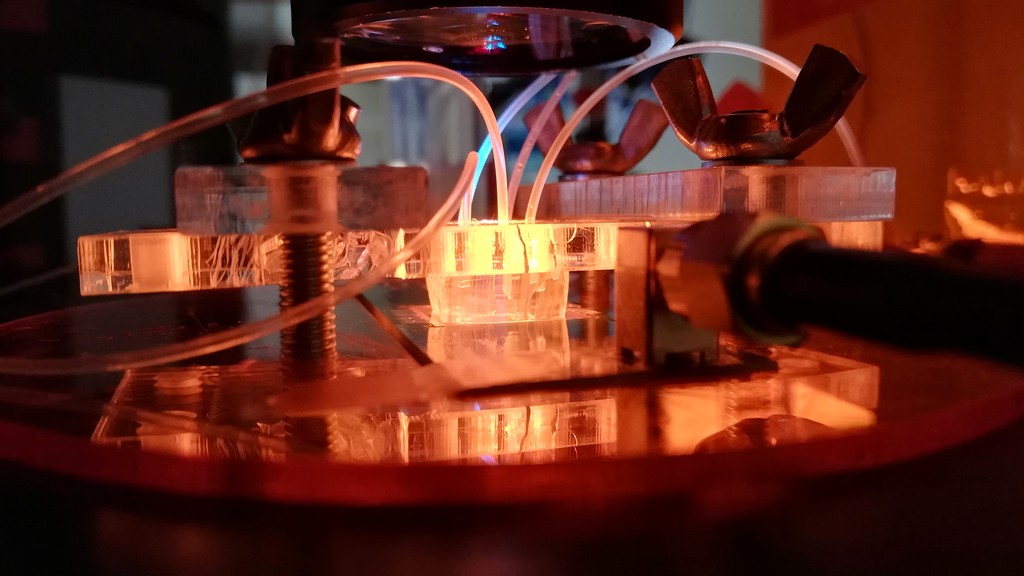
In general, microseparations are small cracks in the microstructure of the material and their nucleation usually occurs in areas with certain characteristics such as high stresses, sufficiently weak interatomic bonds such as voids near material inhomogeneities, or around phase boundaries such as an existing crack or notch.
Total hip prosthesis specimens show very low wear rates when tested in the stiff joint regions under standard walking conditions according to the standard “ISO 14242-1 Implants for surgery - Wear of total hip joint prostheses - Part 1: Loading and displacement parameters for wear testing machines and corresponding environmental conditions for testing”. In addition, the standard “ISO 14242-4 Implants for surgery - Wear of total hip joint prostheses - Part 4: Testing of hip prostheses under changes in component positioning resulting in direct edge loading” includes a more severe loading scenario simulating edge loading due to steep acetabular cup inclination and dynamic separation (micro-separation).
These tests can be performed in in vitro and in vivo environments, the standard kinematic movements and processes are created between the femoral cup and the femoral head, and force is applied to the implant from a special area. The separation between the cup and the femoral head is measured and reported with high precision position measurement sensors.
Meanwhile, “PI-78 Microseparation test” is based on ISO 14242-4 standard developed by International Standards Organization (ISO). This standard describes the test conditions to simulate the edge loading in hip prostheses due to steep acetabular cup inclination angle and dynamic separation conditions. This standard is used together with ISO 14242-1 or ISO 14242-3 standard. The two test conditions are summarized in the table given in the standard. Examples for the evaluation of edge loading are included in the standard appendix (Annex A).
At least three test components should be used during testing. The spring is positioned so that it can hold the femoral head or acetabular cup in the intended insertion disproportion when no medial-lateral force is acting on the acetabular cup and no vertical load is on the acetabular cup. During dynamic loading conditions, the spring experiences maximum compression during peak loading of the stance phase and the femoral head articulates in the intended bearing area of the acetabular cup. During the swing phase with low axial load, the spring compression decreases so that the acetabular cup moves medially relative to the center of the femoral head and the centers of the femoral head and acetabular cup are separated and the femoral head articulates at the edge or rim of the acetabular cup, simulating dynamic separation of the centers. At the beginning of heel strike, the axial load increases and begins to move the acetabular cup back toward the intended articular position. At the beginning of the stance phase, an increasing load is applied by the femoral head to the rim of the acetabular cup, allowing the acetabular cup to return to the intended position.
A spring with a constant value of 100 N/mm is used in the tests. In some simulators, the spring force is also applied to the femoral head to provide dynamic separation.
Among the numerous testing, measurement, analysis and evaluation studies that our organization has carried out for businesses in various sectors, it also provides testing services defined in the "PI-78 Microseparation test" standard with its trained and expert staff and advanced technological equipment.
To get an appointment, to get more detailed information or to request an evaluation, you can ask us to fill in our form and reach you.

