

The standard "ASTM D1622 Standard Test Method for Apparent Density of Rigid Cellular Plastics," developed by the American Society for Testing and Materials (ASTM), describes a test method covering the density of a cellular plastic. Density can be evaluated as either the apparent overall density (including formed skins) or the apparent core density (removed formed skins).
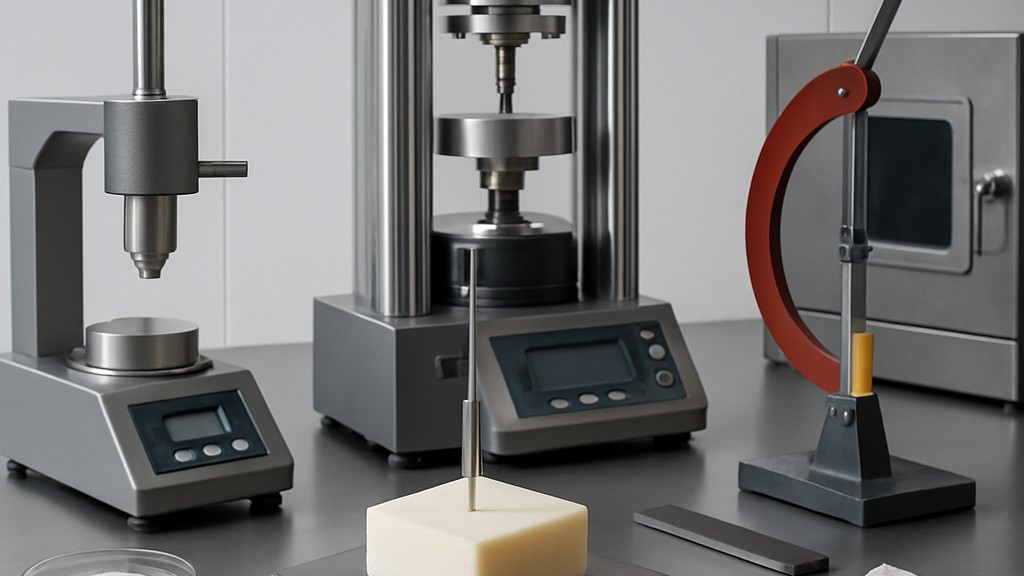
The apparent density of rigid cellular plastics refers to the measured density of the foam-like plastic material, taking into account both the solid portions of the plastic and the air-filled cells (or voids) within it.
Rigid cellular plastics are plastics with a foam structure, containing many small, closed air pockets (cells), making them lightweight yet rigid. Examples include rigid polyurethane foam, polystyrene foam, and rigid PVC foam.
Apparent density is the density calculated by dividing the total mass of the foam sample by its total volume, including the volume occupied by air cells. It is called apparent density because it reflects the bulk density of the material, not just the density of the solid polymer.
Apparent density is the ratio of the mass of the foam sample to the total volume of the foam sample (including air cells).
Apparent density is important for the following reasons:
If the material to be tested contains forming skins, the apparent overall density or the apparent core density, or both, must be determined. If the material has no forming skins, the term overall density is not applicable.
This test method can also be applied to spray foam materials.
Before proceeding with this test method, the properties of the material to be tested must be consulted. Any test specimen preparation, conditioning, dimensions, or test parameters, or combination thereof, included in the relevant ASTM material specification take precedence over those specified in this test method. If no relevant ASTM material specification is available, the default conditions in this method apply.
The ASTM D1622 test method utilizes an analytical balance, a micrometer dial indicator, and two-component spray equipment. The sample is weighed on a scale, and its dimensions are measured using a measuring device. The sample's weight is checked to an accuracy of plus or minus 0,1 percent. The sample is measured using a caliper or dial gauge with a minimum area of 6,5 cm2. The dial foot pressure is maintained at 2,7 kPa plus or minus 0,7 kPa until the sample is indented. If any indentation occurs, the pressure is reduced. The tester must ensure that the caliper jaws do not compress the sample. Three measurements are taken for each dimension. To ensure there is no error, the measurement is performed three times.
Sample size and number must be as required by ASTM D1622. Three samples are taken, each with a volume that can be accurately calculated and is not less than 16,4 cm3.
Major applications of the ASTM D1622 standard include:
In short, ASTM D1622 covers the determination of density in rigid cellular plastics, both surface-coated and spray-foam materials. The process involves precise weighing and dimensional measurement to ensure accuracy in both overall apparent densities and core densities. It is an important method for research, development, and quality control, providing critical information for material properties and performance evaluation. Furthermore, thanks to the ASTM D1622 specifications, the industry is better positioned to improve product quality and consistency, make better decisions about appropriate material applications, and enhance overall product reliability.
Our organization, which has been supporting businesses across all sectors for years through a wide range of testing, measurement, analysis, and evaluation activities, has a strong team of employees who closely follow global developments in science and technology and are constantly improving themselves. In this context, we also provide testing services in accordance with ASTM D1622 Standard Test Method for Apparent Density of Rigid Cellular Plastics.
To get an appointment, to get more detailed information or to request an evaluation, you can ask us to fill in our form and reach you.

