

Low strain rate testing (SSRT) is a method used to determine stress thresholds and susceptibility to stress corrosion cracking by applying a constant elongation rate to materials, particularly in environments such as the nuclear and aerospace industries. Generally described in detail in the ASTM G129 standard, “Standard practice for slow strain rate testing to assess the susceptibility of metallic materials to environmentally induced cracking,” it is a rapid material assessment technique that evaluates susceptibility to stress corrosion cracking or hydrogen embrittlement by applying a very slow elongation rate (typically up to 100 nm) to a sample in a specific environment. This technique ranks material performance in corrosive environments by inducing accelerated failure compared to conventional testing.
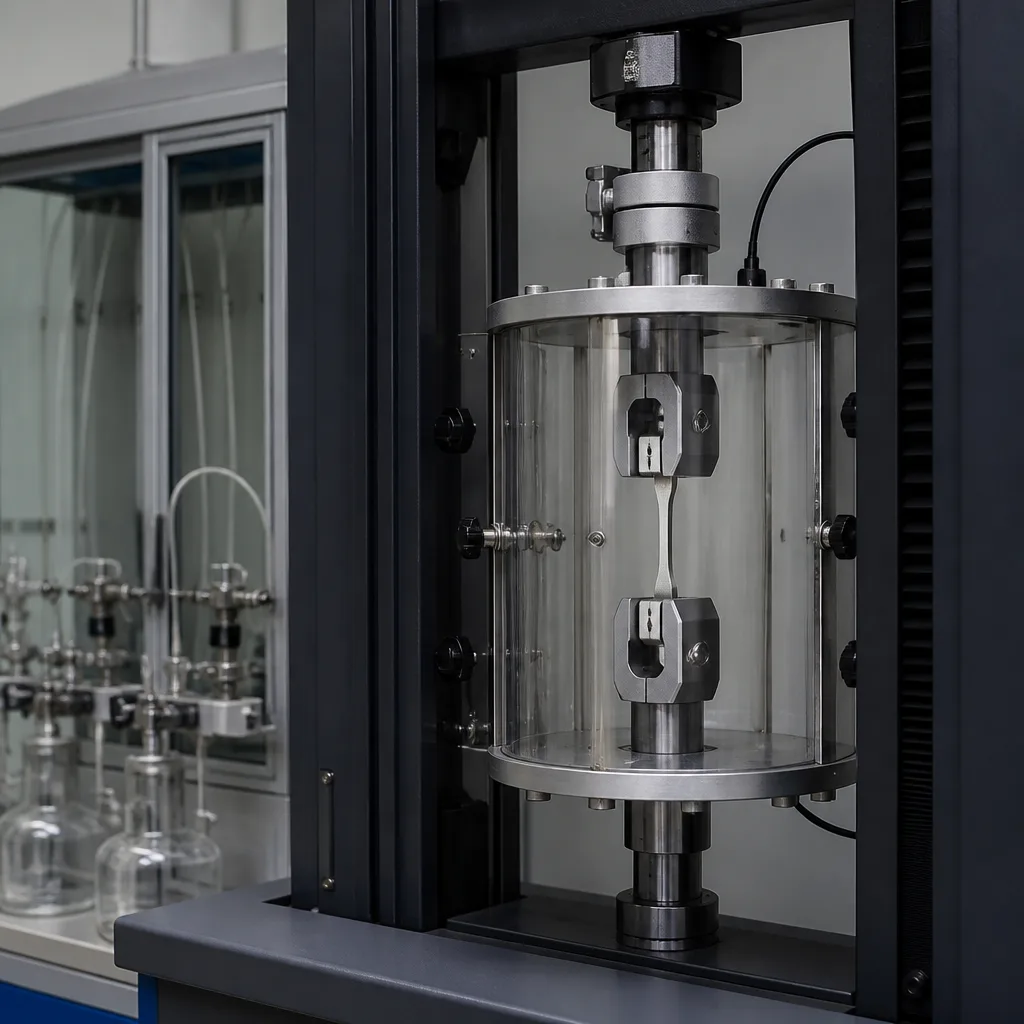
Low-stretch rate testing refers to mechanical tests performed at deliberately slow deformation rates, far below those of conventional tensile tests (which typically use high strain rates). These tests are essential in materials science and engineering for two main purposes:
The most prominent form is the slow strain rate test (SSRT), also known as the constant strain rate tensile test. In this test, a smooth tensile specimen is pulled at a constant low strain rate while exposed to a specific medium (abrasive, high temperature, or gas). Typical strain rates range from 10⁻⁸ to 10⁻³ s⁻¹ , and common values for stress corrosion cracking studies are around 10⁻⁵ to 10⁻⁷ s⁻¹ . The slow rate allows time for environmental interactions (e.g., corrosion, hydrogen diffusion, or passive film degradation) to affect crack formation and propagation, effects that may not be visible in faster tests.
Materials are sensitive to strain rate: their strength, ductility, and failure modes can vary significantly with deformation rate.
In tensile tests performed on mild steel at low strain rates, researchers observed differences in yield strength, ultimate tensile strength, and uniform elongation depending on the exact strain rate selected within the low regime. Even non-standard specimen designs can yield reproducible results for these properties.
Low strain rates for polymers and composites help simulate long-term service conditions (e.g., slow warm-up in a vehicle dashboard), while high speeds are needed for collision modeling.
Slow strain rate testing generally follows these steps:
Tests are typically performed both in the aggressive medium and in an inert reference medium for comparison (e.g., air or argon). A significant reduction in ductility in the medium indicates susceptibility to stress corrosion cracking or hydrogen embrittlement.
The oscillating slow strain rate test is a variant that repeatedly disrupts protective passive films by adding small load cycles around the yield point, making it more aggressive for evaluating long-term durability in alloys such as stainless steels or nickel alloys.
The standards that guide slow tensile strength testing are as follows:
The main application areas of the slow strain rate testing method are as follows:
For example, in nuclear research, slow strain rate testing in simulated pressurized water reactor water at approximately 7,4 x 10⁻⁷ s⁻¹ has shown irradiation hardening reaching saturation around 10 dPa, decreased ductility at higher doses, and occasional splitting or intergranular cracking.
The advantages of this method are as follows:
However, this method has some limitations:
For many years, our organization, with its competent and experienced staff, has been understanding the needs of its clients, providing the advanced testing services they require, and assisting in the establishment, implementation, and improvement of management systems. Within this framework, we also provide low strain rate testing (SSRT) services to businesses.
To get an appointment, to get more detailed information or to request an evaluation, you can ask us to fill in our form and reach you.

