

The standard "ASTM D5229/D5229M Standard Test Method for Moisture Sorption and Equilibrium Conditioning of Polymer Matrix Composite Materials," developed by the American Society for Testing and Materials (ASTM), describes a test method for determining through-thickness moisture sorption or desorption properties for single-phase Fickian solid materials in flat or curved panel form. This standard also includes procedures for conditioning test coupons before use in other test methods. These are brought to either a substantially moisture-free state, equilibrium in a standard laboratory atmosphere, or equilibrium in a non-laboratory environment.
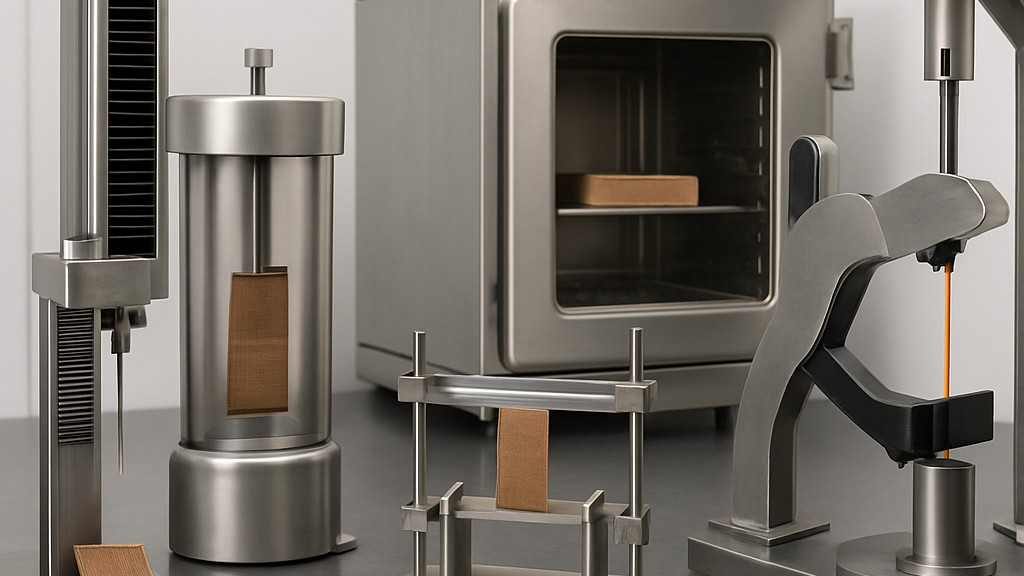
This standard also includes procedures for determining moisture loss during elevated-temperature tests, as well as moisture loss from thermal exposure after removal from the conditioning environment, such as strain gauge mounting. While primarily designed for laminated polymer matrix composite materials, these procedures are also applicable to other materials that meet the assumptions of this standard.
The calculation of the moisture diffusion constant through thickness in Procedure A assumes a single-phase Fickian material with constant moisture sorption properties throughout the thickness of the sample. The validity of the equations used in Procedure A to evaluate the moisture diffusion constant in a material with previously unknown moisture sorption behavior is uncertain prior to testing because the test results determine whether the material follows a single-phase Fickian diffusion model. A reinforced polymer matrix composite material tested below the glass transition temperature generally meets this requirement, but two-phase matrices, such as cured epoxies, may require a multiphase moisture sorption model. While the test procedures can be used for multiphase materials, the calculations used to determine the moisture diffusion constant in Procedure A are only valid for single-phase materials.
The evaluation of moisture equilibrium content material property by Procedure A does not assume single-phase Fickian diffusion behavior and is therefore not limited to it (Fickian diffusion refers to a solvent diffusion process in polymer networks characterized by a diffusion rate significantly slower than the polymer relaxation rate).
The procedures used in this test method can be performed with suitable automated equipment and the resulting data can be reduced.
Procedure A is designed to produce moisture diffusion material property data that can be used to:
Procedure BE is designed to condition test coupons to a specific environmental condition or equilibrium state prior to other material property tests (including, but not limited to, mechanical tests).
Procedure YZ is designed to determine the loss in moisture content due to removal of a test coupon from the conditioning chamber (such as by connecting a strain gauge) or by heating the test coupon before and during mechanical loading.
A single pair of tests on thin and thick samples using Procedure A provides the moisture diffusion constant and equilibrium moisture content at a given moisture exposure level and temperature. Multiple tests at different temperatures are required to determine the temperature dependence of the diffusion constant. Multiple tests at different moisture exposure levels are required to determine the dependence of the moisture equilibrium moisture content on the moisture exposure level.
For many polymer matrix composites, moisture diffusion is generally weakly related to relative humidity and is generally assumed to be a function of temperature only. For many of these materials, equilibrium moisture content is weakly related to temperature and is generally assumed to be a function of relative humidity only.
When the ambient conditions during use are vapor, such as moist air, vapor exposure testing should be used to condition the sample. Liquid bath immersion should be used to simulate vapor exposure only when visible absorption properties are desired for qualitative purposes. Properties determined by the latter method should be reported as visible properties.
For many polymer matrix composites, moisture absorption properties under atmospheric humidity are generally not equivalent to those of liquid immersion or exposure to pressurized vapor. These latter environments may have different material diffusion properties.
ASTM D5229/D5229M is a standard test method designed to evaluate the moisture absorption and desorption properties of polymer matrix composite materials. This standard is critical for industries such as aerospace, automotive, and civil engineering, where composite materials such as carbon fiber-reinforced plastics and glass fiber-reinforced plastics are widely used. Understanding how these materials interact with moisture is crucial to ensuring their durability and performance in moisture-sensitive environments.
In short, ASTM D5229/D5229M provides procedures for determining the moisture sorption and desorption properties of polymer matrix composites through-thickness for single-phase Fickian solid materials. It applies to flat or curved panel forms and includes methods for conditioning test specimens prior to other material property tests. This standard is particularly applicable to materials used in structural and functional applications, such as epoxy, polyester, and phenolic matrix composites, as well as hybrid and sandwich structures.
This standard is divided into several procedures:
The basic method in ASTM D5229/D5229M is a gravimetric test that monitors changes in sample mass over time when exposed to a controlled humidity environment, such as humid air or liquid immersion. For Procedure A, the process typically includes:
For conditioning procedures (B, C, and D), the samples are exposed to specific environmental conditions until they reach effective moisture equilibrium, which is defined as a state where the change in average moisture content over a specified period is minimal.
Moisture absorption can significantly affect the performance of polymer matrix composites, causing swelling, plasticization, or microcracking. ASTM D5229/D5229M provides critical data for:
Results from the standard, such as diffusion coefficients and saturation points, are used to model moisture behavior under service conditions and to evaluate the effect of absorbed moisture on dimensional stability and mechanical properties. This is particularly important for aerospace (e.g., aircraft components), automotive (e.g., interior parts), and civil engineering (e.g., bridges) applications.
As a result, the ASTM D5229/D5229M standard is a vital tool for characterizing the moisture sorption and conditioning behavior of polymer matrix composites. Its standardized procedures provide engineers and researchers with reliable data to evaluate material performance in moisture-sensitive environments. By providing information on moisture diffusion, equilibrium content, and conditioning protocols, the standard supports the design and application of durable composite materials across a variety of industries.
Our organization, which has been serving for many years and meticulously following global developments in science and technology, employs a team of experienced professionals and a broad infrastructure to conduct testing, measurement, and analysis in a wide range of areas for businesses across all sectors. In this context, we also provide testing services in accordance with the "ASTM D5229/D5229M Standard Test Method for Moisture Sorption and Equilibrium Conditioning of Polymer Matrix Composite Materials."
To get an appointment, to get more detailed information or to request an evaluation, you can ask us to fill in our form and reach you.

