

The standard “ASTM D792 Standard Test Methods for Density and Specific Gravity (Relative Density) of Plastics by Displacement,” developed by the American Society for Testing and Materials (ASTM), describes test methods for determining the specific gravity (relative density) and density of solid plastics in forms such as sheet, rod, tube, or molded products:
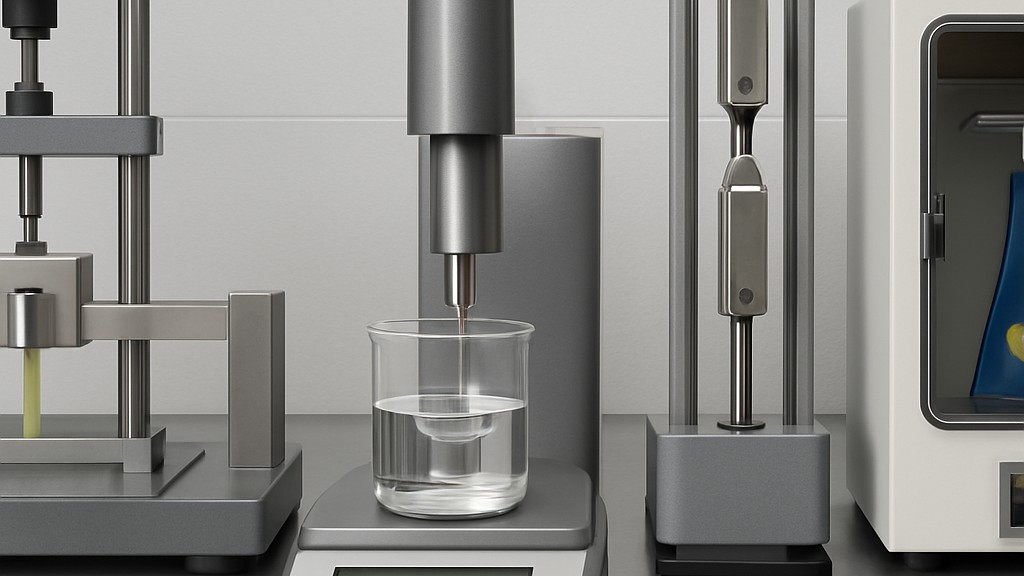
The specific gravity or density of a solid is a property easily measured to identify a material, to track physical changes in a sample, to indicate the degree of uniformity between different sampling units or samples, or to indicate the average density of a large product.
Variations in the density of a single material can result from local differences in crystallinity, loss of plasticizer, solvent absorption, or other causes. It is possible for sections of a sample to vary in density due to differences in crystallinity, thermal history, porosity, and composition (types or proportions of resin, plasticizer, pigment, or filler).
Useful for calculating density, strength-to-weight, and cost-to-weight ratios.
The test specimen should be a single piece of material of a suitable size and shape for the test apparatus, with a volume of not less than 1 cm3 and smooth surfaces and edges. The specimen thickness should be at least 1 mm for every 1 g of weight. A specimen weighing 1 to 5 g has been found to be suitable, but specimens weighing up to approximately 50 g are also acceptable. Specifications for specific plastics require specific specimen preparation methods and should be consulted if applicable. Care should be taken when cutting specimens to avoid density changes resulting from compressive stresses or frictional heating. The specimen should be free of oil, grease, and other foreign matter.
During the test, the mass of a solid plastic sample in air is determined. It is then immersed in a liquid, its apparent mass during immersion is determined, and its specific gravity (relative density) is calculated.
The sampling units used to determine specific gravity (relative density) should be representative of the quantity of product for which data are required. If the sample is known or suspected to consist of two or more layers or sections, completed finished parts, or complete erosion with different specific gravities prior to testing in accordance with Procedure A of ASTM D618, this shall be adhered to unless otherwise specified in the contract or the relevant material specifications. In cases of disagreement, tolerances shall be plus or minus 1 degree Celsius and plus or minus 5 percent relative humidity.
Unless otherwise specified in this standard or in contractual or relevant material specifications, tests are conducted in a standard laboratory environment at 23°C plus/minus 2°C and 50% plus/minus 10% relative humidity. In cases of disagreement, tolerances shall be plus/minus 1°C and plus/minus 5% relative humidity.
Briefly, this standard describes test methods for determining the density and specific gravity of solid plastics and is often used in quality control, material identification and material comparison.
Within the scope of this standard, density is the mass per unit volume, while specific gravity (relative density) is the ratio of the density of the plastic to the density of water at a given temperature.
ASTM D792 provides a reliable, standardized method for determining the density and specific gravity of plastics, critical material properties, making it widely applied. This standard is considered important for the following reasons:
Meanwhile, displacement plastics refers to a method used to measure the density or specific gravity of plastic materials by determining how much liquid (usually water) they displace when immersed in water. This technique is used in ASTM D792, which is based on Archimedes' principle: an object immersed in a liquid displaces a volume of liquid equal to its own volume.
In summary, the ASTM D792 standard is important for ensuring the identity, quality, and consistency of plastic materials in manufacturing and product development.
Our organization, which has been supporting businesses across all sectors for years through a wide range of testing, measurement, analysis, and evaluation activities, has a strong team of employees who closely follow global developments in science and technology and are constantly improving themselves. In this context, we also provide testing services in accordance with ASTM D792 Standard Test Methods for Density and Specific Gravity (Relative Density) of Plastics by Displacement.
To get an appointment, to get more detailed information or to request an evaluation, you can ask us to fill in our form and reach you.

