

The standard "ASTM C297/C297M Standard Test Method for Plane Tensile Strength of Sandwich Structures," developed by the American Society for Testing and Materials (ASTM), describes a test method for determining the planar tensile strength of the core of a bonded sandwich panel, or the bond between the core and its surfaces. This test method consists of subjecting a sandwich structure to a tensile load perpendicular to the sandwich plane. This load is transmitted to the sandwich via thick loading blocks bonded to the sandwich, the sandwich surfaces, or directly to the core.
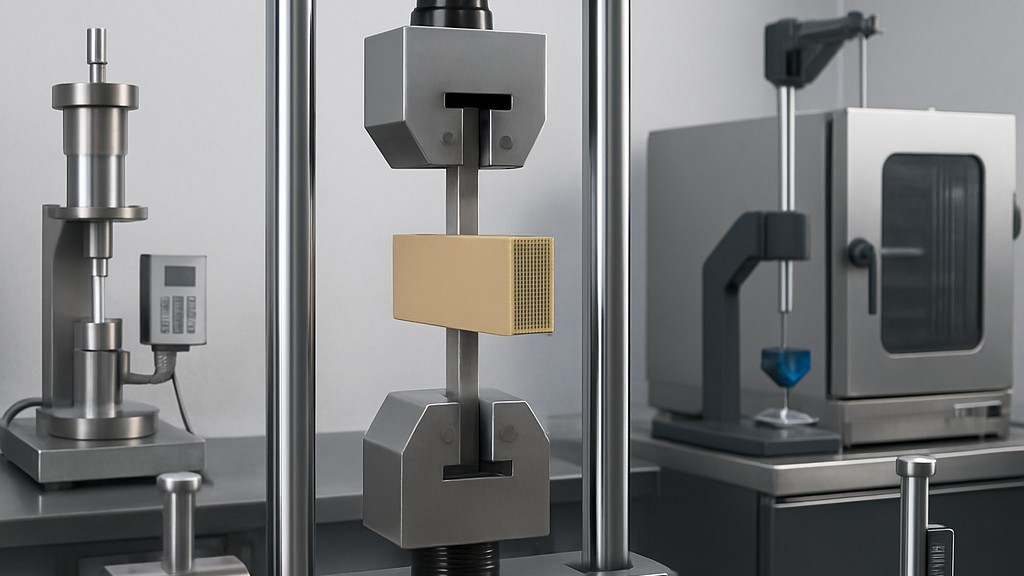
In a sandwich panel, core-to-surface bond integrity is essential to maintain face stability and allow load transfer between the faces and the core. This test method can be used to provide information on the strength and quality of the core-to-surface bonds. It can also be used to generate in-plane tensile strength data for the core material. Although primarily used as a quality control test for bonded sandwich panels, it can also be used to generate in-plane tensile strength data for structural design specifications, material properties, and research and development applications.
Factors that affect straight tensile strength and therefore should be reported include: coating material, core material, adhesive material, material manufacturing methods, coating stacking sequence and overall thickness, core geometry (cell size), core density, adhesive thickness, specimen geometry, sample preparation, specimen conditioning, test environment, specimen alignment, loading procedure, test speed, coating void content, adhesive void content, and coating volume percent reinforcement. Properties that can be derived from this test method include straight tensile strength.
Sandwich panels are a composite material formed by bonding two thin skins to a lightweight but thick core. They are favored for their high flexural stiffness and generally low density, but tend to be weaker materials in terms of tensile strength. Therefore, they can be tested for straight tensile strength using the ASTM C297 standard test method.
The straight tensile strength of sandwich panels is a measure of the bond strength between the substrate and the core material, or between the core and the surfaces of a combined sandwich panel. Core material forms permitted in this standard include those with continuous bonding surfaces (such as balsa wood and foams) and those with discrete bonding surfaces (such as honeycomb).
In general, poor material manufacturing practices, lack of control over fiber alignment, and damage from improper sample processing are known causes of high data scatter in composites. When preparing sandwich composite samples in particular, attention should be paid to incomplete or uneven core bonding to the surfaces, misalignment of core and surface elements, the presence of joints, voids, or other core and surface discontinuities, out-of-plane curvature, surface thickness variation, and surface roughness.
The test consists of subjecting a sandwich structure to a tensile load perpendicular to the sandwich plane, which is transmitted to the sandwich via thick loading blocks bonded to the sandwich surfaces or directly to the core. When considering a rupture, the only acceptable failure modes for straight tensile strength are those within the internal sandwich structure. Failure of the loading block-sandwich bond is not an acceptable failure mode.
Sandwich structural materials are composite structures composed of at least two separate materials. These materials typically consist of a core sandwiched between two faceplates and optional adhesive layers. These components are collectively known as core and facing elements. Due to their high strength, stiffness, and low density, sandwich structural materials are highly versatile and are widely used in industries such as aerospace, marine, and construction.
Regarding the mechanical properties of sandwich structural materials, sandwich structural materials possess a high strength-to-weight ratio, high stiffness-to-weight ratio, and low density, making them resistant to corrosion. The combination of face plates and core material increases bending stiffness, while the core itself provides adequate shear strength and increased rigidity. These materials can be tailored from a variety of facing and core materials to suit specific applications. Depending on the intended use, the selected materials exhibit different properties, allowing for customization to meet various performance requirements.
The development of the ASTM C297 standard was driven by the increasing demand for sandwich panel materials across various industries, including aerospace, marine, and construction. The need for a standardized test method to evaluate the shear tensile strength of these materials has become increasingly important to ensure their performance and safety. This standard is continually updated to reflect advances in testing technology, changes in industry requirements, and the need for more precise and accurate test methods. Today, it is widely recognized and adopted for evaluating the shear tensile strength of sandwich structures.
Our organization, which has been supporting businesses across all sectors for years through a wide range of testing, measurement, analysis, and evaluation activities, has a strong team of employees who closely follow global developments in science and technology and are constantly improving themselves. In this context, we also provide testing services in accordance with the "ASTM C297/C297M Standard Test Method for Plain Tensile Strength of Sandwich Structures" standard.
To get an appointment, to get more detailed information or to request an evaluation, you can ask us to fill in our form and reach you.

