

The standard “DIN 53512 Testing of rubber and elastomers - Determination of rebound strength” developed by the German Institute for Standardization (DIN) describes a method for determining the rebound strength of rubber and elastomers.
Rebound resilience refers to a rubber material's ability to return or recover to its original shape and size after being deformed (usually by compression, stretching, or impact). It is a measure of how well a material rebounds after an external force is applied and removed. More simply, it describes a rubber's elasticity, or how quickly and effectively it can return to its original state after being compressed or stretched.
High rebound resilience means the rubber material will quickly and effectively return to its original shape without permanent deformation. This is important for applications where materials are subjected to frequent stretching or compression.
Rebound resilience is typically measured by observing the height to which a rubber sample rebounds after being dropped from a specific height onto a hard surface. The higher the bounce, the better the rebound resilience.
The main factors affecting rebound resilience are:
Rebound resilience is considered important in several applications:
Rubber, particularly for cushioning or shock-absorbing materials (such as machinery or protective equipment), must have good rebound resilience to recover quickly and provide effective shock resistance. In short, high rebound resilience generally results in better performance in applications involving repeated compression, impact, or flexing.
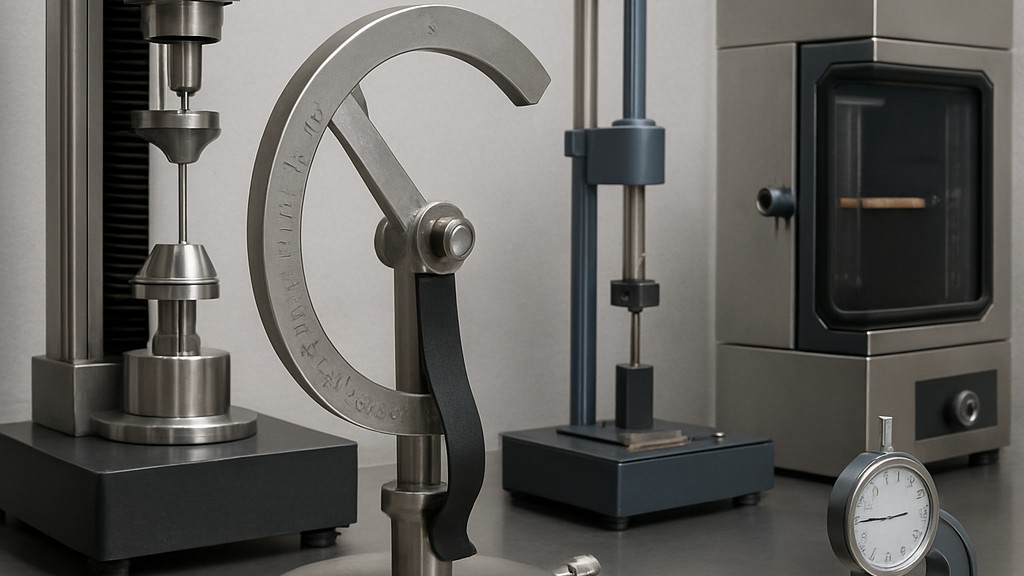
The DIN 53512 standard uses the Schob pendulum to determine the rebound resilience of rubber. The Schob-type rebound resilience pendulum is designed to measure the percentage resilience of a rubber compound as an indicator of the hysteretic energy loss, which can be defined by the relationship between the storage modulus and the loss modulus. The measured percentage rebound is inversely proportional to the hysteretic loss.
Percentage resilience, or rebound resilience, is widely used in quality control testing of polymers and compound chemicals. Rebound resilience is determined by a freely falling pendulum hammer dropped from a specific height and striking a test sample, imparting a specific amount of energy. Some of this energy is returned to the pendulum by the sample and can be measured by the degree of pendulum's rebound, thus determining the restoring force due to gravity.
This test method specifies a means of determining the flexibility of rubber over a range of impact stresses and strain rates by means of impact and measurement apparatus conforming to the requirements specified in this standard. This test method is applicable to thermoset rubbers and thermoplastic elastomers having a hardness between 30 and 85 IRHD at the specified test temperatures. It may also be applicable to certain polyester, polyether foam, and plastic foam materials.
This standard is considered important for the following reasons:
In short, the DIN 53512 standard is important for evaluating the rebound resistance of rubber, helping to ensure performance, quality and reliability in products that rely on dynamic elastic properties.
Our organization, which has been supporting businesses across all sectors for years through a wide range of testing, measurement, analysis, and evaluation activities, has a strong team of employees who closely follow global developments in science and technology and are constantly improving themselves. In this context, we also provide testing services in accordance with the DIN 53512 "Testing of rubber and elastomers - Determination of rebound resistance" standard.
To get an appointment, to get more detailed information or to request an evaluation, you can ask us to fill in our form and reach you.

