

The American Society for Testing and Materials (ASTM) standard "ASTM E1225 Standard Test Method for Thermal Conductivity of Solids Using the Proof-Comparative-Longitudinal Heat Flow Technique" describes a steady-state technique for determining the thermal conductivity of homogeneous opaque solids. This test method is valid for materials having effective thermal conductivities in the range of 0,2 to 200 W/(m K) over the temperature range of 90 K to 1300 K. Outside these ranges, it may be used with lesser accuracy.
For this technique, a system is homogeneous if the apparent thermal conductivity of a sample does not vary by more than plus or minus 5 percent with changes in thickness or cross-sectional area. For composites or heterogeneous systems composed of sheets or plates bonded together, the sample should be greater than 20 units wide and 20 units thick, respectively. One unit is the thickness of the thickest sheet or plate, so that changes of one-half unit in diameter or length affect the apparent thermal conductivity value by less than plus or minus 5 percent. For systems that are non-opaque or partially transparent in the infrared, the combined error due to non-homogeneity and photon transmittance should be less than plus or minus 5 percent. Measurements on highly transparent solids should be accompanied by information on the infrared absorption coefficient, or the results should be reported as apparent thermal conductivity.
In materials science and engineering, thermal conductivity is a critical property that determines how effectively a material can transfer heat. This property is essential for the design of everything from efficient heat sinks in electronics to durable thermal barriers in aerospace components. ASTM provides rigorous standards to ensure accurate and repeatable measurements. ASTM E1225 provides a precise comparative method for evaluating thermal conductivity in solid materials. This standard supports advancements in high-performance materials.
This standard focuses on measuring the thermal conductivity of homogeneous solid materials, expressed in watts per meter-kelvin, using a steady-state comparative heat flow technique. This method is particularly suitable for materials with moderate to high thermal conductivity, such as metals, alloys, ceramics, polymers, refractories, carbons, graphites, and their composites.
This method minimizes heat losses by placing the test sample between reference materials in a controlled heat flow column, ensuring uniform heat transfer along its length. This technique is ideal for temperatures ranging from ambient to 1300°C, making it versatile for both room-temperature and high-heat applications. Unlike transient methods (e.g., laser flash), this steady-state approach provides highly accurate data for engineering design and quality control. This standard excludes materials with high porosity, anisotropy, or low conductivity, directing users to alternative methods such as ASTM C518 for foams or ASTM E1461 for transient plane welding methods.
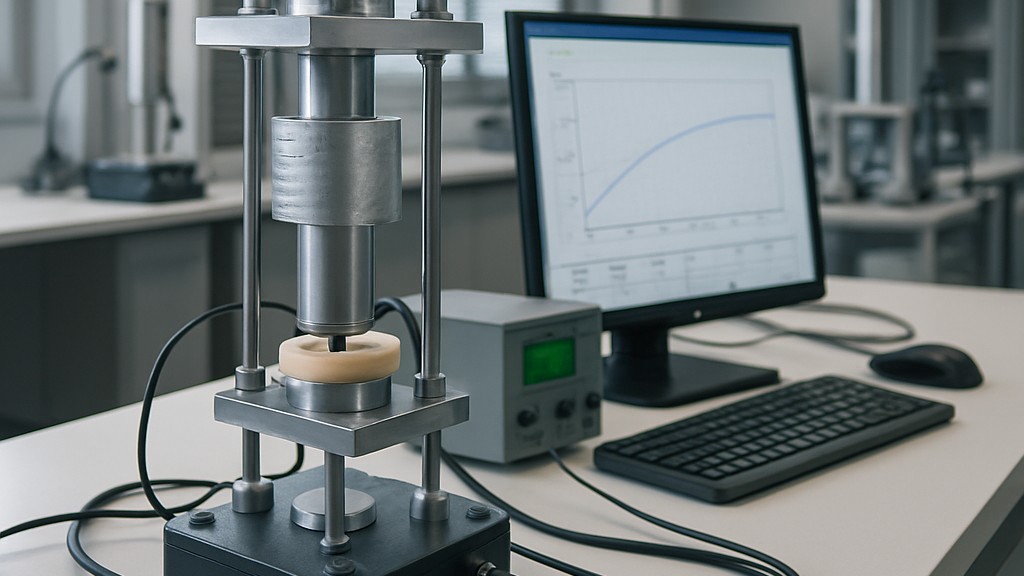
The essence of the ASTM E1225 standard lies in the protected heat flow apparatus that creates a homogeneous temperature gradient. When setting up the test device,
During sample preparation, cylindrical or rectangular specimens (typically 25-50 mm in diameter and 50-150 mm in length) are cut from the material, ensuring parallelism and surface flatness of 0,025 mm. The column is stacked with references, thermal grease is applied to the interfaces, and calibrated using standard reference materials (e.g., NIST-traceable quartz or metals).
During measurement, heat is applied to achieve a steady-state gradient across the sample. Temperatures, heat input, and dimensions are recorded. The k value is calculated using Fourier's law. Additionally, contact resistance, radiation, and instabilities are corrected using the equations given in this standard. When reporting, k values are included at the specified mean temperatures, uncertainty (typically plus/minus 3-5 percent), and environmental conditions.
The ASTM E1225 standard is widely used in industries where thermal management is crucial:
Our organization, with its competent and experienced team, understands the needs of its customers, provides them with the advanced testing services they need, and assists them in establishing, implementing, and improving management systems. In this context, we also provide testing services in accordance with ASTM E1225 Standard Test Method for Thermal Conductivity of Solids Using the Proof-of-Conformity-Longitudinal Heat Flow Technique.
To get an appointment, to get more detailed information or to request an evaluation, you can ask us to fill in our form and reach you.

