

The standard “ASTM C837 Standard test method for methylene blue index of clay” developed by the American Society for Testing and Materials (ASTM) describes a test method that involves measuring the adsorption of methylene blue dye by clay, which is calculated as the methylene blue index of a clay.
Tests on many clays generally show a linear relationship between the methylene blue index and key clay properties such as cation exchange capacity, dry bond strength, and casting rate. When the colloidal portion of the clay is kaolinite, there is also a direct correlation with specific surface (as determined by nitrogen adsorption). When the colloidal portion contains significant amounts of illite or montmorillonite, the same close correlation is not present. The methylene blue index correlates better with ceramic-forming properties than with specific surface.
This fraction of a clay, located in the colloidal range (usually defined as the range 0,5 to 0,001 µm), determines the clay's strictly colloidal properties and, together with the amount and type of organic matter associated with the clay and the fraction between 2 and 0,2 µm, largely determines the clay's properties when used in ceramic-forming processes. The specific surface of a clay is a function of particle size and morphology, and there is a relationship between dye adsorption and specific surface. However, the methylene blue index should not be considered a particle size analysis because the resulting value is solely dominated by the characteristics of the very fine end of the particle size distribution. This procedure describes the determination of dye adsorption (in this case, methylene blue) of a clay.
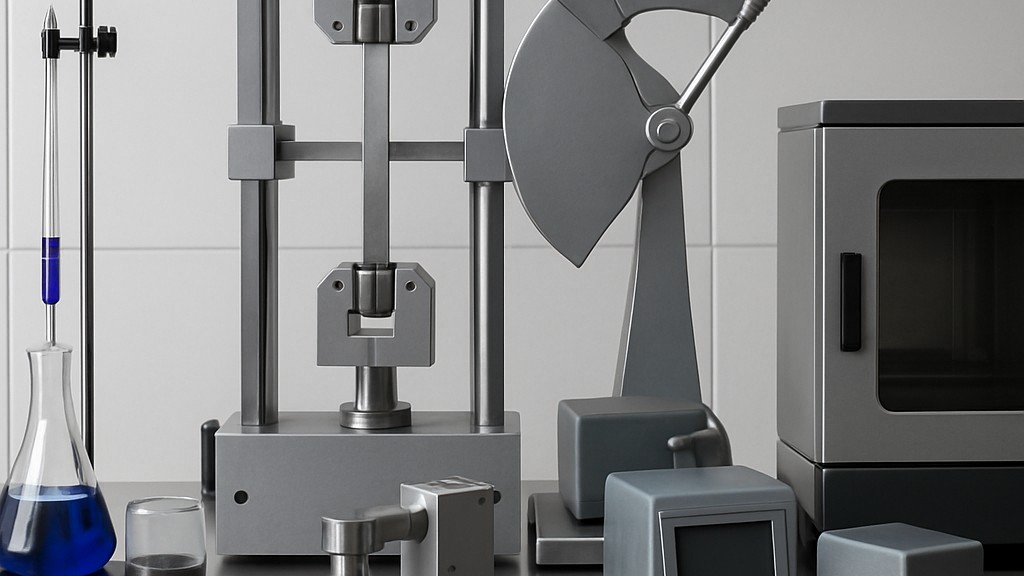
The main equipment used in these tests are:
Reagent-grade chemicals must be used in all tests. Unless otherwise specified, all reagents are intended to conform to the specifications of the American Chemical Society's Committee on Analytical Reagents, where such specifications exist. Other grades may be used, provided it is determined first that the reagent is of sufficient purity to permit its use without diminishing the accuracy of the determination.
Unless otherwise stated, the term water shall be understood to mean distilled water or water of equal purity.
Methylene blue solution should be stored in the dark.
When testing, 2,00 g of dried clay, according to the test method described in ASTM C324, is weighed and placed in a 600-mL beaker. If the clay cannot be tested immediately after drying, it should be stored in a desiccator. Add 300 mL of distilled water to the beaker and mix with a mixer until the clay is evenly dispersed. Determine the pH of the slurry, and add sufficient sulfuric acid to bring the pH to 2,5 to 3,8. Continue mixing while adjusting the pH and continue for 10 to 15 minutes after the last acid addition. Test the slurry again for pH, and add acid if necessary to bring the pH back to 2,5 to 3,8. While the slurry is still under the mixer, fill the burette with methylene blue solution, add 5 mL of the solution, and mix for 1 to 2 minutes. Using a dropper or glass stirring rod, take a drop of the slurry and place it on the edge of the filter paper.
Observe the appearance of the drop on the filter paper. The endpoint is indicated by the formation of a light blue halo around the drop. Continue adding methylene blue solution to the slurry in 1,0 mL increments, stirring for 1 to 2 minutes after each addition, and then test until the endpoint is reached. For ball clays with relatively high methylene blue indices, the test can be started after two or three 5 mL additions to save time. Allow 1 to 2 minutes of stirring after each 5 mL increment. After the endpoint is reached, continue stirring for 2 minutes and retest. Greater sensitivity can be achieved by using larger samples, which have little effect on the obtained value.
Calculations are calculated using the equation given in the standard.
The sensitivity of this test method is the calculated methylene blue index plus/minus 0,25 meq/100 g clay. The methylene blue index value cannot be directly related to any single, simply measured property of the clay, so the bias of this test method cannot be stated.
In short, the methylene blue index is a simple index test that indicates clay activity. The methylene blue index of clay is a measure of the amount of active clay minerals, particularly those with high cation exchange capacity. It is often used to assess the surface activity and adsorption capacity of clay in soil science, civil engineering, and mineral processing.
The methylene blue index is defined as the amount of methylene blue dye adsorbed per gram of clay or material until the dye is no longer adsorbed but remains free in solution.
The objectives of this testing method are to:
Our organization, which has been supporting businesses across all sectors for years through a wide range of testing, measurement, analysis, and evaluation activities, has a strong team of employees who closely follow global developments in science and technology and are constantly improving themselves. In this context, we also provide testing services in accordance with the "ASTM C837 Standard Test Method for Clay Methylene Blue Index."
To get an appointment, to get more detailed information or to request an evaluation, you can ask us to fill in our form and reach you.

