

The European standard "EN 59 Glass-reinforced plastics - Determination of indentation hardness by means of a Barcol hardness tester" describes a method for determining the indentation hardness of glass-reinforced plastic materials by means of a Barcol hardness tester. The Barcol hardness tester is a portable instrument that can be used with a stand. This method is suitable for testing the indentation hardness of individual test specimens or finished products for production control purposes.
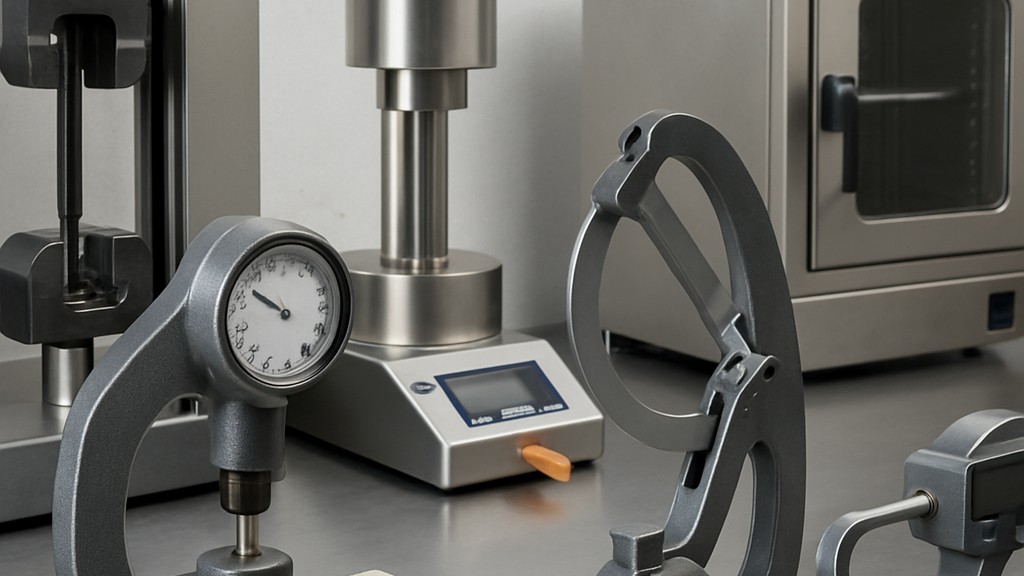
In principle, in this test method, under specified conditions, a specified indentation is forced into the test material and the penetration depth is measured.
The Barcol hardness tester used in these tests includes:
Calibrated reference plates made of aluminum and a flat glass plate or hardened steel plate are also used in the tests.
The thickness of the test specimens shall be at least 1,5 mm. The test area shall be sufficient to provide a distance of at least 3 mm in all directions from the test point to the edges of the test specimen or the previous test point.
All parameters of the indenter and presser foot are calibrated to the tolerances and uncertainties given in the table using appropriate calibration instruments for length and angle measurement. A Barcol hardness tester meets the requirements of this standard when the actual values match the target values within the measurement uncertainty.
Calibration of the test force is performed using a force gauge as a comparison measurement. In this case, the actual values of the nominal values listed in the table are the Barcol hardness unit of the Barcol hardness tester, while the force gauge serves as the reference standard. The Barcol hardness tester meets the requirements of this standard when the actual values match the target values within the measurement uncertainty.
Penetration depth calibration is performed using a length measuring device as a comparison measurement. The actual values of the nominal values given in the table are in Barcol hardness units of the Barcol hardness tester, with the length measuring device serving as the reference standard. A Barcol hardness tester meets the requirements of this standard when the actual values match the target values within the measurement uncertainty.
Glass fiber-reinforced plastics, also known as fiberglass-reinforced plastics, are a type of composite material made by combining plastic resin with glass fibers for increased durability and performance. Glass fiber-reinforced plastics combine the lightweight, malleable nature of plastics with the strength and stiffness of glass fibers. Common applications include:
The purpose of the EN 59 standard is to specify a method for determining the indentation hardness of glass-reinforced plastics using a Barcol hardness tester. This standard provides a consistent procedure for measuring the surface hardness of glass-reinforced plastic materials, particularly glass-fiber-reinforced thermoset plastics. The resulting hardness values help to:
Barcol hardness testing according to standard EN 59 is a non-destructive technique, making it suitable for in-situ inspections and testing of finished products. This method is particularly important in industries such as automotive, aerospace, marine, and construction, where glass-reinforced plastic components are widely used.
In summary, the EN 59 standard aims to provide reliable, repeatable and standardized measurement of surface hardness in glass-reinforced plastic materials and to support quality assurance and material selection processes.
Our organization, which has been supporting businesses across all sectors for years through a wide range of testing, measurement, analysis, and evaluation activities, boasts a strong team of employees who closely follow global developments in science and technology and are constantly improving themselves. In this context, we also provide testing services to businesses in accordance with the EN 59 Glass-Reinforced Plastics - Determination of Indentation Hardness Using a Barcol Hardness Tester standard.
To get an appointment, to get more detailed information or to request an evaluation, you can ask us to fill in our form and reach you.

