

The standard “ISO 2285 Rubber, vulcanized or thermoplastic - Determination of tension set under constant extension and of tension set, elongation and creep under constant tensile load” developed by the International Organization for Standardization (ISO) describes a number of methods for determining dimensional changes in vulcanized or thermoplastic rubber test pieces during and after tensile loading for relatively short periods at constant extension or under constant loading.
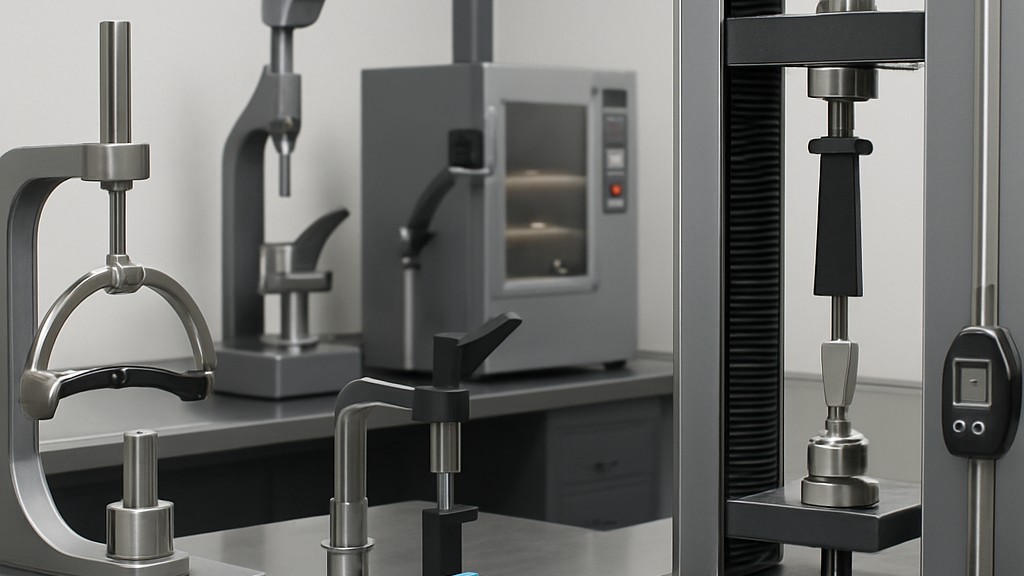
The retained elongation test is intended to measure the ability of rubbers to retain their elastic properties after being extended to a specified stress at a standard laboratory temperature, maintained for a specified time at the same or a specified higher temperature and then released at the test temperature or standard laboratory temperature.
The constant load test describes a method for determining the elongation, creep and stress set of rubbers subjected to a constant load at standard laboratory temperature.
These test methods are intended to measure the elastic properties of rubber in the hardness range of 20 IRHD to 94 IRHD. Creep measurement is not intended for product design or the evaluation of low-creep materials. ISO 8013 applies to these, and there is no agreement between the results of this test and the test results of ISO 8013.
The constant load test is primarily designed for measuring the state of cure and quality control of thin-walled products. An increase in the state of cure or degree of crosslinking is generally reflected in a decrease in set, creep, or elongation.
For the purposes of this standard, the following definitions apply in addition to the terms and definitions given in ISO 8013:
Test pieces shall be prepared in accordance with ISO 23529. Test pieces shall be cut from flat sheet metal, 2 mm plus or minus 0,2 mm thick, prepared by moulding or by cutting and polishing in accordance with ISO 23529 (except for large ring test pieces, which shall be cut from sheet metal, 4 mm plus or minus 0,2 mm thick). Strip test pieces and flared-end strip test pieces shall be cut using a sharp die with a cutter specified in ISO 23529. Ring test pieces shall be cut from sheet metal by a pair of concentric circular dies or by rotating cutters. The separation of the two cutting edges shall not differ by more than 0,05 mm from the mean value.
For testing under constant strain, strip test pieces should be between 2 mm and 10 mm wide. A width of 6 mm is preferred. The length of a specific strip depends on the selected reference length and the type of tensioning device. Strip test pieces with flared ends should have a narrow length section between 25 mm and 50 mm to serve as the reference length, as shown in the figure. Ring test pieces should be one of the following sizes:
For testing under constant load, test pieces must have the shape and dimensions shown in the figure.
Reference marks should be drawn on the test pieces using an ink that does not affect the material and is resistant to the test temperature and a suitable marker.
The ISO 2285 standard is important for the following reasons:
Our organization, which has been supporting businesses across all sectors for years through a wide range of testing, measurement, analysis, and evaluation activities, boasts a strong team of employees who closely follow global developments in science and technology and are constantly improving themselves. In this context, we also provide testing services in accordance with the ISO 2285 standard for rubber, vulcanized or thermoplastic - Determination of stress set under constant extension and stress set, elongation, and creep under constant tensile load.
To get an appointment, to get more detailed information or to request an evaluation, you can ask us to fill in our form and reach you.

