

ASTM D3479/D3479M Standard Test Procedure for Tensile Fatigue of Polymer Matrix Composite Materials
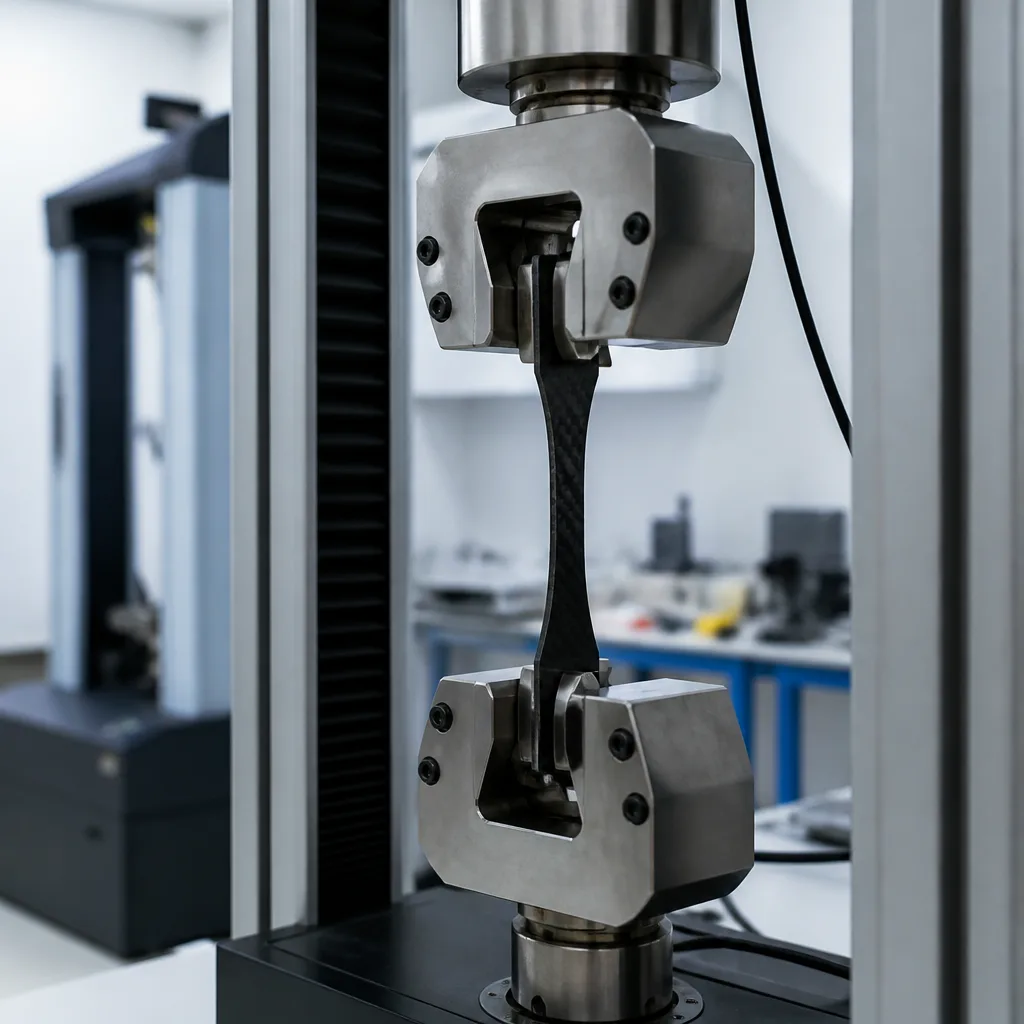
The ASTM D3479/D3479M standard test method for tensile fatigue of polymer matrix composite materials, developed by the American Society for Testing and Materials (ASTM), describes a test method used to determine the fatigue behavior of polymer matrix composite materials subjected to tensile cyclic loading. The composite material forms are limited to composites reinforced with continuous or discontinuous fibers, whose elastic properties are specifically orthotropic with respect to the test direction. This test method is limited to unnotched test specimens subjected to constant amplitude uniaxial in-plane loading, where the loading is defined in terms of a test control parameter.
This testing method presents two procedures, each defining a different test control parameter:
This testing method is designed to obtain tensile fatigue data for material properties, research and development, quality assurance, and structural design and analysis. The primary test result is the fatigue life of the test specimen under a given loading and environmental condition. Repeated tests can be used to obtain fatigue life distributions for specific material types, laminate layer configurations, environments, and loading conditions. Guidance on the statistical analysis of fatigue life data, such as determining linearized stress-life or strain-life curves, is found in the ASTM E739 standard.
This testing method can be used to investigate fatigue damage in polymer matrix composites, such as the occurrence of microscopic cracks, fiber fractures, or layer separations.
The sample's residual strength or stiffness, or both, may change due to these damage mechanisms. Stiffness loss can be measured by obtaining a quasi-static axial stress-strain curve by stopping cyclic loading at selected cycle intervals, using the modulus determination procedures found in the ASTM D3039/D3039M standard test method. Strength loss associated with fatigue damage can be determined by obtaining static strength by stopping cyclic loading using the ASTM D3039/D3039M standard test method.
The ASTM D3479/D3479M standard defines a standardized method for evaluating the fatigue behavior of polymer matrix composites under repeated tensile loading. These materials, often reinforced with fibers such as carbon or glass, are widely used in aerospace, automotive, marine, and structural applications where cyclic loading is critical.
Fatigue performance is particularly important for composites because damage often accumulates gradually (e.g., microcracks, delamination) without immediately apparent failure.
This standard focuses on determining fatigue properties under tensile-stress cyclic loading, meaning the material is repeatedly stretched but not compressed. Its key elements are:
The described test method evaluates how a composite behaves under repeated tensile loads until fracture. The two main test procedures are as follows:
These approaches enable engineers to simulate different real-world loading conditions.
The primary outcome of the test is fatigue life, typically expressed as follows:
Additional observations may include:
The ASTM D3479/D3479M standard specifies the following:
The testing machines to be used must be capable of applying cyclical loads of controlled amplitude.
The ASTM D3479/D3479M standard is widely used in the following areas:
The data helps engineers predict service life and reliability under cyclical loading conditions.
The main advantages of this standard are:
However, this standard has some limitations:
This standard is commonly used in conjunction with the following:
Together, these provide a complete understanding of the mechanical behavior of composites.
In conclusion, the ASTM D3479/D3479M standard is a fundamental standard for evaluating the fatigue performance of polymer matrix composites under cyclic tensile loading. Its structured methodology enables engineers to generate reliable fatigue data necessary for designing robust, high-performance composite structures for demanding applications.
For many years, our organization, with its competent and experienced team, has been understanding the needs of its clients, providing the advanced testing services they require, and assisting them in the establishment, implementation, and improvement of management systems. Within this framework, we also provide testing services in accordance with the ASTM D3479/D3479M standard.
To get an appointment, to get more detailed information or to request an evaluation, you can ask us to fill in our form and reach you.

