

The "JIS A 1460 Determination of formaldehyde emissions from building panels - Drying pan method" standard, developed by the Japan Industrial Standards Agency (JIS), describes a method for determining the amount of formaldehyde emitted from building panels.
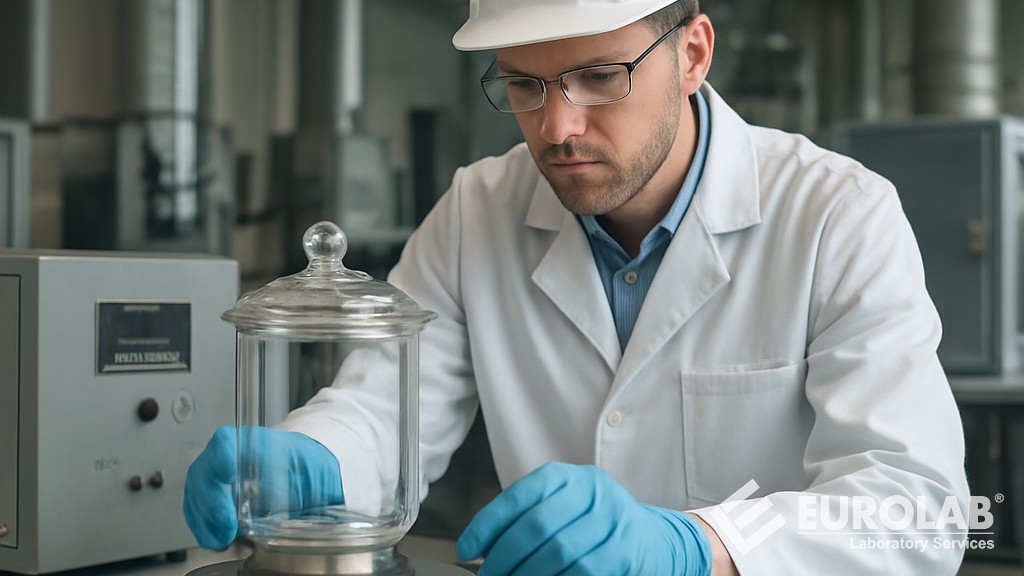
The test to determine the amount of formaldehyde released from building panels using the desiccator method is performed using a glass desiccator as shown in the standard. Test samples with a specified surface area are placed in the desiccator containing a specified amount of distilled water or ionized water under a controlled temperature. The formaldehyde concentration absorbed in the distilled water or ionized water is measured after 24 hours.
The principle for determining the concentration of formaldehyde absorbed in distilled water or ionized water is based on the Hantzsch reaction, in which formaldehyde reacts with ammonium ions and acetylacetone to form diacetyldihydrolutide.
Test site conditions should be at a temperature of 20 degrees plus/minus 0,5 degrees, as specified in the JIS Z 8703 standard. Common conditions are as follows.
Test specimens are cut from selected boards according to a reasonable sampling plan. This plan is created taking into account the necessary conditions for examining the properties of the building boards (e.g., avoiding edge cutting). The cutting of test specimens is done according to the JIS A 1902-1 standard.
The test specimen should be 150 mm plus/minus 1 mm in length and 50 mm plus/minus 1 mm in width. The number of test specimens should be such that the total surface area, defined as the sum of the areas of the end, side, and front surfaces, is as close as possible to 1800 cm², and two sets should be prepared.
The terms and conditions are as follows:
Many physical, mechanical, electrical, and chemical properties of materials and products are sensitive to temperature, relative humidity, and to a lesser extent, atmospheric pressure. To ensure comparable and reliable test results across different laboratories, organizations, or time periods, tests must be conducted under controlled and standardized atmospheric conditions (or samples must be preconditioned). The JIS Z 8703 standard defines precisely these reference conditions.
In short, the JIS A 1460 standard defines a standardized test method for measuring the amount of formaldehyde emitted from building boards (such as plywood, particleboard, fiberboard, and other wood-based panels commonly used in construction and furniture). Formaldehyde is a volatile organic compound (VOC) frequently found in adhesives (particularly urea-formaldehyde resins) used in composite wood products. Long-term exposure to high formaldehyde emissions indoors can pose health risks, including irritation to the eyes, nose, and throat, and is classified as a carcinogen.
The JIS A 1460 standard provides a reliable and reproducible method for measuring formaldehyde emissions and helps manufacturers ensure their products meet regulatory limits and international requirements for low-emission materials.
The essence of the JIS A 1460 standard is the drying vessel method, a small-scale chamber test performed under controlled conditions. The basic steps are as follows:
The method is relatively simple and cost-effective and is widely used for quality control and product certification.
It is often compared to or used in conjunction with the following standards:
With increasing global awareness of indoor air quality, the JIS A 1460 standard continues to play a significant role in the production of safer and lower-emission wood-based products. The latest update improves precision, updates references to newer analytical standards, and addresses harmonization needs.
For many years, our organization, with its competent and experienced staff, has been understanding the needs of its clients, providing the advanced testing services they require, and assisting them in the establishment, implementation, and improvement of management systems. Within this framework, we also provide testing services compliant with the JIS A 1460 standard.
To get an appointment, to get more detailed information or to request an evaluation, you can ask us to fill in our form and reach you.

