

The standard “JIS H8682-3 Anodizing of aluminium and its alloys - Measurement of wear resistance of anodic oxidation coatings - Part 3: Falling sand wear resistance test” developed by the Japanese Industrial Standards organization (JIS) focuses on measuring the wear resistance of anodic oxidation coatings on aluminium and its alloys.
In the world of materials engineering and surface treatment, ensuring the durability of protective coatings is crucial, especially for aluminum products exposed to harsh environmental conditions or mechanical wear. Japanese Industrial Standards (JIS) plays a key role in standardizing these processes in Japan, working closely with international standards to facilitate global trade and quality assurance. One of these standards, JIS H 8682-3, provides a reliable method for assessing the abrasive resistance of anodic oxidation coatings, helping manufacturers and engineers select materials that perform reliably in demanding applications such as aerospace, automotive components, and architectural facades.
Anodizing is an electrochemical process that transforms the aluminum surface into a durable, corrosion-resistant oxide layer, commonly referred to as an anodic oxidation coating. This coating not only enhances aesthetics through coloration but also increases hardness and wear resistance. However, real-world use subjects these coatings to constant wear, from wind-blown sand outdoors to mechanical friction in machinery.
Abrasion resistance testing ensures that the coating maintains its integrity over time. Without standardized testing, inconsistencies can lead to premature failure, costly recalls, or safety issues. The JIS H 8682-3 standard addresses this issue by specifying a precise falling sand abrasion resistance test that simulates natural abrasion in a controlled environment.
This standard applies to anodic oxidation coatings exceeding 5 micrometers (µm) in thickness on aluminum and its alloys. It outlines the test method for determining wear characteristics such as the rate of material loss or surface deterioration resulting from the free fall of abrasive particles onto the coated surface.
Key points of coverage include:
This standard applies particularly to products requiring high durability, such as electronic housings, marine equipment and smartphone cases.
The JIS H 8682-3 standard is based on the falling sand test, a simple yet effective simulation of erosive wear. Unlike more aggressive methods such as jet abrasion, this test mimics the gradual, low-velocity particle impact, making it ideal for assessing long-term environmental exposure.
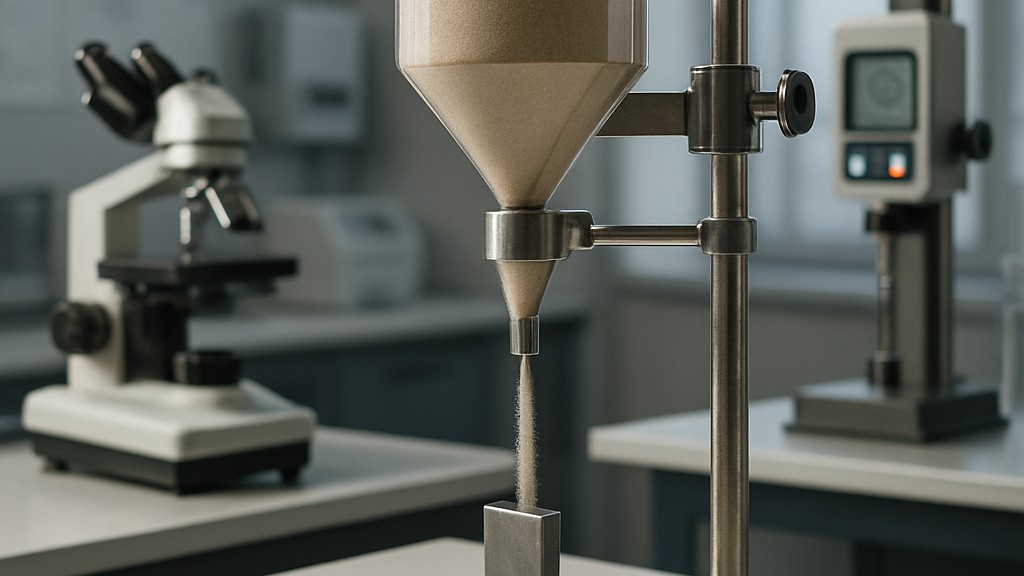
The device used in the tests is a vertical tube (typically 50-100 mm in diameter and 1-2 meters long) placed above the test sample to allow the abrasive particles to fall freely under gravity. The tube terminates with a controlled dispersion mechanism to ensure uniform distribution. Standard artificial abrasives, typically alumina-based (according to JIS R 6111), with specified grain sizes (e.g., F4 to F220 macrogrits according to JIS R 6001-1), are typically used in the tests. To ensure repeatability, these abrasives must be clean, dry, and free of contaminants.
The anodized sample is mounted horizontally at a 90-degree angle to the falling stream. The surface must be clean and representative of production conditions. Before testing, the sample is weighed accurately (to the nearest 0,1 mg) and, if necessary, the initial coating thickness is measured. Abrasive particles are dropped from a height reaching a velocity of approximately 5-10 m/s and fed into the tube at a constant rate. The duration or amount of grit application depends on the desired level of abrasiveness.
After exposure, loose debris is removed, the sample is reweighed, and visible wear is checked. Key measurements include mass loss, wear depth, and visual assessment.
Testing is performed under standard ambient conditions (23 degrees plus/minus 2 degrees Celsius and 50 percent plus/minus 5 percent relative humidity) to minimize variables.
The areas of application of this standard are:
As a result, the JIS H 8682-3 standard provides a simple yet scientifically sound method for measuring wear resistance in anodized aluminum. By simulating real-world wear through falling sand testing, it enables engineers to design more durable products, closing the gap between laboratory precision and practical durability.
Our organization, which has been serving for many years and meticulously following global developments in science and technology, employs a team of experienced professionals and a broad infrastructure to conduct testing, measurement, and analysis in a wide range of areas for businesses across all sectors. In this context, we also provide testing services in accordance with the standard "JIS H8682-3 Anodizing of aluminum and its alloys - Measurement of abrasion resistance of anodic oxidation coatings - Part 3: Falling sand abrasion resistance test."
To get an appointment, to get more detailed information or to request an evaluation, you can ask us to fill in our form and reach you.

