
EN 12332-1 Rubber or Plastic Coated Fabrics - Determination of Burst Strength - Part 1: Steel Ball Method

EN 12332-1 Rubber or Plastic Coated Fabrics - Determination of Burst Strength - Part 1: Steel Ball Method

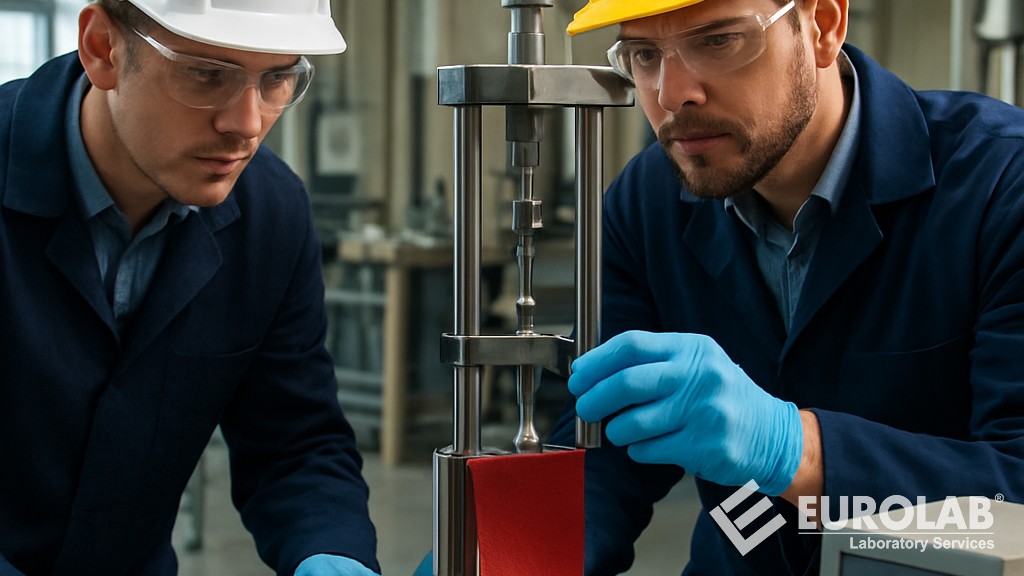
The European standard “EN 12332-1 Rubber or plastic coated fabrics - Determination of burst strength - Part 1: Steel ball method” describes a method for determining the burst strength of coated fabrics using a mechanically actuated steel ball.
EN 12332-1 Rubber or Plastic Coated Fabrics - Determination of Burst Strength - Part 1: Steel Ball Method

Burst strength, as opposed to unidirectional tensile tests, measures a coated fabric's resistance to multidirectional compression. This property is critical for applications where fabrics are subjected to compression from multiple angles. For example,

  • Inflatable structures (e.g., boats, balloons, air-supported roofs)
  • Protective clothing and equipment
  • Tarpaulins, tents and covers
  • Industrial hoses and flexible containers
  • Automotive and medical textiles

This standard focuses on a mechanical steel ball method that simulates a localized, concentrated force that gradually increases until the material explodes.

The test generally follows these steps:

  • A circular sample of the coated fabric is securely clamped at its edge into a ring-shaped holder.
  • A polished steel ball of a specific diameter (typically 25 mm) is mechanically pushed perpendicular to the center of the sample at a constant speed.
  • The force that caused the fabric to burst (tear) is recorded, along with the corresponding displacement, if necessary.
  • Burst strength is expressed in Newtons (N). This is the maximum force at which a metal breaks.

The equipment used in these tests includes:

  • Clamping system: A circular system with a defined inner diameter to hold the sample without slipping.
  • Steel ball: A precisely sized, smooth, and hard ball.
  • Drive mechanism: A mechanism with a constant speed of movement.
  • Force measuring device: Precision load cell or equivalent.

Samples are typically conditioned in a standard atmosphere (e.g., according to ISO 2231 or equivalent standards for coated fabrics).

This method is simple, repeatable, and widely used in quality control and product specification for coated fabrics.

This standard closely coincides with “ISO 3303-1 Rubber or plastic coated fabrics - Determination of burst strength - Part 1: Steel ball method”.

The relevant standard, EN 12332-2, defines a hydraulic method (using liquid pressure and a diaphragm) as an alternative burst test.

Manufacturers, testing laboratories (e.g., those using universal strength testing equipment), and certification bodies rely on this method to verify that coated fabrics meet strength and durability performance specifications. The results help compare materials, ensure safety in end-use products, and support compliance with industry or regulatory requirements.

For those working with coated fabrics during product development, quality assurance, or material selection phases, this standard remains a fundamental reference for burst performance assessment.

The EN 12332-1 standard is now largely compatible with (and has even replaced) the ISO 3303-1 standard and remains a fundamental standard in the testing of coated technical textiles. Its importance stems from the way it assesses material performance under real-world stress conditions that other common tests cannot capture.

The main reasons why this standard is considered important are:

  • It measures multi-directional strength, not just unidirectional tensile strength: Most textile strength tests (e.g., strip or grip tensile) apply force in only one or two directions. In contrast, the steel ball blast test applies pressure from all directions simultaneously until fracture occurs by pushing a polished ball perpendicularly into a compressed circular specimen. This closely simulates the multi-directional loading that coated fabrics encounter in real-world use.

Coated fabrics generally behave like composite materials (fabric substrate + polymer coating). Here, the coating can crack or separate into layers, and the base fabric can tear under multi-directional pressure. Therefore, burst strength provides a more realistic indicator of overall structural integrity and tear resistance than tensile properties alone.

  • In high-risk applications, it is critical for safety and performance: Many end-use products rely on coated fabrics to withstand pressure, resist punctures, or maintain their structural shape under load. Failure can lead to adverse outcomes, product recalls, injuries, or significant financial losses. Key examples include:
  • Inflatable products: Lifeboats, inflatable boats, rescue slides, air beams/tents, bouncy houses, sports balls, advertising balloons, and air-supported structures (domes, hangars).
  • Pressurized materials: Flexible tanks, balloons, industrial hoses, fuel balloons, and inflatable gaskets/sealing elements.
  • Protective and heavy-duty applications: Truck tarpaulins, geomembranes, agricultural silos, flexible containers, conveyor belts, and some medical textiles (e.g., inflatable mattresses).
  • Automotive and aerospace: Retractable roofs, airbag fabrics, and lightweight structural components.

Manufacturers specify minimum burst strength values ​​in their specifications because low values ​​can indicate a risk of sudden failure under pressure or impact.

  • Required for quality control, certification and market acceptance:
  • Quality assurance: Manufacturers routinely use testing to verify batch consistency, coating adhesion, and resistance to aging/environmental effects.
  • Product certification: Many industries require compliance with explosion-proof minimums for CE marking, type approval, or customer contracts.
  • Material comparison and development: The standardized method allows for fair comparison between different coatings, substrates, or suppliers, and supports R&D to improve formulations (e.g., higher tear resistance or better polymer adhesion).
  • Legal and liability protection: In safety-critical applications, test results documented according to this standard help prove that due diligence has been exercised and can be crucial in legal or insurance contexts in the event of a failure.

In short, the EN 12332-1 standard provides the most relevant indication of how well a coated fabric will perform when subjected to pressure-induced failure modes that actually occur in the most demanding and safety-critical applications.

For many years, our organization, with its competent and experienced staff, has been understanding the needs of its clients, providing the advanced testing services they require, and assisting them in the establishment, implementation, and improvement of management systems. Within this framework, we also provide testing services in accordance with the EN 12332-1 standard.

WhatsApp

