

The standard "ASTM G154 Standard Practice for Operating Fluorescent Ultraviolet (UV) Lamp Apparatus for Exposure of Materials" published by the American Society for Testing and Materials (ASTM) is limited to the basic principles of operating fluorescent UV lamp and water apparatus, and does not provide a specific result alone.
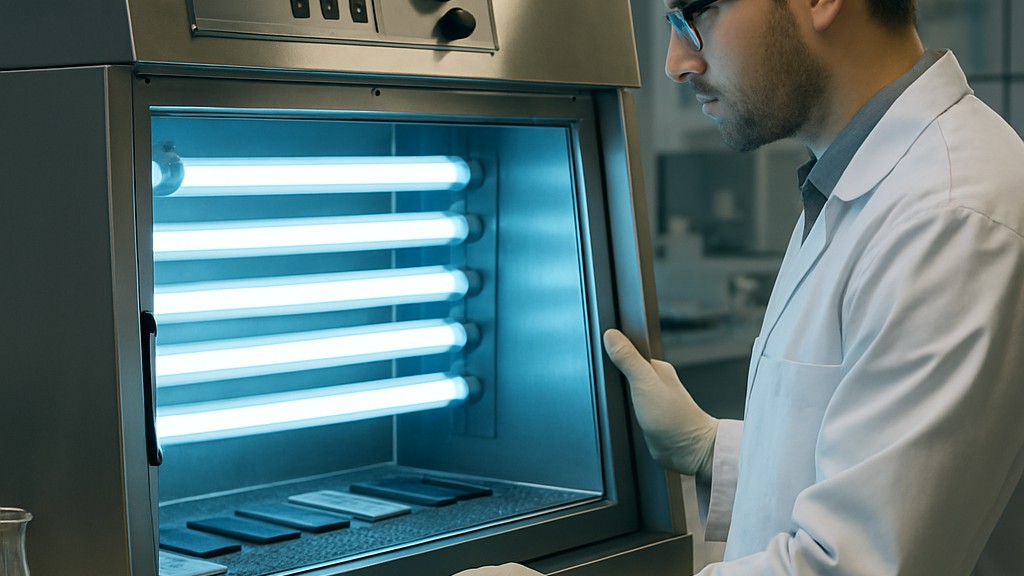
This standard is intended to be used in conjunction with a practice or method that defines specific exposure conditions for an application and as a means of evaluating changes in material properties. This practice is intended to reproduce in actual use the effects of weathering when materials are exposed to sunlight (direct or through window glass) and moisture such as rain or dew. This practice is limited to the procedures employed to obtain, measure, and control exposure conditions.
General procedures for exposing non-metallic materials to accelerated testing equipment using laboratory light sources are described in ASTM G151.
During testing, samples are exposed to fluorescent UV light under controlled environmental conditions. Different types of fluorescent UV lamp sources are described. In this standard, the terms UV light and UV radiation are used interchangeably. Sample preparation and results evaluation are addressed in ASTM methods or specifications for specific materials. General guidance is provided in ASTM G151 and ISO 4892-1.
General information about the methods for determining changes in properties after exposure and reporting these results is described in ISO 4582 and ASTM D5870 standards.
This standard is not designed for corrosion testing of bare metals.
The use of this device is intended to produce property changes appropriate to end-use conditions, including the effects of UV sunlight, humidity, and heat. Typically, these exposures include moisture in the form of condensation. The exposures are not intended to simulate deterioration caused by local weathering phenomena such as atmospheric pollution, biological attack, and saltwater exposure. Alternatively, the exposure may simulate the effects of sunlight passing through window glass.
This application provides general procedures for operating fluorescent UV lamp weatherproofing devices that allow for a wide range of exposure conditions.
In the world of materials science and engineering, predicting how products will withstand the harsh conditions of outdoor, or even indoor, exposure is crucial. Sunlight, humidity, and temperature fluctuations can damage everything from coatings and plastics to adhesives and textiles. This is where ASTM G154, a globally recognized standard that offers a controlled and accelerated method for simulating these environmental stressors, comes in. Focusing on fluorescent ultraviolet (UV) lamps to mimic the damaging effects of sunlight's UV spectrum, this standard helps manufacturers and researchers assess material durability without waiting years for real-world data.
The ASTM G154 standard is not just a laboratory procedure; it's a cornerstone for quality assurance, product development, and regulatory compliance in industries like automotive, construction, and consumer goods. This standard outlines operating guidelines for common fluorescent UV lamp devices. These devices expose test samples to cycles of UV light, heat, and humidity in a controlled chamber, accelerating the aging process to reveal potential failures such as cracking, fading, or loss of mechanical strength.
Unlike natural weathering, which can last months or years, the ASTM G154 standard compresses these effects into weeks or days. This standard specifies parameters such as lamp types, irradiance levels, temperature control, and exposure cycles, but allows for customization based on the material or end-use application. For example, it emphasizes the use of certain fluorescent lamps that emit UVA and UVB wavelengths, mimicking the sun's harmful rays without the full solar spectrum.
This application is particularly valuable for non-metallic materials as it addresses property changes caused by UV radiation, humidity, and high temperatures—conditions compatible with real-world end-use scenarios.
The ASTM G154 standard essentially exploits the principle that UV light is primarily responsible for photodegradation in materials. Some fluorescent lamps produce consistent output in the 295-400 nm range, focusing on the UVA (340 nm) and UVB (313 nm) bands that cause most polymer degradation.
The key components of the test setup are:
This standard emphasizes the importance of calibration and maintenance to ensure repeatability and specifies that results are comparative rather than predictive of absolute lifetimes.
Our organization, with its competent and experienced team, has been understanding the needs of its customers for years, providing them with the advanced testing services they need, and assisting them in establishing, implementing, and improving management systems. In this context, we also provide testing services in accordance with ASTM G154 Standard Practice for Operating Fluorescent Ultraviolet (UV) Lamps for Material Exposure.
To get an appointment, to get more detailed information or to request an evaluation, you can ask us to fill in our form and reach you.

