

The ASTM C692 Standard Test Method for Evaluating the Effect of Insulating Materials on External Stress Corrosion Cracking Tendency of Austenitic Stainless Steel, developed by the American Society for Testing and Materials (ASTM), describes two test methods for laboratory evaluation to determine whether insulating materials contribute to external stress corrosion cracking due to soluble chlorides within the insulating material. This standard is not designed to cover all possible field conditions contributing to external stress corrosion of austenitic stainless steel.
A natural characteristic of some alloys of austenitic stainless steel is their tendency to crack at stress points when exposed to certain corrosive environments. The mechanisms of external stress corrosion cracking are complex and not fully understood, but appear to be related to certain metallurgical properties. Chloride and fluoride ions have the potential to cause stress corrosion cracking in the absence of inhibiting ions.
Chlorides are common in many environments, therefore great care must be taken to protect austenitic stainless steel from chloride contamination.
ASTM C692, a widely accepted materials testing standard for evaluating the effect of thermal insulation on the tendency of austenitic stainless steels to develop external stress corrosion cracking, establishes laboratory procedures to determine whether thermal insulation materials promote external stress corrosion cracking of austenitic stainless steels due to the presence of soluble chlorides and other corrosive species.
Austenitic stainless steels such as 304, 304L, 316, and 316L are commonly used in the following areas:
These materials generally have excellent corrosion resistance. However, they may experience external stress corrosion cracking under the following specific conditions:
The ASTM C692 standard determines whether an insulation material contributes to this failure mechanism before it is approved for service.
External stress corrosion cracking develops on the outer surface of stainless steel beneath the thermal insulation. This process typically occurs as follows:
Because the damage occurs beneath the insulation, it often remains hidden until a significant deterioration occurs.
The ASTM C692 standard provides laboratory methods for evaluating whether insulation materials increase the tendency for external stress corrosion cracking. This standard,
This testing method is primarily designed as a pre-production qualification test, rather than a routine quality control test for each production batch. Chemical verification of production batches is instead handled by the ASTM C871 standard.
This procedure can be applied to numerous insulation products, including:
This procedure can be used to evaluate both absorbent and non-absorbent insulation materials.
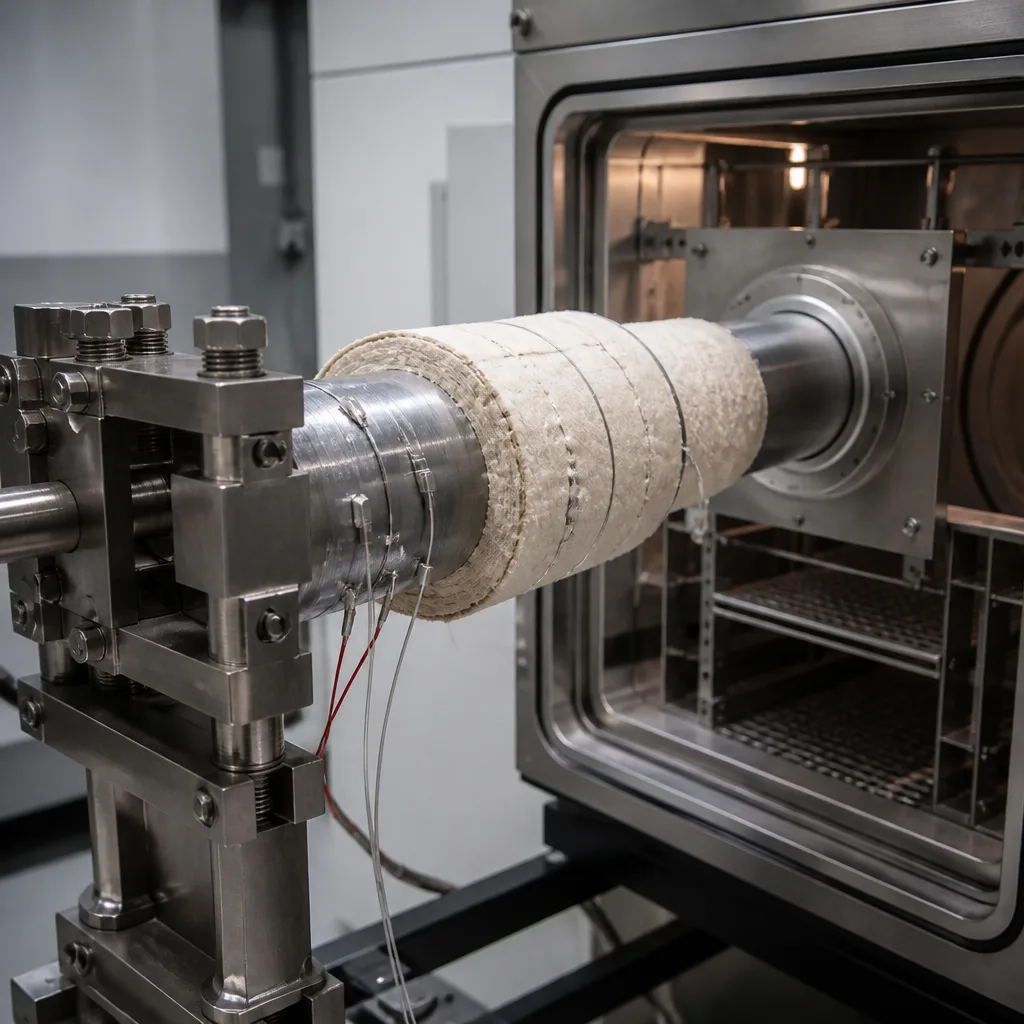
The ASTM C692 standard uses sensitized austenitic stainless steel test specimens that have been deliberately made susceptible to chloride-induced cracking. During testing,
The ASTM C692 standard defines two suitable laboratory procedures for different types of insulation. These methods simulate the following:
The aim is to reproduce the environmental conditions in which external stress corrosion cracking is most likely to be initiated during use.
The equipment used in tests generally includes the following:
After exposure, samples are examined for the following:
If no cracks are observed under the specified conditions, the insulation exhibits acceptable resistance to promoting external stress corrosion cracking.
The ASTM C692 standard is closely related to the “ASTM C795 Standard Specification for Thermal Insulation for Use in Contact with Austenitic Stainless Steel” standard, which is a specification for thermal insulation designed for use in contact with austenitic stainless steel. Typically,
The ASTM C692 standard is widely used in the following areas:
The advantages of using the ASTM C692 standard are as follows:
ASTM C692 is a laboratory proficiency test standard and has some limitations:
ASTM C692 remains the industry standard for the adequacy of thermal insulation materials in terms of their potential to cause external stress corrosion cracking in austenitic stainless steel.
In conclusion, the ASTM C692 standard is a critical standard for industries that rely on insulated stainless steel equipment operating in harsh environments. By providing a standardized method for evaluating whether insulation materials contribute to external stress corrosion cracking, it helps manufacturers and plant operators select safer insulation systems, reduce maintenance costs, and improve the long-term reliability of pipelines, tanks, and process equipment. Along with ASTM C795 and ASTM C871 standards, ASTM C692 forms the basis of insulation qualification programs for corrosion-sensitive stainless steel installations.
For many years, our organization, with its competent and experienced team, has been understanding the needs of its clients, providing the advanced testing services they require, and assisting them in the establishment, implementation, and improvement of management systems. Within this framework, we also provide testing services in accordance with the ASTM C692 standard.
To get an appointment, to get more detailed information or to request an evaluation, you can ask us to fill in our form and reach you.

