

The standard “ASTM F2996-20 Standard practice for finite element analysis (FEA) of nonmodular metallic orthopedic hip femoral stems” developed by the American Society for Testing and Materials (ASTM) describes the requirements for numerical simulation of nonmodular metallic orthopedic hip stems, i.e., limited to monolithic stems with only the femoral head/trunnion taper interface, using finite element analysis (FEA) techniques for estimating stresses and strains. This standard is valid only for stresses below the yield strength as stated in the material certificate.
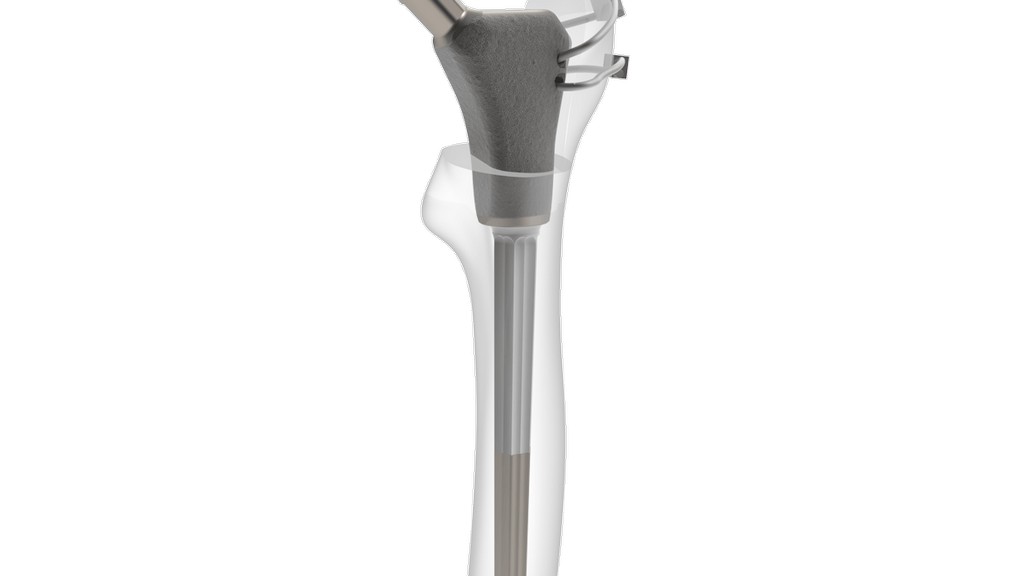
This application specifies requirements and considerations for developing finite element models to be used in the evaluation of nonmodular metallic orthopedic hip stem designs for the purpose of estimating static implant stresses and strains. This procedure can be used for worst-case evaluation within a range of different sizes of the same implant design to reduce physical testing loads. Recommended procedures are provided to perform model checks and verification to help determine if the analysis follows recommended guidelines. This application is limited in discussion to static structural analysis of nonmodular metallic orthopedic hip stems.
This standard applies to the calculation of stresses seen in the femoral hip stem when loaded as described in the ISO 7206-4 standard. This method can be used to determine the worst-case size for a given implant. When stresses calculated using this application were compared to stresses measured from physical strain measurement techniques performed in two laboratories using two different methods, the results showed a correlation of within 8 percent.
This test method can be used to estimate the effects of design variables on the stress and strain of metallic hip femoral stems in a setup that mimics that described in the ISO 7206-4 standard.
Finite element models are based on a geometric representation of the device under consideration. The source of geometric details can be obtained from drawings, solid models, preliminary drawings, or any source suitable for defining the model geometry. In creating the finite element model, certain geometric details may be removed from the orthopedic implant geometry shown in the computer-aided design model if they are determined not to be relevant to the intended analysis.
It is most appropriate to consider the worst case stress condition for the orthopedic implant being simulated. The worst case should be determined from all relevant engineering considerations, such as stem geometry, dimensions, and head offset. If finite element analysis is used to determine the worst case, then the worst case head offset may be unknown. It may be necessary to run several variations of the head offset to determine this.
The material properties required as inputs to a finite element analysis model for strain and displacement calculations are the modulus of elasticity and the Poisson's ratio. These values can be obtained from material certification data. Since the ISO 7206-4 standard is run under load control, the finite element analysis must also be run under load control. When the finite element analysis is run under load control, the modulus of elasticity does not affect the stress calculations under small displacement theory, but it does affect the displacement and strain. The effect of the Poisson's ratio on the stress calculations is negligible.
Among the numerous testing, measurement, analysis and evaluation studies that our organization has provided for businesses in various sectors, it also provides testing services defined in the standard “ASTM F2996-20 Standard practice for finite element analysis (FEA) of non-modular metallic orthopedic hip femoral stems” with its trained and expert staff and advanced technological equipment.
To get an appointment, to get more detailed information or to request an evaluation, you can ask us to fill in our form and reach you.

