

The standard "ISO 3369 Impermeable sintered metal materials and hard metals - Determination of density," published by the International Organization for Standardization (ISO), describes a method for determining the density of impermeable sintered metal materials and hard metals. The principle of this method is based on weighing a test piece first in air and then in liquid, and then calculating its density. ISO 2738 is applicable for determining the density of permeable sintered metal materials.
Density is a fundamental property that directly affects the mechanical, thermal, and electrical properties of sintered metal materials and hard metals, such as tungsten carbide or iron-based alloys. The ISO 3369 standard is considered important for the following reasons:
Sampling procedures must be carried out in accordance with the ISO 4489 standard. The volume of the test piece must be at least 0,5 cm³ . If the density of pieces with a volume less than 0,5 cm³ needs to be determined, a single measurement is taken by grouping several pieces together, each with a volume of at least 0,05 cm³ . The surface of the test piece must be thoroughly cleaned of adhering foreign substances such as dirt, grease, and oil.
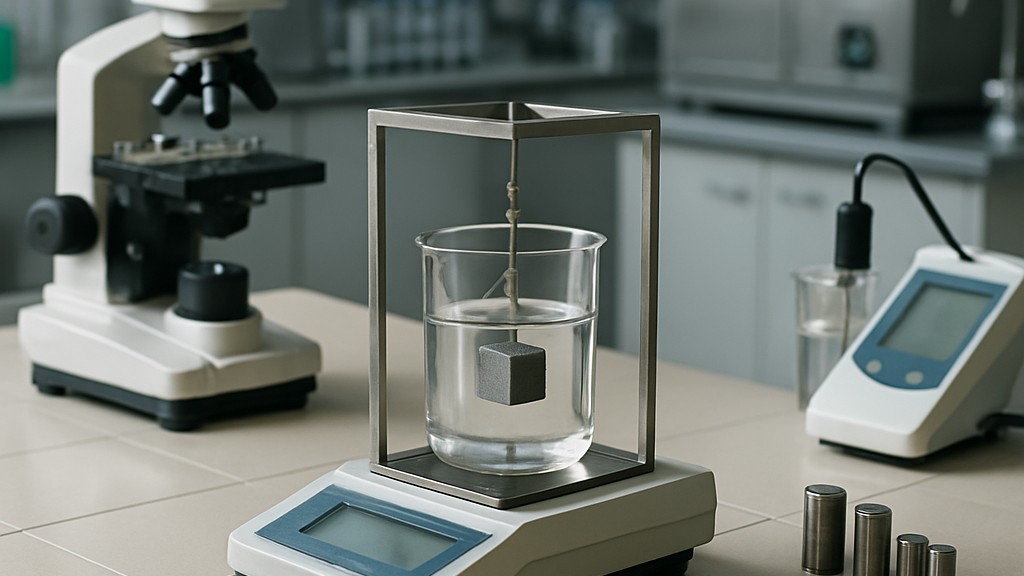
When performing the test, the test piece is placed on the upper shelf or tray. The lower shelf should be completely immersed in water, with the suspension wire hanging freely from the tray and partially submerged in the liquid. All air bubbles are removed, and the test piece is weighed. The test piece is placed on the lower shelf or suspended by a wire. The test piece is lowered into the container containing the liquid, ensuring that only the suspension wire penetrates the surface of the liquid. All air bubbles are removed, and the test piece is weighed. Weighings up to 10 g should be weighed to the nearest 0,1 mg, and weighings over 10 g should be weighed to the nearest 0,001 percent. The test piece, the liquid, and the surrounding air should be at the same temperature during weighing. The temperature of the liquid should be determined. When using distilled water, its density should be obtained from a table.
In materials engineering, particularly powder metallurgy, density is a fundamental property affecting mechanical strength, porosity, and performance under load. The ISO 3369 standard provides a reliable hydrostatic (based on the Archimedes principle) method for testing impermeable materials with minimal open porosity that do not absorb water during testing.
This standard includes a precise gravimetric technique for calculating the density of impermeable sintered metals and hard metals. It targets materials produced by powder compaction and sintering, such as tungsten carbide hard metals or iron-based sintered parts, where impermeability prevents liquid ingress during measurement.
This method is based on weighing samples in air, immersing them in distilled water, and applying a buoyancy correction from Archimedes' principle. It does not cover permeable materials (those with interconnected pores) within the scope of ISO 2738. Notable exceptions include highly porous or absorbent samples, and for such cases, users are directed to alternative methods such as gas pycnometry.
The ISO 3369 standard ensures that measurements for most samples using the water displacement method are simple and have an accuracy of -0,01 g/cm³ . The process prioritizes environmental control and calibrated equipment to minimize errors caused by temperature or surface tension.
The following equipment is used in the tests:
To begin testing, select representative test pieces (at least three per batch) of uniform shape, free of cracks or coatings. They are cleaned and dried at 110°C plus/minus 5°C. The mass is measured to the nearest 0,1 mg. They are suspended in distilled water (degassed if necessary). After stabilization (1-2 minutes), the apparent mass is recorded. The formula given in the standard is used for calculation. If high precision is required, air buoyancy is corrected. When reporting, the average density, temperature, and deviations are stated, and a precision statement is included: repeatability based on interlaboratory studies not exceeding 0,2%, repeatability not exceeding 0,5%.
As a result, the ISO 3369 standard enables engineers to confidently measure density in impermeable sintered materials. As powder metallurgy moves toward more environmentally friendly, high-performance alloys, this standard remains essential for combining laboratory precision with industrial scalability.
Our organization, with its competent and experienced team, understands the needs of its customers, provides them with the advanced testing services they need, and assists them in establishing, implementing, and improving management systems. In this context, we also provide testing services in accordance with the ISO 3369 "Impermeable sintered metal materials and hard metals - Determination of density" standard.
To get an appointment, to get more detailed information or to request an evaluation, you can ask us to fill in our form and reach you.

