

The German Standards Institute (DIN) standard, “DIN 53577 Determination of compressive stress value and compressive stress-strain characteristic for flexible cellular materials,” describes a test method for determining how flexible cellular materials (such as polyurethane foams, polyethylene foams, and other soft elastic foams) behave under compression. This method measures the compressive stress (force per unit area) required to reach specific deformation levels (strain) and plots the stress-strain curve (compressive stress-strain characteristic).
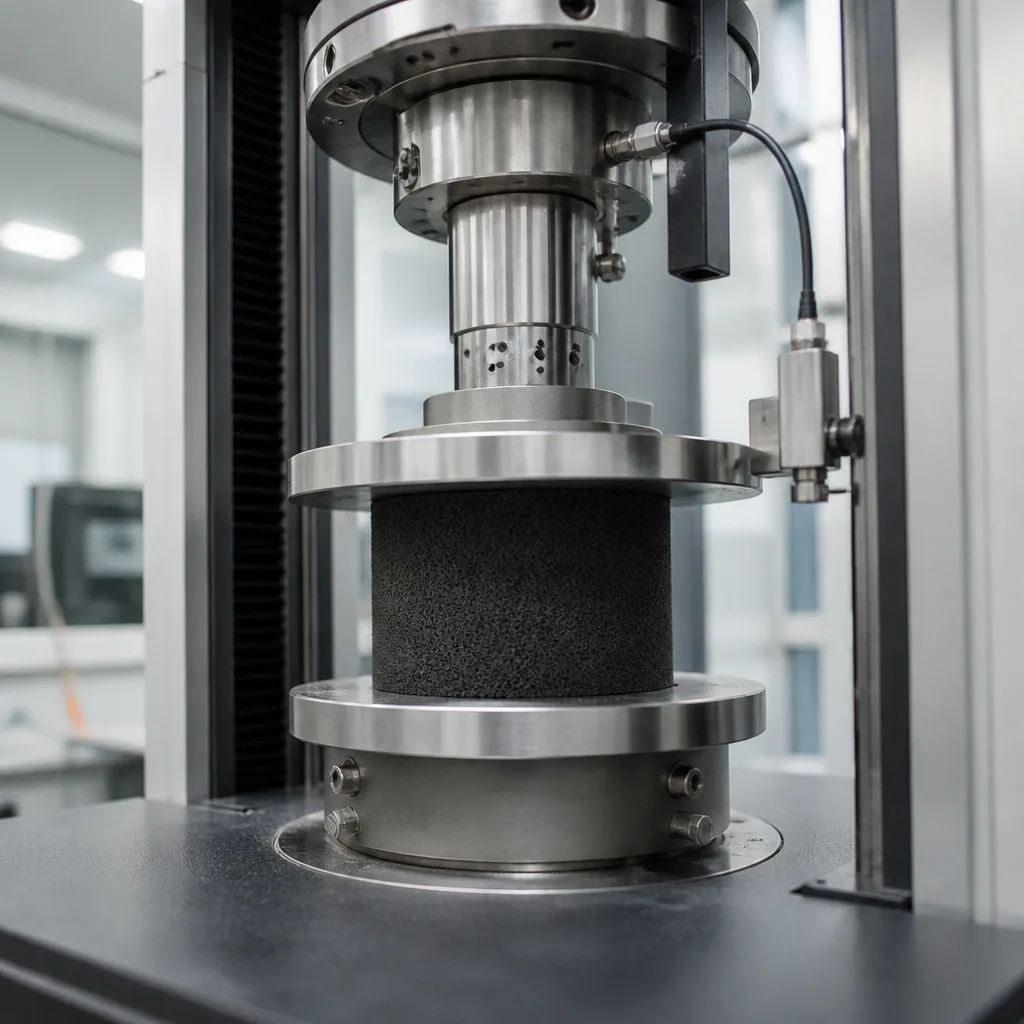
The main areas of application of this standard are:
This standard applies especially to low to medium density flexible foams.
The test typically includes the following:
Example values from product data sheets (for cross-linked closed-cell PE foam, density approximately 45 kg/m³ ) :
These values help engineers evaluate indentation stiffness, load-bearing capacity, and suitability for specific applications.
The DIN 53577 standard has been largely replaced today by the following international standards:
Many modern data sheets still refer to the DIN 53577 standard alongside or instead of the ISO 3386 standard, as it has been widely used in European industry for many years. The test principles are very similar.
The following standards are related to the DIN 53577 standard:
Compression permanent deformation tests (permanent deformation after compression) are often used in conjunction with this (e.g., DIN 53572 or ISO 1856).
In industries such as furniture, automotive, and packaging, the DIN 53577 standard, or its ISO successor, ensures that foams have consistent mechanical performance. A foam with higher compressive stress values at a given deflection is more robust and can carry greater loads without excessive deformation.
In short, the DIN 53577 standard includes methods for determining the wear resistance of rubber and elastomeric materials. Wear resistance is a critical property that indicates how well a material can withstand wear caused by friction, rubbing, or mechanical impact during use. This standard is widely applied in sectors such as automotive, footwear, conveyor systems, and industrial rubber products.
The main objectives of the DIN 53577 standard are as follows:
The key variables controlled according to the DIN 53577 standard are as follows:
DIN 53577 is particularly important for materials used in the following areas:
The advantages of the DIN 53577 standard are as follows:
However, this standard has some limitations:
Wear is one of the most common failure mechanisms in rubber products. It helps manufacturers in the following areas:
In conclusion, the DIN 53577 standard plays a crucial role in evaluating the wear resistance of rubber materials. By providing a consistent and reliable test methodology, it helps industries develop longer-lasting, high-performance elastomer products suitable for real-world applications.
For many years, our organization, with its competent and experienced staff, has been understanding the needs of its clients, providing the advanced testing services they require, and assisting them in the establishment, implementation, and improvement of management systems. Within this framework, we also provide testing services in accordance with the DIN 53577 standard.
To get an appointment, to get more detailed information or to request an evaluation, you can ask us to fill in our form and reach you.

