

The standard “DIN 51130 Testing of floor coverings - Determination of slip resistance - Work areas and activity areas with slip hazards - Walking method - Slope test”, published by the German Institute for Standardization (DIN), describes a performance test method for determining and classifying the slip resistance of floor coverings used in workplaces and work areas with a risk of slipping. This standard also includes a method for measuring the volume of displacement voids in floor coverings with profiled surfaces. This standard provides R ratings (R9 lowest, R13 highest) for floor coverings with shoes and oiled surfaces.
According to this standard, the general assessments are as follows:
However, these tests are only conducted in a laboratory setting (not on-site), using specific footwear/contaminants, and without evaluating long-term wear.
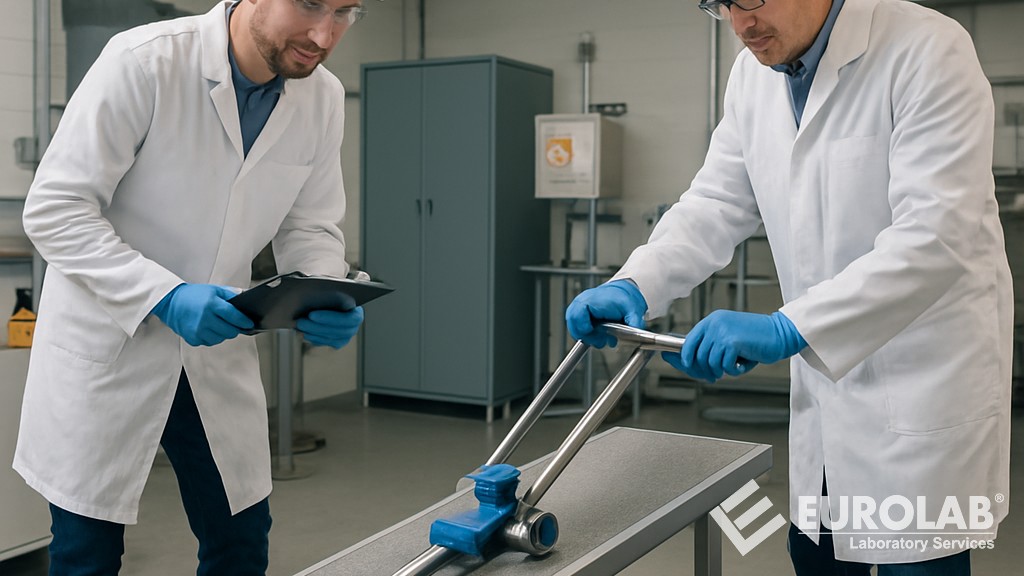
A test operator wearing test shoes walks back and forth in an upright position on the flooring to be tested, initially in a horizontal position and then gradually inclined until the acceptance angle is reached. The acceptance angle is determined using a flooring coated with lubricant. The average acceptance angle achieved is used to classify the degree of shear resistance. Subjective influences on the acceptance angle are limited by a calibration procedure. To determine the displacement gap, the test specimen is leveled by filling it with putty until the profile gaps are flush with the surface, and its mass is measured before and after this process. The volume of the displacement gap is calculated from the difference in mass and density of the putty.
The DIN 51130 standard is designed to test the slip resistance properties of floor coverings in workplaces and areas with a high risk of slipping. It focuses particularly on environments where people wear shoes (shoeing conditions) and where potential contaminants such as oil or grease may be present. Widely used across Europe in commercial, industrial, and public spaces, this standard helps classify materials according to their slip resistance.
The DIN 51130 standard uses the inclined surface walking method (inclined plane test). This test generally follows these steps:
This method simulates real-world slip hazards in workplaces, but uses specific conditions (grease and spiked boots) that don't perfectly reflect everyday pedestrian scenarios.
This standard classifies flooring into groups from R9 to R13: higher R values indicate higher shear resistance (higher slope angles before shear occurs). The R-classifications and their meanings are as follows:
These ratings are particularly helpful in selecting flooring to minimize accidents in workplaces subject to health and safety standards.
The “DIN 51097 Testing of floor coverings - Determination of slip resistance properties - Areas where barefoot walking is possible on wet surfaces - Walking method - Slope test” standard, which uses a similar ramp test but is applied under barefoot conditions with soapy water, classifies areas into AC groups (for pools, showers).
Meanwhile, the “DIN EN 16165 Determination of slip resistance of pedestrian surfaces - Evaluation methods” standard, which includes both shoe and barefoot tests, has largely replaced the DIN 51130 standard while maintaining the R9-R13 classifications to ensure continuity.
In some countries, alternatives such as pendulum testing (e.g., BS 7976 or EN 16165 standards) are generally preferred because they better simulate wet water conditions with everyday footwear and better predict real-world slips.
While the DIN 51130 standard is effective in oily industrial environments with work safety shoes, critics argue it may overestimate safety in waterlogged public areas with regular shoes. This standard does not assess the long-term durability of slip resistance. For comprehensive safety, it is combined with pendulum tests or site-specific assessments.
This standard plays a vital role in preventing slips and falls, which are a leading cause of workplace injuries.
For many years, our organization, with its competent and experienced staff, has been understanding the needs of its clients, providing the advanced testing services they require, and assisting them in the establishment, implementation, and improvement of management systems. Within this framework, we also provide testing services in accordance with the DIN 51130 standard.
To get an appointment, to get more detailed information or to request an evaluation, you can ask us to fill in our form and reach you.

