

The ASTM D543 Standard Practices for Assessing the Resistance of Plastics to Chemical Reagents, developed by the American Society for Testing and Materials (ASTM), describes practices for assessing the resistance of all plastic materials, including cast, hot-molded, cold-molded, laminated resin products, and sheet materials, to chemical reagents.
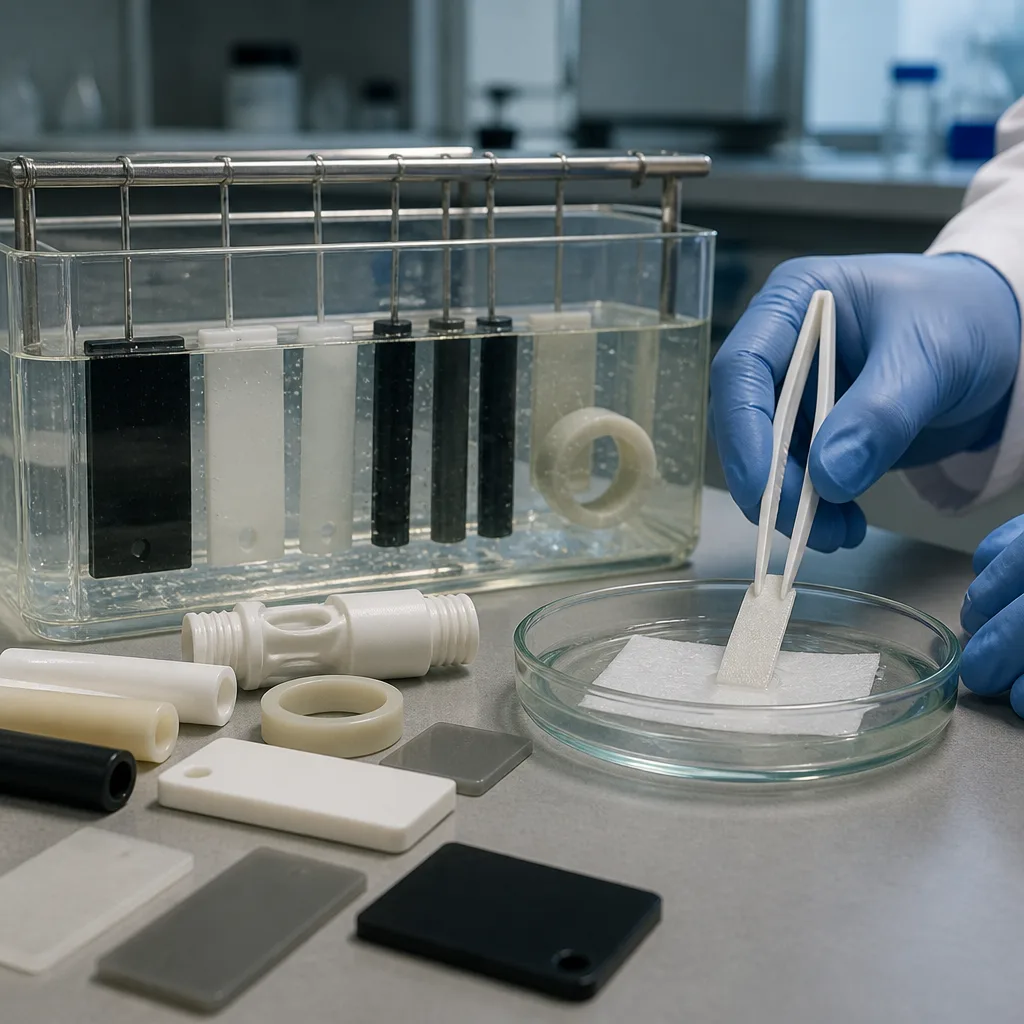
A key feature of the ASTM D543 standard is that it provides three procedures:
The chosen procedure depends on how the plastic is expected to come into contact with the chemical in its intended application. For example, immersion might be suitable for a plastic container or transfer line, while wet patch exposure might better represent a material that is occasionally exposed to splashes or spills.
These regulations include provisions for reporting changes in weight, dimensions, appearance, color, strength, and other mechanical properties.
The ASTM D543 standard specifies standard reagents to achieve comparable results on a comparable basis without precluded the use of other chemical reagents that meet specific chemical resistance requirements. It also provides provisions for exposure to reagents at various exposure times, stress conditions, and high temperatures. The type of conditioning (immersion or wet patch/wipe method) depends on the end-use of the material. If the material is to be used as a container or transfer line, immersion of samples is used. If the material will only be exposed to short-term exposures or used at close range and the reagent will splash or spill onto the material, the wet patch or wipe method is used for applying the reagent to the material.
ASTM D543 is a widely used standard for evaluating the resistance of plastic materials to chemical reagents. This standard provides a structured way to determine how plastics react when exposed to chemicals under controlled laboratory conditions. It applies to many types of plastic products, including cast, molded, laminated, and sheet materials.
The primary purpose of the ASTM D543 standard is to provide a standardized basis for comparing the chemical resistance of different plastics. Plastics may come into contact with fuels, oils, cleaning agents, solvents, acids, alkalis, disinfectants, or other chemicals during production or use. Chemical exposure can cause the following changes:
The ASTM D543 standard specifies controlled exposure conditions for evaluating and comparing these effects. This standard covers the assessment of the resistance of plastic materials to chemical reagents. It is applicable to cast plastics, hot-molding and cold-molding plastics, laminated resin products, and sheet materials.
The general principle is to expose standardized plastic samples to selected chemical reagents for a specific period of time and under specified environmental conditions. Before exposure, the relevant properties of the samples are measured. The samples are then exposed to the selected reagent. After exposure, the same properties can be measured again. The difference between the initial and final measurements provides information about the effect of the chemical exposure.
Depending on the application, measurements may include:
The ASTM D543 standard specifically provides for the evaluation of changes in weight, dimensions, appearance, color, strength, and other mechanical properties.
The chemical reagent, concentration, exposure time, temperature, and stress level are selected according to the purpose of the evaluation. While the ASTM D543 standard provides standardized reagents to facilitate comparisons, it also allows the use of other chemically relevant reagents for specific applications. Where appropriate, the exposure process can also be performed at high temperatures.
This flexibility is important because plastics are used in very different environments. For example, a plastic used inside a car must be resistant to automotive fluids and cleaning chemicals; a plastic used in a medical setting must be resistant to disinfectants.
In immersion testing, plastic samples are directly exposed to a chemical reagent for a specified exposure time. This approach is particularly useful when the actual product will be in prolonged or continuous contact with a liquid. After exposure, the samples are examined and the relevant properties are compared to their original values.
The wet surface exposure method can yield more representative results when continuous submersion of the plastic material in water is not intended. For example, a component may only be exposed to a chemical through accidental spills, splashes, or localized contact. In such cases, applying the reactant to a specific area of the sample can provide a more realistic assessment than full immersion.
The method of mechanical stress and chemical exposure is particularly important because some plastics can withstand a chemical when not under stress, but the same chemical can develop cracks or other damage when combined with mechanical stress. This type of behavior is often associated with environmental stress cracking.
Chemical resistance is an important property when selecting plastics for real-world applications. A material may possess excellent mechanical properties under normal laboratory conditions, but may degrade prematurely after exposure to a particular chemical. The ASTM D543 standard helps engineers and materials specialists with these issues.
This standard emphasizes that test results should be interpreted in relation to the actual service environment. The closer the laboratory exposure conditions are to the intended application, the more useful the results are for predicting service behavior.
The ASTM D543 standard can be useful in many industries, including:
Reagent selection, concentration, exposure time, temperature, voltage, and reported properties can all influence the results. Short-term tests may be useful for eliminating unsuitable materials or establishing a relative ranking, but they may not reproduce long-term service conditions. Therefore, test conditions should be selected appropriately.
For many years, our organization, with its competent and experienced team, has been understanding the needs of its clients, providing the advanced testing services they require, and assisting them in the establishment, implementation, and improvement of management systems. Within this framework, we also provide testing services in accordance with the ASTM D543 standard.
To get an appointment, to get more detailed information or to request an evaluation, you can ask us to fill in our form and reach you.

