DIN 53765 Testing of Plastics and Elastomers - Thermal Analysis - DSC Method
The standard “DIN 53765 Testing of plastics and elastomers - Thermal analysis - DSC method”, published by the German Institute for Standardization (DIN), describes a method for determining the abrasion resistance of plastics using an abrasive disc (or friction wheel). This is essentially the Taber abrasion test.
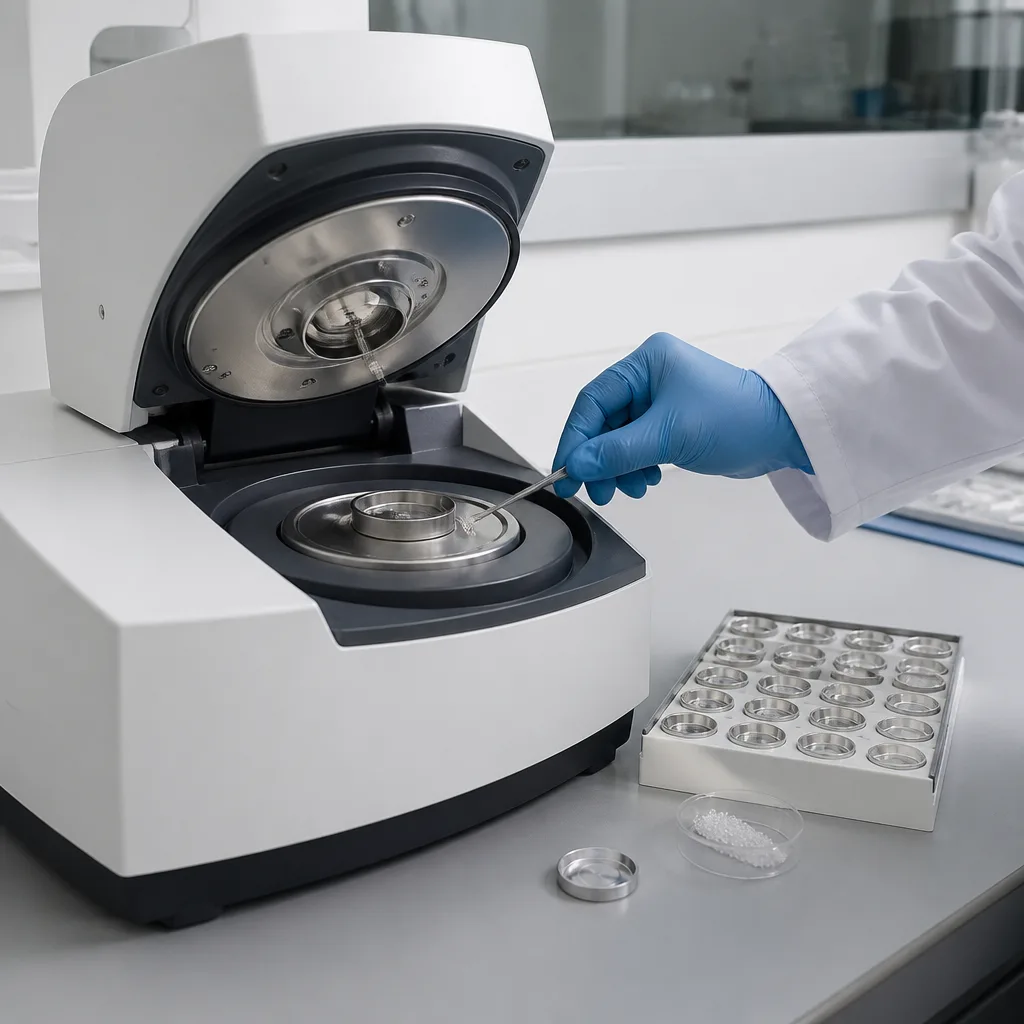
Differential scanning calorimetry (DSC) is one of the most widely used thermal analysis techniques in the characterization of plastics (thermoplastics and thermosets) and elastomers (rubbers and rubber-like materials). When both the sample and an inert reference are subjected to a controlled temperature program, it measures the difference in heat flow between them. This reveals important thermal transitions and reactions that affect material processing, performance, quality control, and failure analysis.
In a differential scan calorimetry (DSC) experiment,
- A small sample (typically 5–20 mg) is placed in a container next to an empty reference container.
- The device heats or cools both at a constant rate (typically 10 degrees/min or 20 degrees/min).
- The sensor detects any endothermic (heat-absorbing, e.g., melting, glass transition) or exothermic (heat-releasing, e.g., crystallization, curing, oxidation) event.
- The results are plotted as a graph representing the relationship between heat flow and temperature or time.
There are two main types of devices:
- Heat flow DSC: Measures the temperature difference between the sample and the reference.
- Power balancing DSC: Adjusts the power to keep the sample and reference at the same temperature.
Modulated DSC is an advanced variant that superimposes a sinusoidal temperature oscillation to separate reversing (heat capacity related) and non-reversing (kinetic) events for better resolution of overlapping transitions.
Differential scanning calorimetry (DSC) provides valuable data for both material development and quality assurance:
- Glass transition temperature: Indicates the transition from the glassy to the rubbery state. Typical applications include flexibility, brittleness, and its critical importance for elastomers and amorphous plastics.
- Melting temperature and enthalpy: Indicates the melting point of crystalline regions. Typical applications include degree of crystallinity and processing temperature for thermoplastics.
- Crystallization temperature and enthalpy: Indicates crystallization during cooling. Typical applications, processing behavior, and nucleating agents.
- Crystallinity: Indicates the percentage of crystal content. Typical applications include mechanical strength and barrier properties.
- Curing/crosslinking: Indicates the enthalpy and temperature of the reaction. Typical applications include vulcanization in thermosets and elastomers.
- Oxidative induction time / onset time: Exhibits oxidative stability. Typical application: Stabilizer activity in polyolefins and rubbers.
- Specific heat capacity: Indicates heat storage capacity. Typical applications include thermal management and processing simulations.
- Degradation/thermal stability: Indicates the onset of degradation. Typical application: upper service temperature limits.
For elastomers, DSC is particularly useful for determining the glass transition temperature (typically very low for most rubbers, e.g., minus 60 degrees), identifying added plastics or fillers, and evaluating residual curing or plasticizer effects. It can also help identify contaminants or blend compositions that traditional methods might miss.
The procedure described in the DIN 53765 standard generally follows these steps:
- A flat test specimen is mounted on a rotating turntable.
- Two abrasive wheels of the specified type are pressed against the sample with a defined load (typically 250 g, 500 g, 750 g, or 1000 g per arm).
- The sample rotates under the wheels, creating a wear pattern in the form of cross springs.
Wear resistance is evaluated using the following methods:
- Mass loss (the difference in mass before and after a certain number of cycles, typically 1000 cycles)
- Volume loss
- Visual assessment of the worn surface.
The test demonstrates the material's resistance to grain shear wear.
This method is used to evaluate the wear resistance of the following materials:
- Hard and flexible plastics
- Coatings
- laminates
- floor coverings
- Rubber and elastomers (commonly used in practice)
- Leather, textiles, paints, paper (although the title focuses on plastics)
This is especially important for materials that are exposed to friction, abrasion, or pedestrian traffic.
In short, the DIN 53765 standard outlines methods for determining the electrical conductivity (or resistance) of plastics and polymeric materials. This property is critical in applications where electrostatic behavior, insulation, or conductivity needs to be controlled. This standard is widely used in sectors such as electronics, automotive, packaging, and materials engineering, particularly in the evaluation of antistatic and conductive plastics.
The main objectives of the DIN 53765 standard are as follows:
- Measuring the electrical conductivity of plastics.
- To evaluate surface and volumetric resistance.
- The materials can be classified as follows:
- Insulator
- antistatic
- Conductive
This helps manufacturers ensure that materials meet performance and safety requirements.
The DIN 53765 standard applies to the following:
- Thermoplastics and thermosets
- Conductive polymer composites (e.g., carbon-filled plastics)
- Coated or modified plastic surfaces
Typical applications of this standard include:
- Electronic enclosures
- Automotive interior components
- Packaging materials for sensitive electronics.
- Floor coverings and flooring requiring static control.
Electrical conductivity is the inverse of resistivity. This standard typically evaluates the following:
- Volumetric resistivity: Resistance across a material.
- Surface resistivity: Resistance across a surface.
The testing process generally follows these steps:
- Sample preparation: Samples must have a defined geometry and thickness. Surfaces must be clean and conditioned. Environmental conditions (temperature, humidity) must be controlled.
- The equipment used includes: a high-resistance meter (electrometer), electrodes (ring or plate type), and a protective ring to minimize leakage currents.
- Procedure: The sample is placed between the electrodes. A known voltage is applied. The resulting current is measured. Resistivity is calculated using standard formulas.
The DIN 53765 standard is important for the following reasons:
- Electrostatic safety: Prevents static discharge from damaging sensitive electronics and reducing the risk of fire or explosion in hazardous environments.
- Quality control: Ensures consistent electrical characteristics throughout production.
- Material development: Supports the development of conductive fillers (carbon black, graphene) and antistatic additives.
In conclusion, the DIN 53765 standard is a fundamental standard for evaluating the electrical behavior of plastics, especially in applications where electrostatic control is critical. By providing reliable methods for measuring conductivity and resistance, it helps industries ensure product safety, performance, and compliance.
For many years, our organization, with its competent and experienced staff, has been understanding the needs of its clients, providing the advanced testing services they require, and assisting them in the establishment, implementation, and improvement of management systems. Within this framework, we also provide testing services in accordance with the DIN 53765 standard.



