ASTM D3039/D3039M Tensile Properties of Polymer Matrix Composite Materials
The standard "ASTM D3039/D3039M Standard Test Method for Tensile Properties of Polymer Matrix Composite Materials," developed by the American Society for Testing and Materials (ASTM), describes the in-plane tensile properties of polymer matrix composite materials reinforced with high modulus fibers. Composite material forms are limited to continuous-fiber or staple-fiber reinforced composites where the laminate is balanced and symmetrical with respect to the test direction.
For the purposes of this standard, the terms and definitions given in ASTM D3878 for high modulus fibers and their composites, ASTM D883 for plastics, ASTM E6 for mechanical testing, and ASTM E456 and ASTM E177 for statistics apply. In the event of a conflict between terms, ASTM D3878 takes precedence over the other standards. In addition, the following definitions apply:
- A nominal value refers to a value assigned to a measurable property that exists only in name, for the purpose of convenient identification. Tolerances may be applied to a nominal value to define an acceptable range for the property.
- The transition region is a strain region of a stress-strain or strain-strain curve where a significant change in the slope of the curve occurs over a small strain interval.
- The transition strain is the strain value in the midrange of the transition region between two essentially linear portions of a pair of linear stress-strain or strain-strain curves. Many filamentous composite materials exhibit essentially bi-linear behavior during force application, as seen, for example, in graphs of longitudinal stress versus longitudinal strain or transverse strain versus longitudinal strain. There are several physical reasons for the existence of a transition region. Common examples include matrix cracking under tensile force and layer delamination.
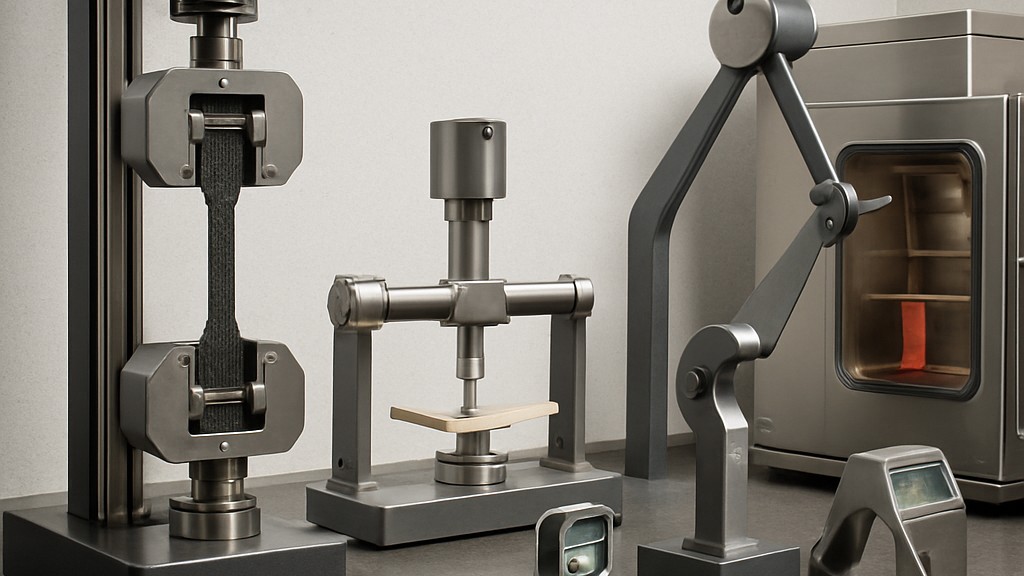
During the tests, a thin, flat strip of material with a constant rectangular cross-section is placed in the grips of a mechanical testing machine and monotonically loaded in tension while the force is recorded. The ultimate strength of the material can be determined from the maximum force sustained before failure. If the coupon stress is monitored with tension or displacement transducers, the material's stress-strain response can be determined, from which the ultimate tensile stress, tensile modulus of elasticity, Poisson's ratio, and transition stress can be derived.
This test method is designed to produce tensile property data for material properties, research and development, quality assurance, and structural design and analysis. Factors that affect tensile response and therefore must be reported include: material, material preparation and placement methods, specimen stacking order, specimen preparation, specimen conditioning, test environment, specimen alignment and grip, test speed, time at temperature, void content, and volume percent reinforcement.
Test-oriented features that can be obtained from this test method include:
- Ultimate tensile strength
- Ultimate tensile stress
- Tensile chord elastic modulus
- Poisson's ratio
- Transitional stress
Interventions are described in this standard as follows:
- Material and sample preparation: Poor material manufacturing practices, lack of control of fiber alignment, and damage from improper coupon processing are known causes of high material data scatter in composites.
- Retention: A high percentage of retention-related failures, especially when combined with high material data scatter, is an indication of sample retention problems. Sample retention methods are discussed in detail in this standard.
- System alignment: Excessive bending will lead to premature failure and grossly inaccurate modulus determinations. Every effort should be made to eliminate excessive bending from the testing system. Bending can be caused by misaligned grips, specimens improperly mounted in the grips, or out of tolerance due to poor specimen preparation. If there is any doubt about the alignment on a particular testing machine, the alignment should be checked as discussed in this standard.
- Edge effects in angle-layer laminates: Laminates containing off-axis layers exhibit premature failure and lower hardness due to edge softening. Therefore, the strength and modulus of angle-layer laminates can be significantly underestimated. For quasi-isotropic laminates containing significant 0-degree layers, the effect is less significant.
The ASTM D3039/D3039M standard is essential because it provides a consistent and reliable method for measuring the tensile properties of polymer matrix composite materials, such as carbon fiber or fiberglass-reinforced plastics. The primary reasons for this standard's importance are:
- Provides comparable data: Without a standardized method, different labs or manufacturers may use different test setups, specimen sizes, or strain rates. This standard ensures that tensile test results are repeatable and comparable across the industry.
- Supports material design: Engineers use data from the tests described in this standard, such as tensile strength, modulus of elasticity, and Poisson's ratio, to:
- Predicting how materials will behave under stress
- Selecting appropriate materials for load-bearing applications
- Performing failure analysis and fatigue assessments
- Quality control: Manufacturers rely on this standard for quality assurance, ensuring that each batch of composite material meets design and performance expectations.
- Compliance and certification: Many industries, particularly aerospace, automotive, and defense, require materials and components to meet specific standards. This standard provides a recognized benchmark for compliance with regulatory and customer requirements.
- Structural safety: By accurately measuring tensile properties, it helps engineers avoid under- or over-design, reducing both the risk of failure and unnecessary material usage.
Our organization, which has been supporting businesses across all sectors for years through a wide range of testing, measurement, analysis, and evaluation activities, has a strong team of employees who closely follow global developments in science and technology and are constantly improving themselves. In this context, we also provide testing services in accordance with the "ASTM D3039/D3039M Standard Test Method for Tensile Properties of Polymer Matrix Composite Materials" standard.



