

The standard “ASTM E203 Standard test method for water using volumetric Karl Fischer titration,” developed by the American Society for Testing and Materials (ASTM), describes a general test method for applying volumetric Karl Fischer titration to determine free water and hydration water in most solid or liquid organic and inorganic compounds.
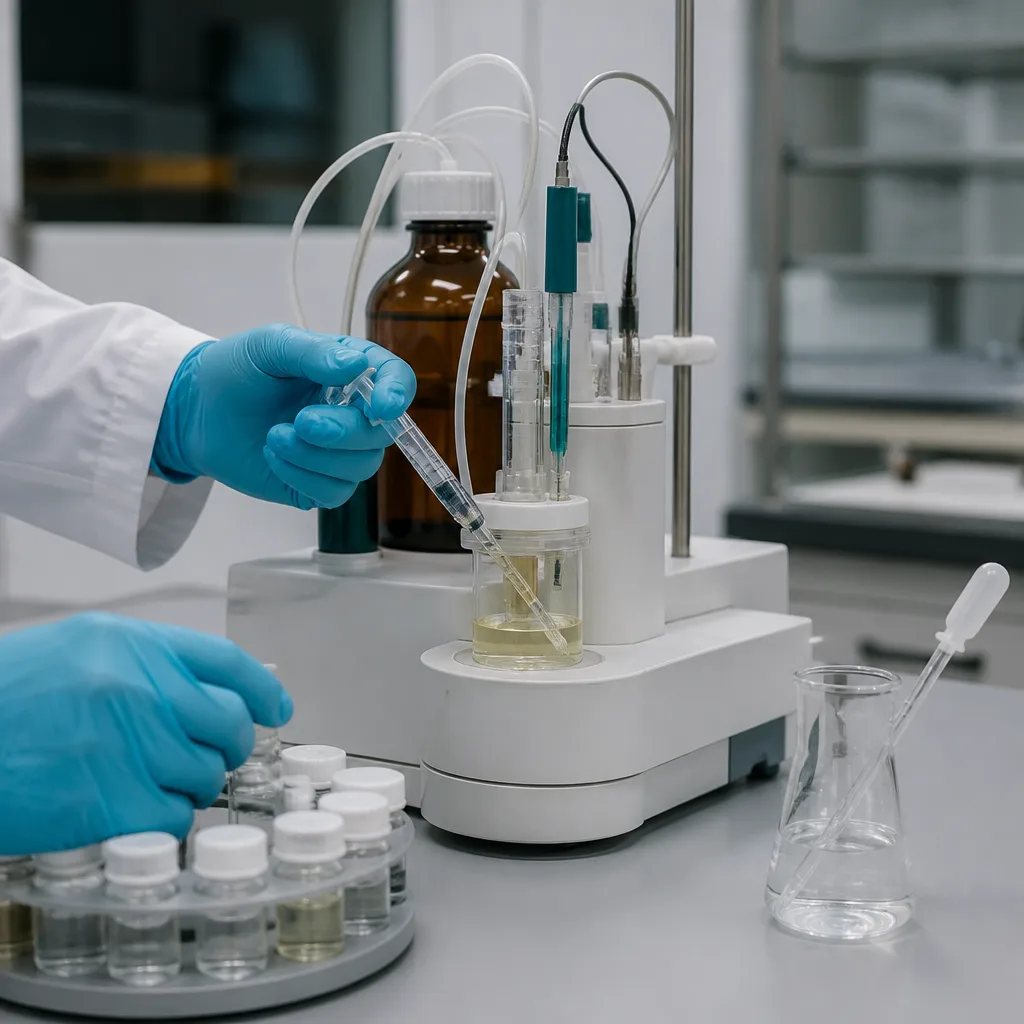
This test method is designed for use with automated titration systems that can potentiometrically determine the endpoint of the Karl Fischer titration, however, a manual titration method for visually determining the endpoint is included in the standard appendix (Appendix X1). Samples that are gaseous at room temperature are not included.
This test method involves the use of both pyridinated and non-pyridinated Karl Fischer reagents for the determination of water by volumetric titration. The determination of water using Karl Fischer coulometric titration is not addressed. With the appropriate selection of sample size, Karl Fischer reagent concentration, and equipment, this test method is suitable for measuring water over a wide concentration range, from parts per million to pure water.
ASTM E203 is a widely recognized international standard. It provides a general method for determining the water content (free water and hydration water) in most solid or liquid organic and inorganic compounds using volumetric Karl Fischer titration.
Karl Fischer titration is based on a specific chemical reaction. In the volumetric version,
The scope of this standard is defined as follows:
This is especially valuable for materials where other dehumidification methods (such as desiccation loss) may not be accurate due to volatile components or bound water.
The advantages of the ASTM E203 standard are as follows:
However, this standard has some limitations:
Laboratories routinely use the ASTM E203 standard for quality control of fuels, where even small amounts of water can cause corrosion, microbial growth, or phase separation. This standard is also critical in the pharmaceutical industry for active ingredients and excipients.
In short, the method described in the ASTM E203 standard explains how to accurately determine the water content in a wide variety of liquid, solid, and gaseous materials using volumetric Karl Fischer titration techniques. Water content analysis is crucial in industries such as chemistry, pharmaceuticals, petroleum, plastics, coatings, food processing, and electronics because excessive or insufficient moisture can significantly affect product quality, stability, processing behavior, and performance.
The primary purpose of the ASTM E203 standard is to provide a reliable and reproducible method for measuring water concentration in materials over a relatively wide moisture range. This standard is used particularly in the following areas:
This method is designed to measure water content specifically, rather than total volatile matter content, making it more accurate than traditional drying loss methods in many applications.
The ASTM E203 standard is based on the chemical reaction between water and the Karl Fischer reagent. The classic Karl Fischer reaction involves iodine, sulfur dioxide, a base, and an alcohol solvent. This technique offers high sensitivity and selectivity for the determination of water.
Karl Fischer titration is considered one of the most specific and accurate methods for water determination because it is chemically selective towards water. It is commonly used in the following areas:
The method is particularly effective for samples containing approximately 0,02 percent to 100 percent water, depending on sample size and reactive strength.
Typical equipment used in ASTM E203 testing includes:
The ASTM E203 standard is important because moisture content can significantly affect material behavior and product safety. Excess water can cause:
In pharmaceutical and chemical manufacturing, precise humidity control is often critical for regulatory compliance and product consistency.
In conclusion, the ASTM E203 standard is one of the most important laboratory standards for accurate water determination using volumetric Karl Fischer titration. Its accuracy, reliability, and versatility make it indispensable in many industrial and research applications. This standard, which enables accurate moisture measurement, helps manufacturers maintain product quality, improve process control, and ensure long-term material performance.
For many years, our organization, with its competent and experienced team, has been understanding the needs of its clients, providing the advanced testing services they require, and assisting them in the establishment, implementation, and improvement of management systems. Within this framework, we also provide testing services in accordance with the ASTM E203 standard.
To get an appointment, to get more detailed information or to request an evaluation, you can ask us to fill in our form and reach you.

