

ASTM D4587, Standard Practice for Fluorescent UV Condensation Exposure of Paint and Related Coatings, published by the American Society for Testing and Materials (ASTM), describes the selection of test conditions for accelerated exposure tests of coatings and related products in fluorescent UV and condensation devices conducted in accordance with ASTM G151 and ASTM G154. This practice also covers the preparation of test specimens and the evaluation of test results. The table provided in the standard describes commonly used test conditions.
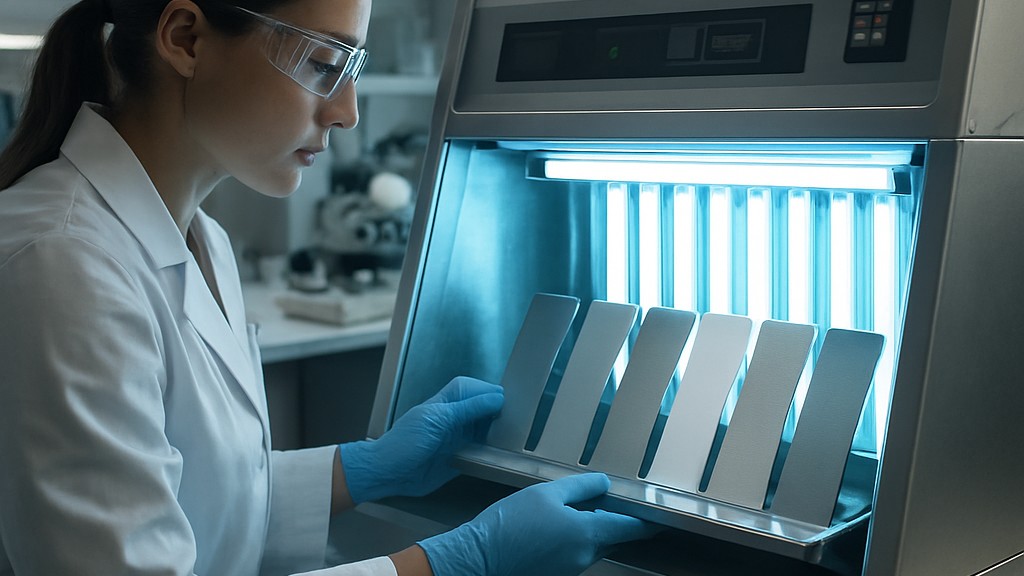
The ability of a paint or coating to resist degradation of its physical and optical properties caused by exposure to light, heat, and water can be crucial for many applications. This application is intended to induce property changes associated with end-use conditions, including the effects of sunlight, humidity, and heat. The exposure used in this application is not intended to simulate degradation caused by local weathering phenomena such as atmospheric pollution, biological attack, or saltwater exposure.
The spectral power distribution of light from fluorescent UV lamps differs significantly from that produced by light and water exposure devices using other light sources. The type and rate of degradation and performance rankings resulting from exposure to fluorescent UV lamps can be very different from those resulting from exposure to other laboratory light sources.
Interlaboratory comparisons are only valid when all laboratories use the same fluorescent UV instrument, lamp, and exposure conditions. Reproducibility of test results between laboratories has been shown to be good when materials are evaluated for stability and performance ranking compared to other materials or a control. A minimum of three replicates for each material is recommended for statistical evaluation of results.
In the world of materials science and engineering, ensuring the longevity and performance of protective coatings, especially for applications exposed to harsh environmental conditions, is paramount. This is where the widely adopted ASTM D4587 standard comes in. This standard provides a controlled method for simulating the damaging effects of sunlight, heat, and moisture on paints, varnishes, and similar coatings. By accelerating the aging process, this standard helps manufacturers predict real-world durability without waiting years for natural exposure.
The ASTM D4587 standard has become a staple in industries like automotive, aerospace, construction, and marine, where coatings must withstand constant UV radiation and moisture. This standard includes a laboratory procedure for exposing paint and coating samples to artificial fluorescent ultraviolet (UV) light combined with condensation cycles. This procedure mimics the primary destructive forces of outdoor weather: UV radiation from the sun, high temperatures, and moisture from rain or dew. Unlike natural outdoor exposure tests, which can take months or years, this accelerated method compresses equivalent damage into weeks or months, enabling faster product development and quality assurance.
This standard is not a standalone performance specification, but rather a tool for comparative evaluation. It allows researchers and quality control teams to evaluate how different formulations, such as acrylic, epoxy, or polyurethane, perform under simulated stress. Importantly, ASTM D4587 emphasizes that the results should be used to rank materials, not to predict definitive service life. This standard closely aligns with international equivalents such as ISO 4892-3 and ISO 11507, making it a globally recognized benchmark for coating durability testing.
Coatings serve as the first line of defense against environmental aggressions by preventing corrosion, fading, and structural deterioration on everything from bridges and buildings to vehicles and outdoor furniture. Without rigorous testing, failures can lead to costly repairs, safety hazards, and environmental impacts from premature material degradation. The significance of ASTM D4587 lies in its ability to:
In an era of climate change and increasingly variable weather conditions, this standard is more critical than ever for sustainable material design.
The ASTM D4587 standard is versatile and applied across a variety of industries:
Our organization, with its competent and experienced team, has been understanding the needs of its customers for years, providing them with the advanced testing services they need, and assisting them in establishing, implementing, and improving management systems. In this context, we also provide testing services in accordance with ASTM D4587 Standard Practice for Fluorescent UV Concentration Exposure of Paint and Related Coatings.
To get an appointment, to get more detailed information or to request an evaluation, you can ask us to fill in our form and reach you.

