

The standard “ASTM G195 Standard Guide for Conducting Abrasion Tests Using a Rotary Abrasive” published by the American Society for Testing and Materials (ASTM) covers the establishment of procedures for conducting abrasion tests on rigid or flexible materials using a rotary abrasive and is intended to assist in these procedures.
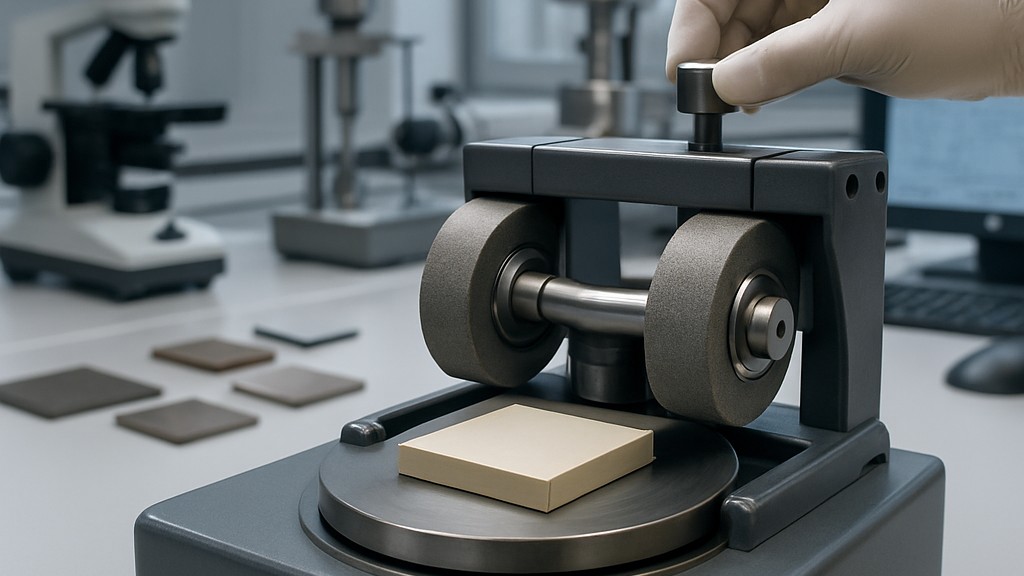
This test guide provides a tool for measuring the wear resistance of material surfaces and can be correlated with end-use performance, used to rank material performance comparatively, or both. The wear resistance of material surfaces measured on a laboratory testing machine is typically only one of several factors contributing to the wear performance experienced in actual use of the material. Other factors may also need to be considered when calculating life expectancy from specific wear data.
The wear resistance of material surfaces can be affected by factors such as test conditions, type of abrasive, pressure between the sample and the abrasive, mounting or stress of the sample, and type, grade, or amount of finishing materials.
Wear tests using a rotating platform abrasive may vary due to changes in the abrasive during specific tests. Depending on the abrasive type and test specimen, the abrasive disc surface may change due to the removal of surface coating or other materials from the test specimens. To mitigate this variation, the abrasive disc surface should be resurfaced at regular intervals.
When evaluating the abrasion resistance of two or more pavements, other factors may need to be considered for accurate comparison. Flexible pavements containing air bubbles may result in less mass loss. Pavements containing fillers may result in greater mass loss but less change in pavement thickness. Pavements containing aggregates or particles may produce wear debris that cannot be vacuumed away and contribute to pavement degradation.
Coatings with a hardness higher than the hardness of the abrasive wheel can cause the abrasive wheel to break down more quickly, requiring more abrasion cycles to produce measurable wear. Examples of coatings that may be affected include epoxies, polymethylmethacrylate, polyurethanemethacrylate, methylmethacrylate, and carbon resin.
In materials science and engineering, wear resistance is a critical property that determines the longevity and performance of surfaces in real-world applications. From consumer electronics to automotive components to architectural coatings, materials must withstand constant abrasion without premature failure.
In short, the ASTM G195 standard provides a standard framework for evaluating how materials, whether rigid or flexible, withstand abrasive forces using a rotating platform device known as a Taber abrader.
Wear occurs when surfaces rub against each other or against abrasive particles, leading to material loss, surface roughening, or failure. Unlike corrosion or fatigue, wear is mechanical and typically accelerated by environmental stressors such as dust, sand, or repeated use. Without standardized testing, comparing materials becomes subjective and carries the risk of inconsistent product quality. The ASTM G195 standard addresses this issue by focusing on the rotary abrasive, a versatile tool that simulates low- to moderate-grade abrasion scenarios. Unlike linear or jet-based tests, this method mimics rotational friction, making it ideal for evaluating coatings, laminates, and textiles.
At the heart of the ASTM G195 standard is the rotating platform base apparatus, a benchtop device that rotates the sample under weighted abrasive wheels. This assembly mimics everyday use conditions, such as shoe soles on the floor or instrument screens being touched by a finger.
The ASTM G195 standard is widely used in various industries:
Ultimately, the ASTM G195 standard exemplifies the power of standardized testing in driving innovation and reliability. By providing a clear and adaptable guide to turntable wear, it enables engineers to predict and improve material performance, ultimately extending product life and minimizing waste. As industries from electric vehicles to wearable technology grapple with increasingly stringent demands, this standard remains the cornerstone of tribological excellence.
Our organization, which has been operating for many years and meticulously follows global developments in science and technology, employs a skilled team and extensive infrastructure to conduct testing, measurement, and analysis in a wide range of areas for businesses across all sectors. In this context, we also provide testing services in accordance with the ASTM G195 Standard Guide for Abrasion Testing Using a Rotating Platform Abrasive.
To get an appointment, to get more detailed information or to request an evaluation, you can ask us to fill in our form and reach you.

