

The ASTM D3410 Standard Test Method for Shear Loading of Compressive Properties of Unsupported Measuring Cross-Section Polymer Matrix Composite Materials, developed by the American Society for Testing and Materials (ASTM), describes a test method for determining the in-plane compressive properties of polymer matrix composite materials reinforced with high-modulus fibers.
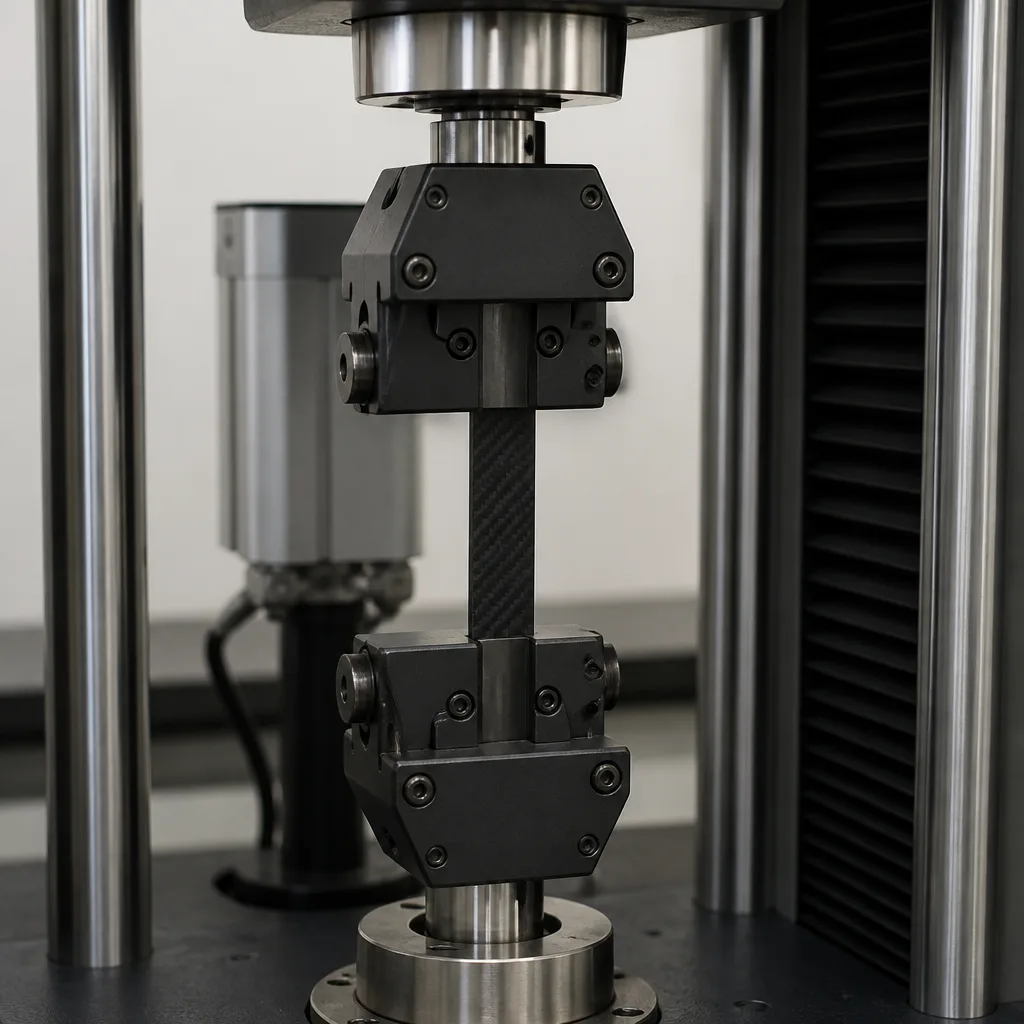
Composite material forms are limited to continuous or discontinuous fiber reinforced composites whose elastic properties are specifically orthotropic with respect to the test direction. This test procedure applies compressive force to the sample by shear at wedge-holding interfaces. This type of force transfer differs from the following procedures:
This test method is applicable to composites made from unidirectional tape, wet fiber insertion, textiles (e.g., fabric), short fibers, or similar product forms. Some product forms may require deviations from the test method.
This test method is designed to generate compressive strength data for material properties, research and development, quality assurance, and structural design and analysis. Factors affecting compressive response, and therefore requiring reporting, include: material, material preparation and layering methods, sample stacking sequence, sample preparation, sample conditioning, test environment, sample alignment and grip, test speed, temperature retention time, void content, and volumetric reinforcement percentage. Test-directional characteristics obtainable from this test method include:
ASTM D3410 is a standard test method used to determine the compressive properties of polymer matrix composite materials. It is particularly important for carbon fiber, glass fiber, aramid fiber, and other reinforced polymer composites, as compressive strength and modulus of compression are critical design properties. This standard provides a controlled laboratory procedure to subject composite samples to compressive load and measure their response until fracture.
The described test method is primarily designed for polymer matrix composites with continuous or discontinuous fibers. Unlike a conventional compression test where the sample tips are directly compressed, the ASTM D3410 standard utilizes a fixture that applies the compressive load via shear loading at the sample tips. This approach helps mitigate some of the problems associated with conventional compression tests, particularly sample tip crushing and instability.
The primary purpose of the ASTM D3410 standard is to define the essential compressive properties of composite materials. These include:
These properties are important because composite materials can behave very differently under tension and compression. For example, a carbon fiber composite might have extremely high tensile strength but significantly lower compressive strength due to the following mechanisms:
The ASTM D3410 standard provides a standardized method for measuring this behavior.
In structures where composite components are subjected to compressive loads, compressive performance is of critical importance. Examples include:
Without a standardized compression test, results from different laboratories can vary significantly due to differences in sample geometry, loading method, alignment, and test equipment. Therefore, the ASTM D3410 standard helps to provide repeatable and comparable test results.
The basic principle is relatively simple. A composite specimen is placed in a special compression fixture. The fixture applies an axial compressive force to the specimen through shear loading at the ends of the specimen. As the load increases, the testing machine records the applied force and the corresponding deformation/strain. The resulting load and strain data can be used to construct a stress-strain curve.
The specimen is typically a relatively narrow, flat composite sample designed to fit into a compression fixture. Key specimen characteristics include:
Sample dimensions and preparation are important because incorrect dimensions or damage can lead to premature failure and misleading results. Samples must be free from the following defects:
A typical test setup includes the following:
In general, the testing process follows these steps:
Understanding how the sample fractured is as important as obtaining the numerical strength value. Common fracture modes include:
Therefore, a test result should be evaluated in conjunction with the refractive mode normally observed.
For many years, our organization, with its competent and experienced team, has been understanding the needs of its clients, providing the advanced testing services they require, and assisting them in the establishment, implementation, and improvement of management systems. Within this framework, we also provide testing services in accordance with the ASTM D3410 standard.
To get an appointment, to get more detailed information or to request an evaluation, you can ask us to fill in our form and reach you.

