EN ISO 2626 Hydrogen Embrittlement Test in Copper - Determination of Average Grain Size
The “EN ISO 2626 Hydrogen embrittlement test of copper - Determination of mean grain size” standard, developed by the International Organization for Standardization (ISO) and later published as a European standard within the scope of harmonization efforts, is applicable to oxide-free and oxygen-free coppers with high conductivity. Embrittlement is revealed by close bending or reverse bending, or by microscopic examination.
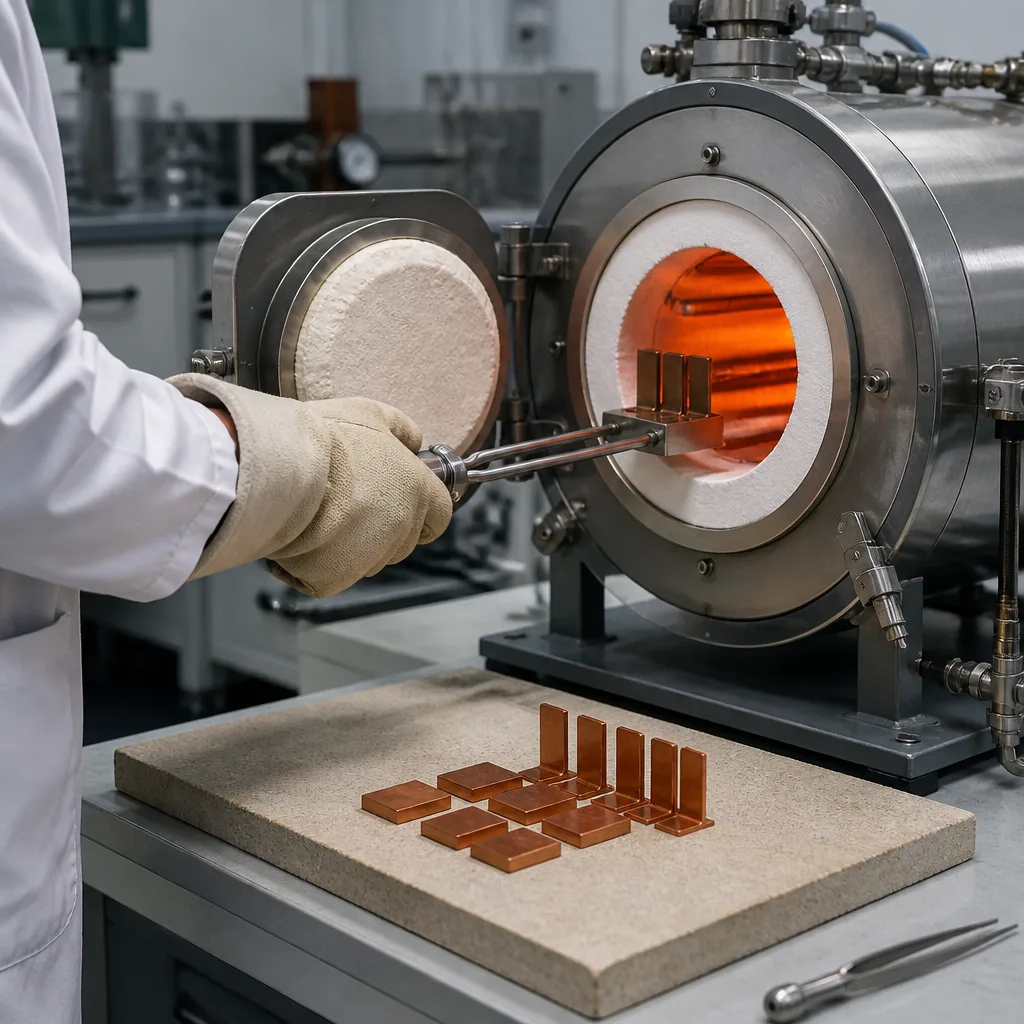
In principle, a test specimen is prepared and heated in a hydrogen-containing environment. If oxygen is present in the metal, a reaction occurs that causes brittleness. The test specimen is then cooled so that it does not come into contact with air. Brittleness is then revealed by close bending or reverse bending, or by microscopic examination.
Test samples are prepared as follows:
- Close bending test piece: This piece must be of a suitable length or full cross-section, or of a suitable thickness or diameter not exceeding 12 mm. Its edges must be rounded and smooth. Test pieces that are not full cross-sections must include a portion of the original surface of the material.
- Reverse bending test piece: This piece should be of suitable length and its thickness or diameter should not exceed 2,5 mm. Its edges should be rounded and smooth. Test pieces that are not in full cross-section should include a portion of the original surface of the material.
- Test specimen for microscopic examination: This sample must be of appropriate size and include the outer surface of the material on at least one face.
The prepared test piece is heated for 30 minutes in a furnace maintained at a temperature between 825 and 875 degrees Celsius and containing at least 10 percent hydrogen, and then cooled in the furnace atmosphere or by rapid cooling through immersion in water.
The vulnerability test is performed as follows:
- Close bending test: The close bending test is performed at ambient temperature. The test piece is bent with constant pressure applied at a right angle to its length until the ends reach the position shown in the figure. The original surface of the material should be outside the bend.
The bending process is normally carried out in two stages.
- For the first stage, any of the methods shown in the ISO/R 398 standard can be used to bend the test piece into a V shape. The choice of method determines the minimum length of the test piece.
- In the second stage, the two legs of the test piece are clamped, for example in a vise, to apply constant pressure to the open end of the V-shape. After the bending process, the stretched surface is visually inspected to see if there are any cracks.
Reverse bending test: A reverse bending test is performed according to the ISO 2625 standard. The test piece is subjected to reverse bending 10 times. The original surface of the material is subjected to maximum stress. After the bending process, the stressed surface is examined for cracks using the naked eye, corrected to normal vision.
- Microscopic examination: The test piece is cut so that its outer surfaces intersect at right angles. The section is polished, etched if desired, and examined under a microscope at 200x magnification for signs of brittleness, such as gas release or open grain structure.
In short, the EN ISO 2626 standard defines a test method for detecting hydrogen embrittlement in specific types of copper. This method is particularly applicable to:
- Deoxygenated copper
- High conductivity coppers in the absence of oxygen.
Hydrogen embrittlement is a phenomenon where copper absorbs hydrogen (for example, during annealing in a hydrogen-containing atmosphere) and can lead to brittleness and cracking, especially when the material is subsequently stretched or bent. Testing helps to assess the material's susceptibility to this problem.
The test involves exposing copper samples to a hydrogen atmosphere at high temperatures, followed by the application of mechanical stress (typically bending) to reveal any brittleness through the appearance of cracks.
This standard is a materials testing standard focusing on quality control in copper production and processing. It is used in the manufacturing and quality assurance of copper products for electrical, electronic, and other high-conductivity applications where material ductility and reliability are critical.
The EN ISO 2626 standard is important because it provides a standardized and reliable method for detecting hydrogen embrittlement in highly conductive copper. This method guarantees material quality, safety, and performance in critical applications.
The main reasons why this standard is considered necessary are as follows:
- It prevents unexpected failures: Fragile copper can suddenly fail during use. This is unacceptable in electrical cables, busbar systems, heat exchangers, electronic components, water pipes, and automotive or aerospace parts where mechanical integrity and conductivity are essential.
- Quality control in production: Copper processing (smelting, casting, annealing) may contain or release residual oxygen. Testing verifies that the material has been properly deoxygenated and is resistant to hydrogen sickness. Without a standardized method, manufacturers and buyers lack a consistent way to assess this risk.
- It ensures repeatability and comparability: This standard defines precise test conditions (hydrogen exposure, temperature, time, bending procedure, and inspection criteria). This ensures consistent results across laboratories, suppliers, and countries.
- It supports material selection and process control: It helps distinguish suitable oxygen-free or low-oxygen copper from materials prone to brittleness. It guides decisions regarding annealing atmospheres (e.g., avoiding hydrogen if oxygen is present) and post-processing applications.
- Legal and industry requirements: Many product standards and customer specifications reference this standard to meet quality, safety, and reliability criteria in electrical, electronic, and mechanical applications.
In conclusion, the EN ISO 2626 standard is crucial because hydrogen embrittlement is a hidden and insidious problem in copper. This standard transforms a complex metallurgical risk into a simple and repeatable test that protects product performance, user safety, and manufacturer reputation.
For many years, our organization, with its competent and experienced staff, has been understanding the needs of its clients, providing the advanced testing services they require, and assisting them in the establishment, implementation, and improvement of management systems. Within this framework, we also provide testing services in accordance with the EN ISO 2626 standard.



