

The purpose of the method described in the standard “PSA D45 1198 Cardboards - Dimensional stability of wood fibre panels” developed by the French automobile company Renault is to characterize the dimensional change between dry and wet conditions for a given material and the irreversible evolution of the dimensions obtained by alternating drying and immersion in water. Changes in the weight of the material can be determined during the same test, if necessary. This standard is valid for cardboards and planar wood fibre panels, as well as materials impregnated or coated on one or both sides.
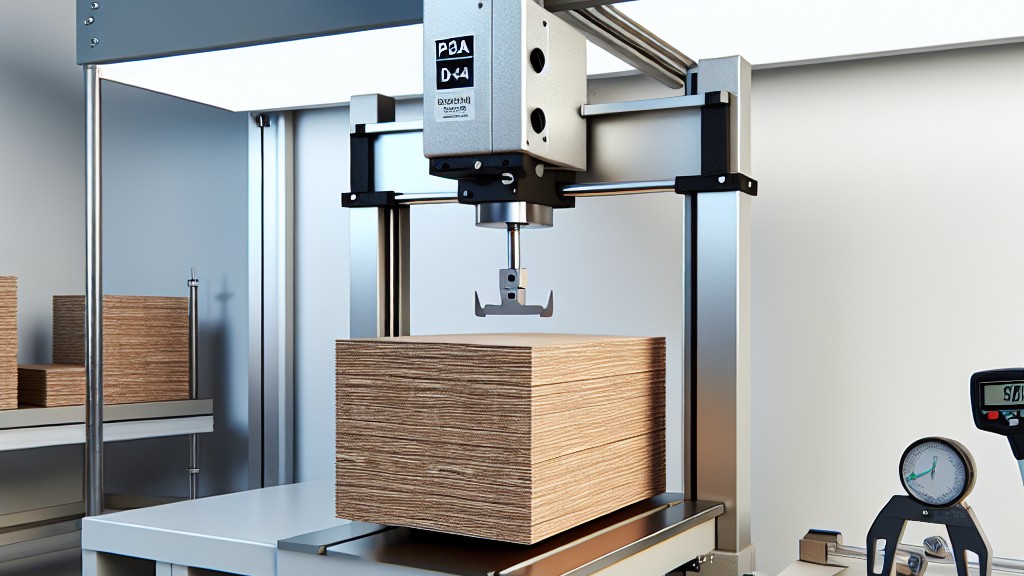
In principle, this method consists in determining the dimensions (for three directions) of a sample subjected to various moisture removal processes:
The equipment used in these tests includes:
Test samples should be representative of the size to be characterized. To ensure this representation, it is necessary to find the basic characteristics of the population under study. Selection criteria for test samples should be stated in the test report in accordance with the PSA A10 0156 standard. In case of doubt about sampling, PSA should be contacted for the rules to be followed.
When preparing test specimens, two specimens per test are required for the tests. Square specimens with sides of 450 mm plus/minus 1 mm are cut in the direction assumed or specified for the production direction of the material. This direction (A direction) is marked on each specimen. Using the template, two pairs of marks are drawn at a distance of 400 mm plus/minus 1 mm from each other as shown in the standard appendix. On the monitored axes, 50 points are indicated at a distance of 4 mm from the edges of the specimen as per the standard appendix. These points represent the measuring point thickness. On one of the sides perpendicular to direction A, two marks are indicated approximately 50 mm from the two corners. These marks are used for positioning the clips. If changes in the weight of the material are to be monitored, the weight of two clips is measured.
When performing the normal test (approval and full control), during the drying process, the clips are attached to the sample close to the two marks drawn on one side. The rings of the clips are put on the suspension bar. The sample is left hanging from the compass in a ventilated oven at 70 degrees for 6 hours plus/minus 1 hour. The sample is removed and measured immediately:
During the first immersion process, the caliper is placed over a container filled with water at 23 degrees, so that the water level slightly exceeds the upper edge of the sample. The sample is left in the water for 16 hours plus/minus 1 hour. The sample is removed from the water and allowed to drain for 10 minutes. The following are then measured:
The cycles of drying and immersion described above are then repeated three times. Thickness and dimension measurements between the marks should only be made after the second drying and final immersion.
The final drying is continued under the conditions of the drying cycle described above and the thickness and dimensions between the marks are measured. In addition, the deviations observed from the center of the sample to the middle of the two diagonals formed by the two straight lines connecting the corners of the sample are measured. The larger of the two values is noted.
In the simplified test method, the change in size and weight between the dry condition and the wet condition is characterized by the following variables with the resulting sign:
Our organization has a strong staff that closely follows the developments in the world in the field of science and technology and constantly improves itself. Among the numerous test, measurement, analysis and evaluation studies provided for businesses in various sectors, there are also testing services in accordance with the "PSA D45 1198 Cardboards - Dimensional stability of wood fiber panels" standard.
To get an appointment, to get more detailed information or to request an evaluation, you can ask us to fill in our form and reach you.

