

Many factors in the injection molding process influence the properties of molded test specimens and, consequently, the measurement values obtained when the specimens are used in a test method. The mechanical properties of such specimens are highly dependent on the conditions of the molding process used to prepare the specimens. Precisely defining each key parameter of the molding process is a fundamental requirement for reproducible and comparable operating conditions. When defining molding conditions, it is important to consider the potential effects of these conditions on the properties to be determined.
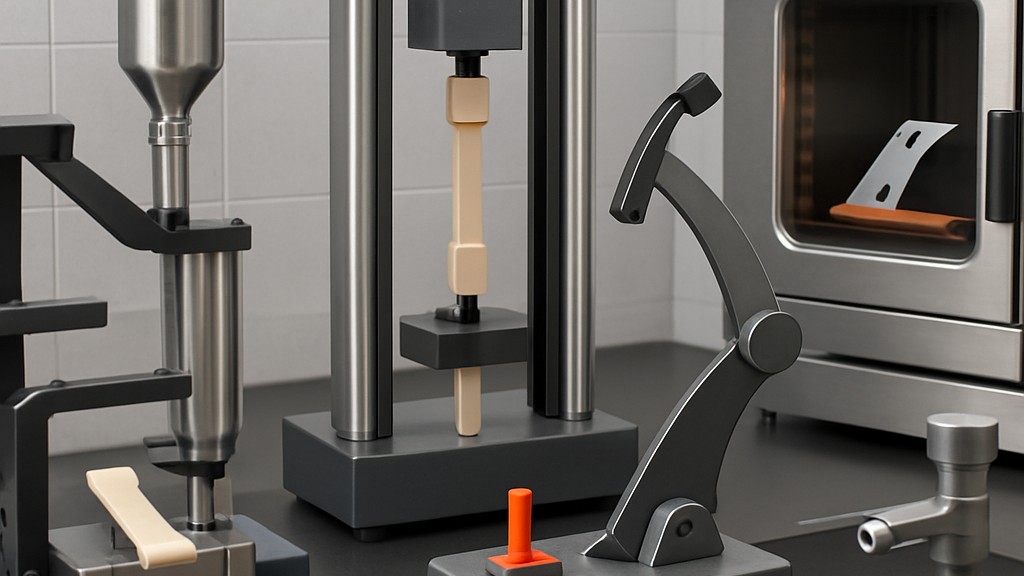
Thermoplastics vary in crystallinity morphology (for crystalline and semicrystalline polymers), phase morphology (for heterogeneous thermoplastics), and molecular orientation due to anisotropic fillers such as short fibers. Residual (frozen) stresses in molded test specimens, and thermal degradation of the polymer during molding also affect properties. Each of these factors must be controlled to minimize variability in the numerical values of the measured properties. All of the ISO molds described are designed to be installed in existing injection molding equipment and feature interchangeable blanking plates.
The “ISO 294 Plastics - Injection molding of test specimens of thermoplastic materials” standard, developed by the International Organization for Standardization (ISO), consists of the following subsections published under the same title:
The purpose of this standard is to provide consistent descriptions of the key parameters of the molding process and to establish a uniform practice for reporting molding conditions. The specific conditions required for reproducible preparation of test specimens vary for each material used and may be specified in the standard for the specific material or agreed upon by the parties involved. Interlaboratory tests with acrylonitrile/butadiene/styrene (ABS), styrene/butadiene (SB), and poly(methyl methacrylate) (PMMA) have shown that mold design is an important factor in the reproducibility of test specimen preparation.
The molding shrinkage defined in this standard excludes the effects of moisture uptake. This is included in the post-molding shrinkage and therefore in the total shrinkage. For cases where post-molding shrinkage is due solely to moisture uptake, ISO 175 applies. The molding shrinkage defined in this standard represents the free shrinkage resulting from unrestricted deformation of the cooling plates during the holding period in the mold. Therefore, it is considered the maximum value of any restricted shrinkage.
It has been found to provide maximum anisotropic properties with only slight sensitivity to injection speed. Whenever possible, a two-cavity mold is intended. For the design of plastic parts, this provides upper and lower limits on tensile properties. Matching the plate thickness to a specific part thickness is not a suitable criterion due to the influence of mold filling rate and part geometry on anisotropy. Examining the anisotropy of materials is a specialized procedure intended to guide mold design for end-use applications and is not intended as a quality control tool.
In injection molding of thermoplastic materials, the flow of molten polymer can affect the orientation of fillers such as fiberglass or polymer chains, resulting in anisotropic behavior.
For the purposes of this standard, the flow direction is defined as the direction from the mold opening to the farthest end of the mold cavity, and the cross direction is defined as the direction perpendicular to the flow direction. The Type F mold is not intended to replace the Type D mold used to determine molding shrinkage of thermoplastics.
The ISO 294 standard is important for the following reasons:
Our organization, which has been supporting businesses across all sectors for years through a wide range of testing, measurement, analysis, and evaluation activities, boasts a strong team of employees who closely follow global developments in science and technology and are constantly improving themselves. In this context, we also provide testing services in accordance with the "ISO 294 Plastics - Injection molding of test samples of thermoplastic materials" standard.
To get an appointment, to get more detailed information or to request an evaluation, you can ask us to fill in our form and reach you.

