

The standard “ISO 845 Cellular plastics and rubbers - Determination of apparent density” published by the International Organization for Standardization (ISO) describes the method for determining the apparent overall density and apparent core density of cellular plastics and rubbers.
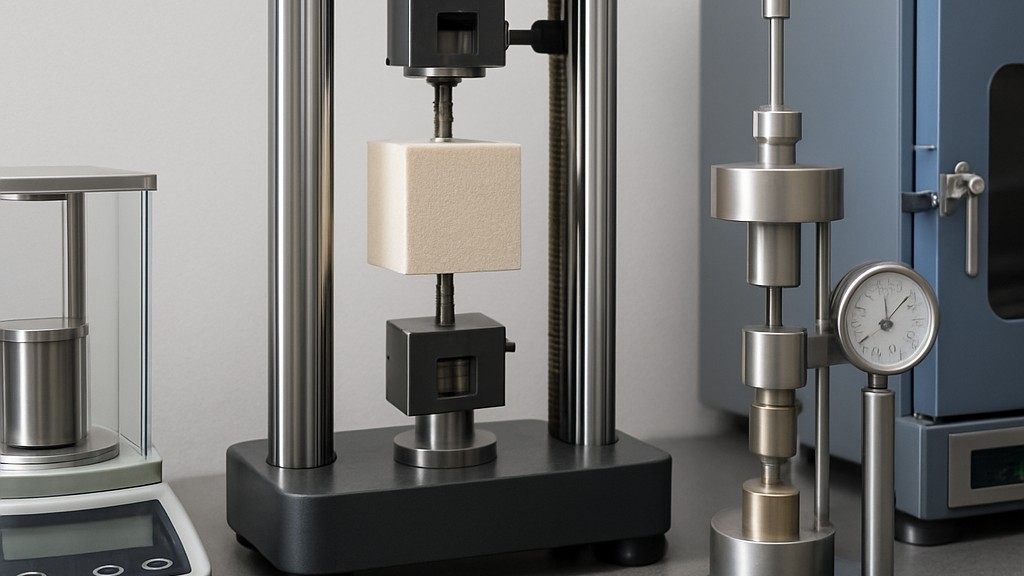
If the material to be tested contains skins formed during molding or extrusion, it is possible to determine the apparent overall density, the apparent core density, or both. If the material forms skins during molding, the overall density statement is not accurate.
Cellular plastics and rubbers refer to a class of materials made by incorporating gas into plastic or rubber to create a structure containing numerous small, closed or interconnected cells. This process results in a material that is lightweight, flexible, and often cushioning. These materials can be open-cell (cells are interconnected) or closed-cell (cells are isolated from each other), which influences their properties such as softness, insulation, and water absorption.
Cellular plastics are plastic materials that have been foamed to contain a cellular structure. Common types include:
Cellular plastics are lightweight, have good thermal and acoustic insulation, high impact resistance, and have variable density and hardness.
Cellular rubbers are rubber materials with a cellular (foamed) structure used where cushioning, sealing, or insulation is required. Common types include:
Cellular rubbers are flexible and elastic, offer good sealing and shock absorption, are generally resistant to weathering, UV, and chemicals, and are used for gaskets, vibration dampers, and seals. They are used in the automotive industry for gaskets and padding; in the construction industry for insulation and weatherproofing; in consumer goods for sponges, cushions, and protective clothing; in the packaging industry for shock-absorbing inserts and protective pads; and in the medical field for orthopedic supports, pads, and cushioning.
The ISO 845 standard provides a standardized method for determining the apparent density of cellular plastics and rubbers—that is, the mass per unit volume, including the volume of cells (open or closed). Apparent density is obtained by dividing the mass of a sample by its total volume, including any open or closed cells in the structure.
Apparent density is important for the following reasons:
For the purposes of the ISO 845 standard, the following terms and definitions apply:
Each sample must have a shape that allows for easy calculation of its volume. The material must be cut without disrupting its original cellular structure. Samples must be cut to specific dimensions to ensure clean and accurate measurements. The sample dimensions (length, width, height) must be precisely measured and weighed. The sample size should preferably be as large as possible, compatible with available equipment and the shape of the original material. The total volume of the sample should be at least 100 cm3. For rigid materials, when determining the apparent total density using a sample cut from a larger sample, the ratio of the skin area formed during molding to the total volume should be the same for each sample.
At least five samples should be tested. The total mass and total volume of the sample can be used to determine its density. For measurement purposes, samples should be conditioned for at least 72 hours after production before cutting samples from the product. If necessary, this period may be reduced to 48 or 16 hours if the difference in density after 48 or 16 hours compared to the density after 72 hours is less than 10 percent. The sample should be held in standard atmospheres or in a desiccator (dry conditions) for at least 16 hours, as defined below. This conditioning process may be part of the 72-hour post-production process. According to ISO 291, standard atmospheres are as follows:
The values given in this standard were developed from data obtained using only hard materials and test specimens conditioned for 72 hours. Validity for other materials and conditioning periods has not yet been established.
The inter- and intra-laboratory accuracy of this test method can be expected to vary for different materials. Results from a collaborative testing program involving five laboratories have shown that absolute density differences measured for certain materials can be limited to 1,7 percentage points at a 95 percent confidence level within a single laboratory.
Our organization, which has been supporting businesses across all sectors for years through a wide range of testing, measurement, analysis, and evaluation activities, has a strong team of employees who closely follow global developments in science and technology and are constantly improving themselves. In this context, we also provide testing services in accordance with the ISO 845 Cellular plastics and rubbers - Determination of apparent density standard.
To get an appointment, to get more detailed information or to request an evaluation, you can ask us to fill in our form and reach you.

