

The ASTM D5178 Standard Test Method for Scratch Resistance of Organic Coatings, developed by the American Society for Testing and Materials (ASTM), describes a test method for determining scratch resistance on flat and smooth surfaces. The results are expressed in terms of the scratch strength of organic coatings such as paint, varnish, and lacquer when applied to flat and smooth panel surfaces.
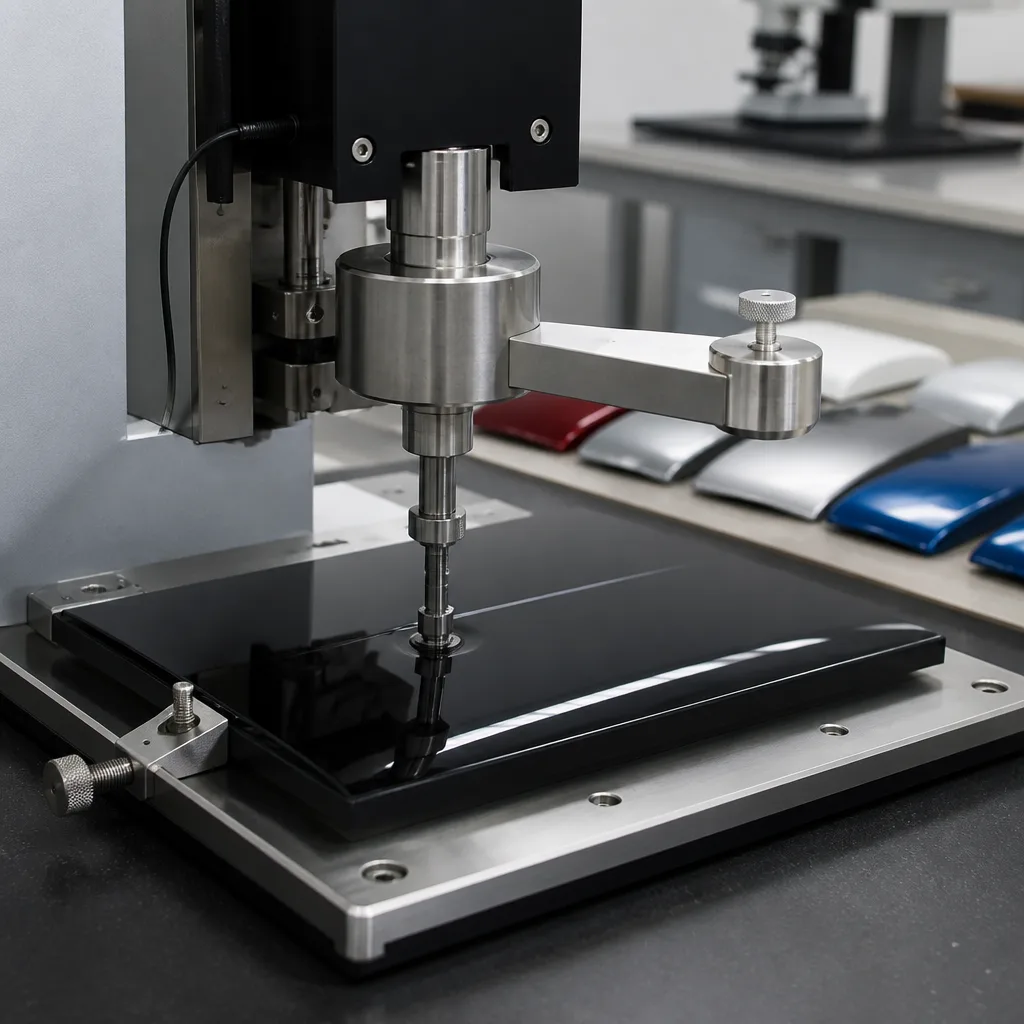
In some cases, scratching of coatings applied to substrates under typical usage conditions is unacceptable. This testing method has been found useful in distinguishing the degree of scratching of coatings on substrates. In particular, it is quite useful in providing relative ratings for a range of coated panels that show significant differences in scratching degree.
The test method described in the ASTM D5178 standard is primarily applicable to coatings such as paints, varnishes, and lacquers. It evaluates how well a coating resists visible surface damage when subjected to a controlled mechanical force.
Scratch resistance is an important property because coated surfaces can be damaged during manufacturing, transportation, assembly, cleaning, handling, and normal use. A coating with good scratch resistance can better maintain its appearance and protective function.
This test is particularly useful for comparing various coated panels and determining which coating provides better resistance to surface marks. It is noted as being the most useful test for obtaining relative ratings among coatings that show significant differences in scratch resistance.
A scratch is a type of visible surface mark, scuff, or other surface damage that occurs when an object comes into contact with a coated surface. Scratch resistance should not be confused with hardness or abrasion resistance. A coating may have high hardness but still be susceptible to certain surface marks. Therefore, scratch resistance provides information about the coating's ability to maintain its surface appearance against a specific mechanical stress. For example, an automotive interior trim component may come into contact with tools, wrenches, packaging materials, or other components during assembly and use. A coating with poor scratch resistance may develop visible marks even if the underlying material remains structurally intact.
In principle, the ASTM D5178 standard specifies the force required to create a detectable mark on a coated surface. A controlled testing device applies a graded or appropriately controlled force to the coating using a specified contact element. The surface is then inspected to determine whether a visible mark has formed. Higher forces required to create a given mark generally result in better resistance to test-induced surface marks. Precise equipment, preparation requirements, operating conditions, and evaluation criteria are necessary to obtain valid and reproducible results.
The ASTM D5178 standard is designed for organic coatings on smooth, flat planar substrates. Examples specifically mentioned in this standard include:
Therefore, the method is applicable to industries where appearance and surface durability are important.
In general, the testing method follows these steps:
The test result depends on the coating preparation, substrate, thickness, conditioning, equipment, and evaluation conditions.
The ASTM D5178 standard is important because cosmetic surface damage can be a significant quality issue, even if a coating remains physically adhered to its substrate. This test provides a standardized method for comparing coating systems and helps manufacturers answer questions such as:
This standard specifically outlines the situations where scratching is unacceptable and states that the method can distinguish the degree of scratching between coated panels.
The ASTM D5178 standard can be particularly useful in automotive coating development and quality assessment. Vehicle components have surfaces that are frequently touched, handled, cleaned, or exposed to contact with other objects. Potential applications include the evaluation of:
In automotive applications, scratch resistance can contribute to long-term visual quality. A surface that quickly develops scratches or marks can give the impression of low quality, even if its structural performance is not affected.
Several factors can influence scratch resistance results. Key considerations include:
The ASTM D5178 standard is not a universal measure of all coating durability. It specifically addresses scratch resistance on flat, smooth surfaces and provides results relating to the force required to create a scratch. Therefore, it should not be automatically interpreted as a complete measurement of:
Scratch resistance is part of a broader family of coating performance characteristics. Depending on the application, manufacturers may also require the following tests:
These tests measure different characteristics and should not be considered interchangeable.
For many years, our organization, with its competent and experienced team, has been understanding the needs of its clients, providing the advanced testing services they require, and assisting them in the establishment, implementation, and improvement of management systems. Within this framework, we also provide testing services in accordance with the ASTM D5178 standard.
To get an appointment, to get more detailed information or to request an evaluation, you can ask us to fill in our form and reach you.

