

The standard “ISO/TS 14778 Paper and board - Measurement of water contact angle by optical methods” developed by the International Organization for Standardization (ISO) describes a procedure for optical assessment of the contact angle between water and the paper and board surface. Here, the process of droplet formation, application to planar substrates or measurement of the droplet shape in contact with the solid is carried out by automatic equipment.
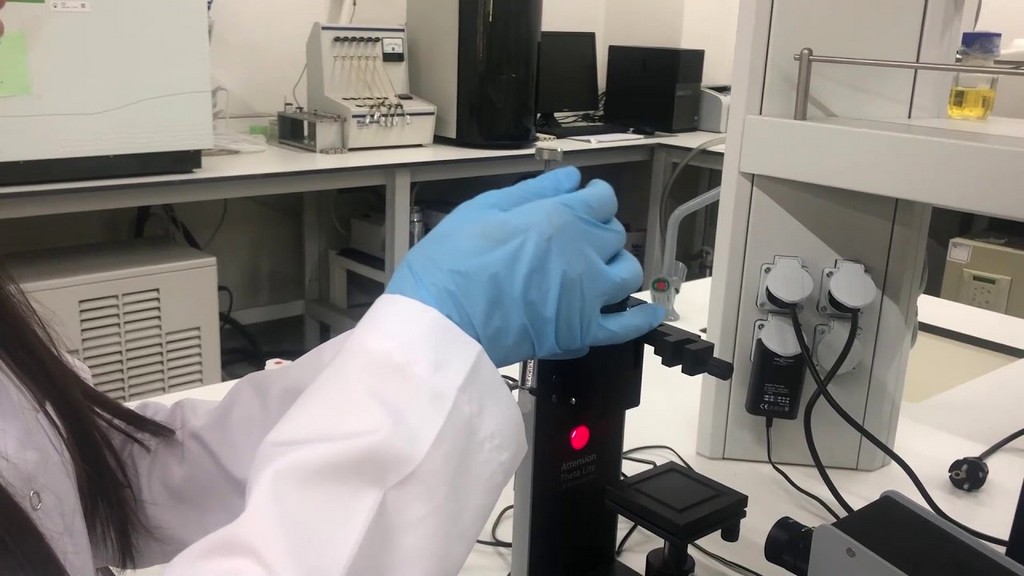
The measurement limits are determined by the capabilities of the instrumentation used. The instrumental capabilities defined in this standard use a digital image capture system operating at a minimum of 50 frames per second and require the ability to perform the first measurement after no more than 20 ms to 40 ms of contact between the droplet and the substrate. This test method is applicable to most types of paper or board, but not to structured materials.
For the purposes of this standard, the following terms and definitions apply:
In principle, when a water droplet is applied to the horizontal planar surface of paper or cardboard, the contact angle of the droplet with the material is evaluated by optical digital imaging.
The reagent is distilled water with a surface tension of at least 13530 mN/m at 23 degrees, as specified in the ISO 72 standard. This method can be used with other liquids, provided that they can be distributed in droplet form by the liquid distribution system described in this standard and that they do not cause significant swelling of the substrate such that the baseline can no longer be defined over the time scale of the measurements. Furthermore, for liquids with high vapour pressures, the rate of evaporation may be too rapid to permit the use of the technique unless it is carried out in a vapour-saturated atmosphere (e.g. a closed glass cuvette containing a few drops of solvent). Contact angle values produced using other liquids cannot be compared with values produced using water.
Some contact angle meters have the ability to heat liquids prior to droplet formation. Heating changes both surface tension and viscosity, both of which can affect the contact angle. If the liquid is heated, this is a deviation from the standard.
Many contact angle meters can also measure liquid surface tension and can be used to examine water surface tension. It is recommended to periodically check that the water is free of contamination as this will have a direct impact on the contact angle readings.
The main equipment used in these tests includes:
Sufficient test pieces are prepared to make at least 5 valid measurements on each side under the same atmospheric conditions used to condition the sample before testing begins. Contact of the test area with hands or fingers is avoided and folds, wrinkles, cracks and other defects including watermarks are avoided.
Among the numerous testing, measurement, analysis and evaluation studies that our organization has carried out for businesses in various sectors, it also provides testing services defined in the “ISO/TS 14778 Paper and cardboard - Measurement of water contact angle by optical methods” standard with its trained and expert staff and advanced technological equipment.
To get an appointment, to get more detailed information or to request an evaluation, you can ask us to fill in our form and reach you.

