

The ASTM C1161 Standard Test Method for Flexural Strength of Advanced Ceramics at Ambient Temperature, developed by the American Society for Testing and Materials (ASTM) , describes a test method for determining the flexural strength of advanced ceramic materials at ambient temperature. As shown in the standard, four-point, 1/4-point, and three-point loadings with the specified openings are standard. Rectangular specimens with the specified cross-sectional dimensions are used with the specified specimen-fixture combinations and properties.
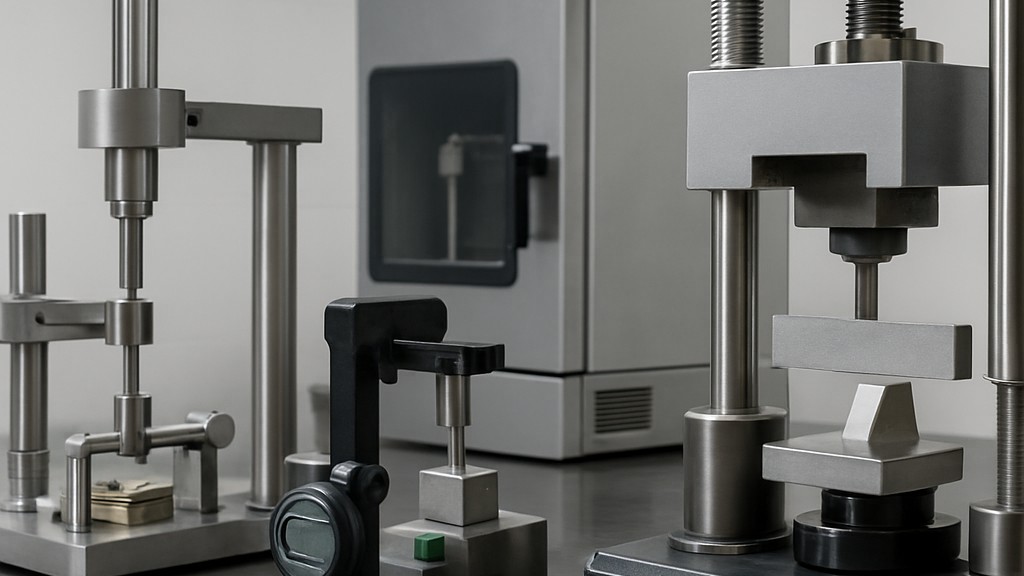
Test specimens may have dimensions of 3 x 4 x 45 to 50 mm, tested in four-point or three-point fixtures with 40 mm outer clearance. Alternatively, test specimens and fixture openings of half or double these dimensions may be used. The method allows testing of machined or fired test specimens. Various options for processing preparation are included: application-matched processing, customary procedure, or specified standard procedure. This method describes the apparatus, specimen requirements, test procedure, calculations, and reporting requirements. The test method is applicable to monolithic or particulate- or whisker-reinforced ceramics. It can also be used for glasses. This standard does not apply to continuous fiber-reinforced ceramic composites.
This test method can be used for materials development, quality control, characterization, and design data generation. This test method is intended for use with ceramics having a strength of 50 MPa or greater.
Bending stress is calculated based on simple beam theory, assuming the material is isotropic and homogeneous, the moduli of elasticity in tension and compression are the same, and the material is linearly elastic. The average grain size should not exceed one-fiftieth of the beam thickness. The standard's assumption of homogeneity and isotropy precludes the use of this test for continuous fiber-reinforced ceramics.
The flexural strength of a set of test specimens is affected by various parameters associated with the test procedure. These factors include the loading rate, test environment, specimen size, specimen preparation, and test fixtures. Specimen sizes and fixtures were selected to provide a balance between practical configurations and the resulting errors.
In brief, this standard provides test procedures for determining the flexural strength of advanced ceramic materials, which are generally brittle and require specialized test methods due to lack of ductility and high hardness.
The purpose of this standard is to standardize the methodology for measuring the modulus of rupture (flexural strength) of monolithic advanced ceramics. This standard is specifically designed to account for the unique mechanical behavior of ceramics under stress, particularly their sensitivity to defects and surface conditions.
ASTM C1161 is applicable at ambient temperature and is commonly used for:
This standard defines three recommended specimen configurations:
Rods are tested with polished or ground surfaces to simulate actual usage conditions and evaluate surface defect sensitivity.
The ASTM C1161 standard outlines both three-point and four-point bending test methods:
Both methods involve loading the ceramic rod at a constant rate until fracture occurs. The flexural strength is calculated from the fracture force, specimen dimensions, and test configuration.
The main parameters evaluated in this standard are:
The ASTM C1161 standard is vital in industries where ceramics are used in structural applications. For example,
By using a consistent and repeatable testing method, engineers and materials scientists can confidently compare material performance, monitor manufacturing quality, and validate design assumptions.
In summary, the ASTM C1161 standard provides a critical basis for evaluating the mechanical reliability of advanced ceramics.
Our organization, which has been supporting businesses across all sectors for years through a wide range of testing, measurement, analysis, and evaluation activities, has a strong team of employees who closely follow global developments in science and technology and are constantly improving themselves. In this context, we also provide testing services in accordance with the "ASTM C1161 Standard Test Method for Flexural Strength of Advanced Ceramics at Ambient Temperature" standard.
To get an appointment, to get more detailed information or to request an evaluation, you can ask us to fill in our form and reach you.

