

The standard "ASTM D5147/D5147M-14 Standard test methods for sampling and testing modified bituminous sheet material" developed by the American Society for Testing and Materials (ASTM) describes test methods for sampling and testing prefabricated reinforced polymer modified bituminous sheet material designed for single or multi-layer application in roofing and waterproofing membranes. Such products can use various surface materials on one side.
These test methods cover a range of different products. Not all tests are required for each product. Only those specified in the product standard are required. These test methods include:
These test methods are used for sampling and testing modified bitumen sheet materials. The property requirements determined by these test methods are found in the following product standards:
From each shipment or fraction thereof, a number of rolls equal to half the cube root of the total number of rolls in the lot is randomly selected. If the number calculated is a fraction, it is expressed as the next highest integer. For convenience, a table showing the number of rolls to be selected from lots of various sizes is included in "ASTM D146/D146M-04 Standard test methods for sampling and testing bitumen-saturated felts and woven fabrics for roofing and waterproofing".
Other sampling frequencies may be used and reported within the framework of these procedures when mutually agreed upon by the parties involved. The minimum sample shall consist of five rolls. The rolls thus selected shall constitute the representative sample used for all subsequent observations and tests of the batch of material examined.
Unless otherwise specified, test samples are conditioned at 4 degrees plus/minus 23 degrees and 2 percent plus/minus 50 percent relative humidity for at least 5 hours prior to testing.
The thickness gauge shall be a dial or digital-electronic type micrometer capable of measuring dimensions to an accuracy of 0,1 mm. The micrometer shall be equipped with a flat, circular presser foot with a diameter equal to or greater than 9,5 mm and less than 32 mm. During operation, the contact between the presser foot and the sample is ensured by a spring inside the micrometer or by the weight of the presser foot and the mounted parts.
A sample is taken from each of the rolls selected in accordance with this standard. Each sample shall be at least 700 mm long, in accordance with the manufactured width of the roll. Five sheet thickness measurements and five edge thickness measurements are taken on each sample. All measurements are taken in such a way that the presser foot contacts the edge of the sheet intended to be exposed when applied in accordance with the manufacturer's instructions. Separate spot measurements, mean and standard deviation are reported for both sheet thickness and edge thickness measurements for each sample.
The average of the sample sheet thickness averages is calculated and this value is reported as the sample sheet thickness. The average of the sample edge thickness averages is calculated and this value is reported as the sample edge thickness. Unless otherwise specified by the product standard referring to these test methods, the sample sheet thickness and sample edge thickness are the values used for comparison with the product standard requirements.
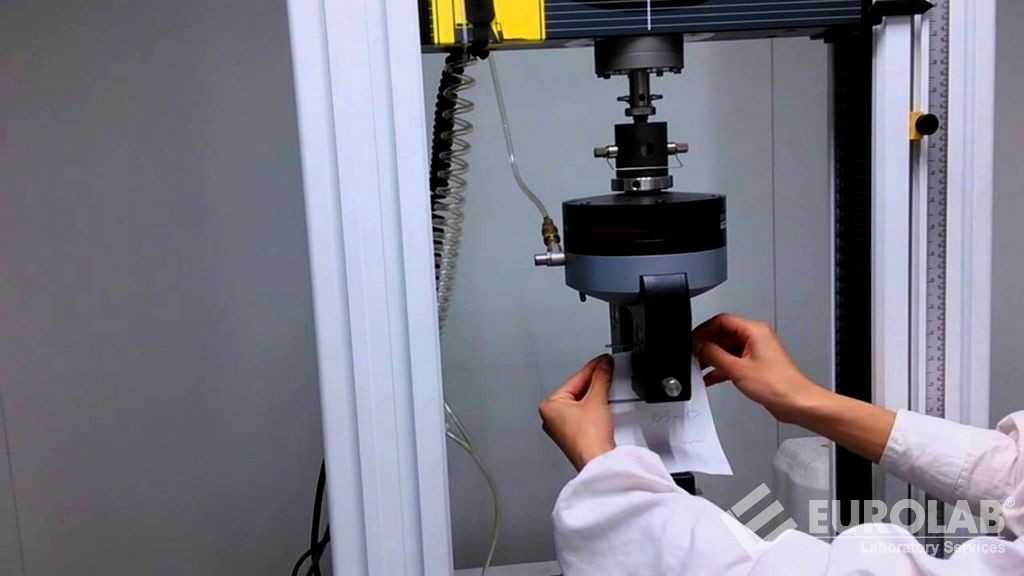
This test method covers the determination of load-deformation (tensile elongation and deformation energy) properties of polymer modified bitumen sheets.
Among the numerous testing, measurement, analysis and evaluation studies that our organization has provided for businesses in various sectors, it also provides testing services defined in the standard “ASTM D5147/D5147M-14 Standard test methods for sampling and testing modified bituminous sheet material” with its trained and expert staff and advanced technological equipment.
To get an appointment, to get more detailed information or to request an evaluation, you can ask us to fill in our form and reach you.

