

The ASTM C1421 Standard Test Methods for Determining the Fracture Toughness of Advanced Ceramics at Ambient Temperature, developed by the American Society for Testing and Materials (ASTM) , describes test methods for determining the fracture toughness of advanced ceramics at ambient temperature. These methods specify the pre-cracked beam test specimen, the surface crack in bending, and the strip-notch beam test specimen. Fracture toughness values are determined using beam test specimens with sharp cracks. The crack is a straight crack resulting from bridge bending, a semi-elliptical surface crack resulting from a Knoop indentation, or it forms and propagates in a strip notch as shown in the standard.
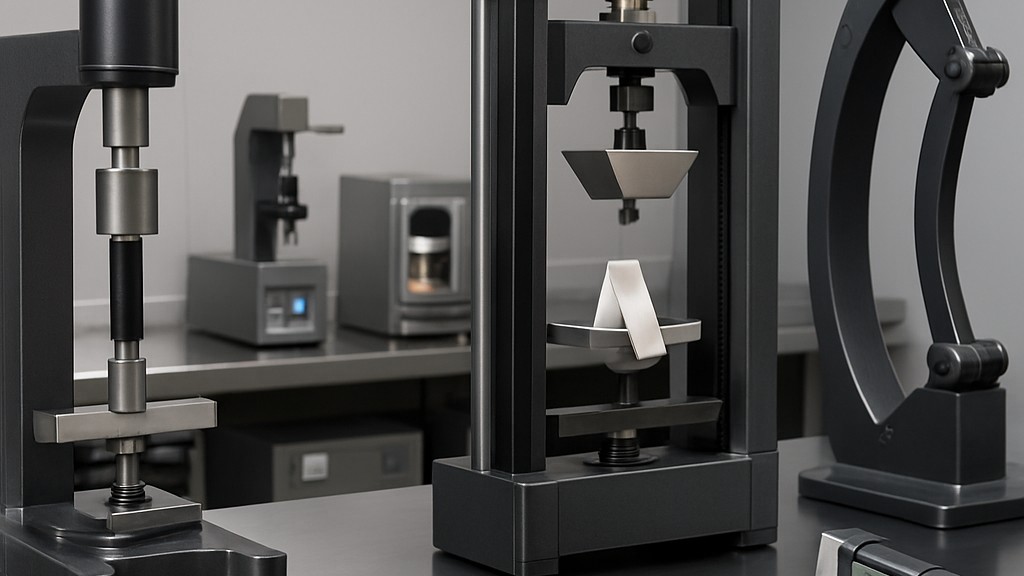
Fracture toughness is a measure of the resistance to crack propagation in a brittle material. These test methods can be used for materials development, material comparison, quality assessment, and characterization.
While bridge flexural and chevron notch fracture toughness values provide information about the fracture resistance of advanced ceramics containing large sharp cracks, Knoop indentation fracture toughness values provide this information for small cracks of similar size to natural fracture sources. Different sizes of cracks can be used for the Knoop indentation method. If fracture toughness values vary depending on crack size, it can be expected that the values for pre-cracked beam test specimens, surface cracks in bending, and strip-notched beam test specimens will differ. The advantages, disadvantages, and applicability of each method are listed in the table provided in the standard.
In short, ASTM C1421 defines procedures for evaluating the room-temperature fracture toughness of monolithic advanced ceramic materials. Ceramics are widely used in structural, aerospace, biomedical, and electronic applications due to their high hardness, wear resistance, and thermal stability. However, their brittle nature makes fracture toughness one of the most important mechanical properties to evaluate. ASTM C1421 provides four standard test methods for determining this property:
These methods are designed for use with monolithic ceramics and are not applicable to composites or porous ceramics.
The primary reasons why the ASTM C1421 standard is so important are:
The ASTM C1421 standard is widely used in the following areas:
As a result, ASTM C1421 is a comprehensive and technically rigorous standard that plays a key role in evaluating advanced ceramics. Multiple test methods provide flexibility to accommodate different material forms and application needs, ensuring safety and performance in critical environments.
Our organization, which has been supporting businesses across all sectors for years through a wide range of testing, measurement, analysis, and evaluation activities, boasts a strong team of employees who closely follow global developments in science and technology and are constantly improving themselves. In this context, we also provide testing services in accordance with ASTM C1421 Standard Test Methods for Determining the Fracture Toughness of Advanced Ceramics at Ambient Temperature.
To get an appointment, to get more detailed information or to request an evaluation, you can ask us to fill in our form and reach you.

