

The International Organization for Standardization (ISO) standard "ISO 1856 Flexible cellular polymeric materials - Determination of compression set" describes three methods for determining the compressive strength of flexible cellular materials. This standard is applicable to latex and polyurethane foams with a thickness greater than 2 mm.
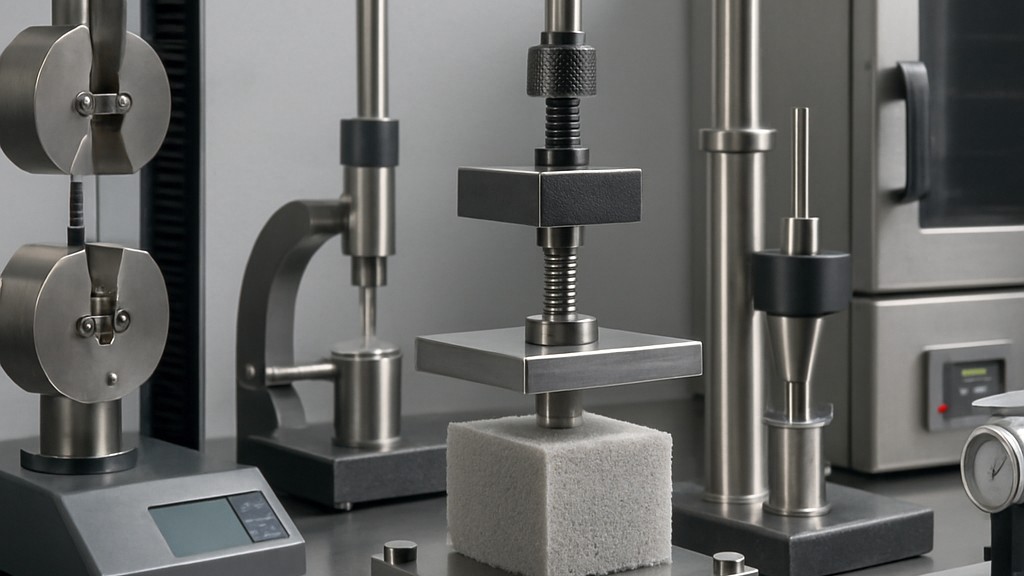
For the purposes of this standard, compression set means the difference between the initial thickness and the final thickness of the test piece after compression of the cellular material at a specified temperature for a specified time and after compression at a specified temperature for a specified time.
In principle, a test piece is held for a certain time at a certain temperature under a constant deflection, and the effect on the thickness of the test piece after release is recorded.
The tests use a clamping device consisting of two flat plates larger than the test pieces, equipped with spacers and clamps that hold the plates parallel and allow the gap between the plates to be adjusted to the desired deflection height. For testing thin materials, the required number of square photographic glass mounting slides must be provided. The slides should have a thickness between 1 mm and 1,5 mm, and a side length between 50 mm and 55 mm. Measurement instruments conforming to ISO 1923 are also used in the tests to measure the dimensions of the test pieces.
The top and bottom surfaces of the test pieces should be parallel and the edges should be substantially vertical. They should be 50 mm plus/minus 1 mm long, 50 mm plus/minus 1 mm wide, and 25 mm plus/minus 1 mm thick. The vertical edges of all test pieces should be free of contamination and incrustations.
If thin materials with a minimum thickness of 2 mm are to be tested, a sufficient number of 50 mm x 50 mm test pieces should be taken so that their total pre-compression thickness is at least 25 mm. At least two layers of foam should be used, and if there are more than two test pieces, each should be interlocked with photographic mounting slides. The entire assembly should be prepared as a single thick test piece during testing.
The process should be carried out in the direction in which the finished product will be subjected to stress under service conditions. Five 25 mm thick test pieces, or five assemblies in the case of thin materials, are tested.
Materials should not be tested after 72 hours of manufacture unless it can be demonstrated that the average results obtained at 16 or 48 hours after manufacture do not differ by more than plus or minus 10 percent from the results obtained at 72 hours. In such cases, testing for 16 hours and 48 hours, respectively, prior to testing is permitted.
Test pieces shall be conditioned for at least 16 hours in one of the following atmospheres according to ISO 23529:
This conditioning may constitute the final portion of the post-manufacturing period or, in the case of testing 16 hours after manufacture, the entire post-manufacturing period. For quality control testing, test pieces may be obtained sooner (up to a minimum of 12 hours) after manufacture, and tests may be conducted after conditioning for a shorter period (up to a minimum of 6 hours) in one of the atmospheres specified above.
The test can be performed using one of methods A, B, or C, or all three. However, these three methods may produce different results.
The test piece or assembly is placed between the plates of a compression device. It is compressed to 50 percent plus/minus 4 percent or 75 percent plus/minus 4 percent of its thickness and held there. In special cases, a 90 percent compression ratio may be specified. Within 15 minutes, the compressed test piece or assembly is placed in an oven at 70°C plus/minus 1°C and held for 22 hours plus/minus 0,2 hours.
The device is removed from the oven, and within 1 minute, the test piece is removed from the device and placed on a low-thermal-conductivity surface, such as wood. The surface should be at the same temperature as the surface used for conditioning. The test piece is allowed to recover at the same temperature as the conditioning temperature for 30 minutes plus or minus 5 minutes.
The thickness is measured again. For thin materials, the assembly must be intact. The thickness is calculated by subtracting the total thickness of the glass slides from the total measured thickness of the assembly of glass slides and test pieces.
In materials science, evaluating long-term performance under sustained loads is crucial, especially for foam-based products. A key international standard, ISO 1856, addresses this issue by outlining methods for measuring compressive strength in flexible cellular polymeric materials. These materials, commonly known as flexible foams, are commonly found in everyday items such as mattresses, seat cushions, and automotive interiors, where they are valued for their durability and comfort. This standard provides reliable protocols for measuring the extent of permanent deformation following compression.
The ISO 1856 standard is vital for industries where foam durability impacts user safety and product lifespan, ensuring test results are comparable across global suppliers and laboratories. It focuses solely on flexible foams that exhibit elastic recovery, excluding rigid or semi-rigid variants.
The ISO 1856 standard plays a key role in quality control, allowing manufacturers to predict foam performance over time and reduce failure rates in end-use scenarios. In the furniture industry, a low compression ratio ensures that seat cushions maintain their shape even after years of use. Automotive sectors rely on this standard for vibration-absorbing pads, while medical beds utilize hygienic and durable foams. By standardizing testing, it supports sustainable innovations like bio-based polyurethanes and ensures they are consistent with raw material performance. Failure to comply with this standard risks product recalls or diminished consumer confidence.
Our organization, which has been serving for many years and meticulously following global developments in science and technology, employs a skilled team and extensive infrastructure to conduct testing, measurement, and analysis in a wide range of areas for businesses across all sectors. In this context, we also provide testing services in accordance with the ISO 1856 Flexible cellular polymeric materials - Determination of compression set standard.
To get an appointment, to get more detailed information or to request an evaluation, you can ask us to fill in our form and reach you.

