

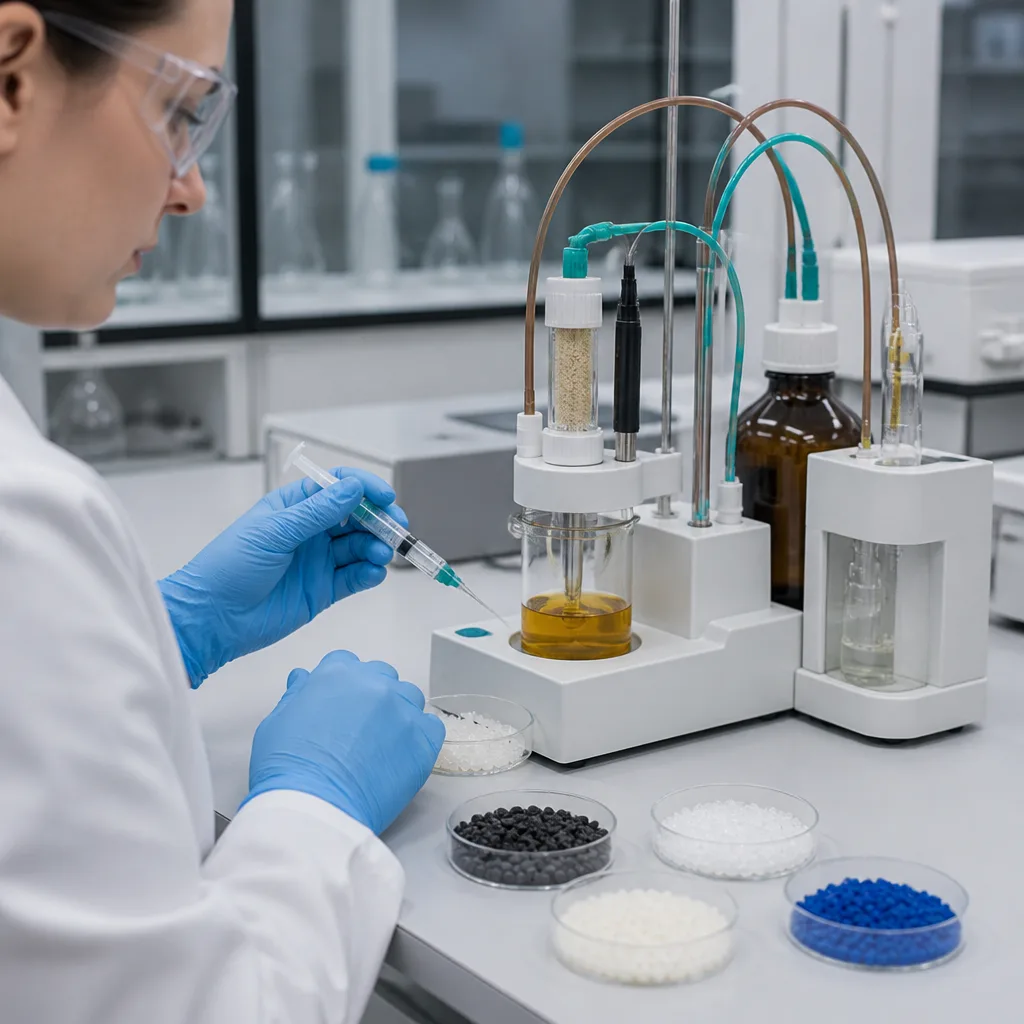
The standard “DIN 53715 Testing of plastics - Determination of water content by titration method according to Karl Fischer”, published by the German Institute for Standardization (DIN), describes the method for determining the water (moisture) content in plastics (polymers) and their final products. This method uses the Karl Fischer titration technique, a highly specific and accurate chemical method for measuring trace amounts of water.
Many plastics (such as polyamides, polycarbonates, polyesters, and polypropylene) are sensitive to moisture. Excess water can cause:
Accurate moisture content determination is critical for pre-processing material drying, quality assurance, and compliance with technical data sheets. For materials such as polypropylene (PP), polyamide 66/Nylon 66 (PA66), high-density polyethylene (HDPE), and polymethyl methacrylate/acrylic (PMMA), moisture values are typically reported in technical data sheets according to the DIN 53715 standard.
Karl Fischer titration is a volumetric or coulometric technique based on the Bunsen reaction modified for water:
The DIN 53715 standard method defines sample preparation, titration procedure, reagents, equipment, and calculations for plastics in various forms (granules, powder, finished parts).
Although the DIN 53715 standard has been repealed, the Karl Fischer method continues to be widely used in the plastics industry. This standard has been largely replaced or harmonized with the following international standards:
Many testing laboratories still accept or offer tests according to the DIN 53715 standard for older specifications.
Typical applications are as follows:
In short, the DIN 53715 standard describes a method for determining the water content in plastics using the highly sensitive Karl Fischer titration technique. Moisture content is a critical parameter in polymer materials, as even small amounts of water can significantly affect processing behavior and final product performance.
The purposes of this standard are to:
The DIN 53715 standard is based on Karl Fischer titration, a chemical method specifically designed to measure water content. This method works as follows: The water in the sample reacts with iodine, sulfur dioxide, and a base in a suitable solvent (usually methanol). The reaction is stoichiometric, meaning the amount of iodine consumed is directly proportional to the amount of water present.
Two common approaches are used with this method:
The procedure described in the DIN 53715 standard typically follows these steps:
The DIN 53715 standard is commonly used for moisture determination in the following areas:
Moisture can have serious effects on plastics:
Using the DIN 53715 standard, manufacturers provide the following:
The main advantages of the Karl Fischer method are as follows:
The DIN 53715 standard is compatible with similar international standards, including:
These standards share the same basic principle, but may differ slightly in procedure and reporting.
In conclusion, the DIN 53715 standard provides a standardized Karl Fischer titration procedure for reliable moisture measurement in plastics. Although no longer active, its principles remain fundamental in polymer processing and quality control. In current work, laboratories often refer to the ISO 15512 standard, and many older material specifications still refer to this standard.
For many years, our organization, with its competent and experienced staff, has been understanding the needs of its clients, providing the advanced testing services they require, and assisting them in the establishment, implementation, and improvement of management systems. Within this framework, we also provide testing services in accordance with the DIN 53715 standard.
To get an appointment, to get more detailed information or to request an evaluation, you can ask us to fill in our form and reach you.

