

The standard "ISO 178 Plastics - Determination of Flexural Properties," developed by the International Organization for Standardization (ISO), describes a method for determining the flexural properties of rigid and semi-rigid plastics under defined conditions. This standard defines a preferred test specimen and includes parameters for alternative specimen sizes for use where appropriate. A range of test speeds has also been added to the standard.
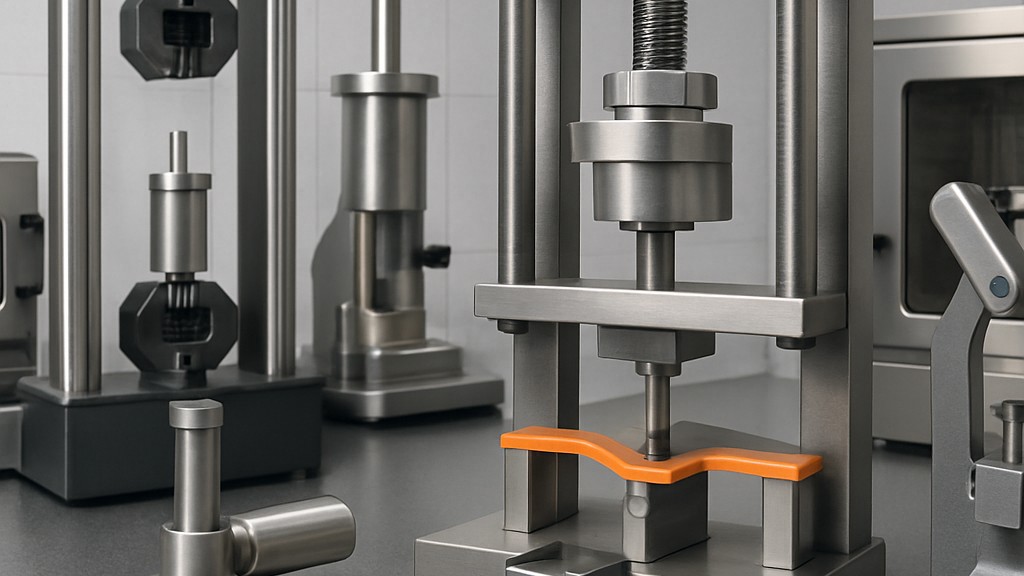
This method is used to investigate the flexural behavior of test specimens and to determine the flexural strength, flexural modulus, and other aspects of the flexural stress or strain relationship under defined conditions. It is applied to a freely supported beam loaded at mid-span (three-point loading test).
This method is suitable for use with the following range of materials:
In accordance with ISO 10350-1 and ISO 10350-2, this standard applies to fiber-reinforced composites with fiber lengths of up to 7,5 mm before processing. ISO 14125 applies to long-fiber-reinforced materials (laminates) with fiber lengths of at least 7,5 mm.
The method described is not suitable for use with rigid cellular materials or sandwich structures containing cellular material. In such cases, the ISO 1209-1 and ISO 1209-2 standards can be used. A four-point bend test is used for some types of textile fiber-reinforced plastics. This method is described in the ISO 14125 standard.
The method is performed using specimens machined from the center section of a standard multipurpose test specimen (ISO 20753), which can be molded to specified dimensions, or from finished or semi-finished products such as moldings, laminates, or extruded or cast sheet. The method specifies the preferred dimensions for the test specimen. Tests performed on specimens of different sizes or on specimens prepared under different conditions may produce non-comparable results. Other factors, such as test speed and sample conditioning, may also influence the results. For injection-molded semi-crystalline polymers in particular, the thickness of the oriented surface layer, which depends on the molding conditions, also affects the flexural properties. This method is not suitable for determining design parameters, but it can be used in materials testing and as a quality control test.
This standard describes two methods. Method A uses a strain rate of 1 percent/min throughout the test. Method B uses two different strain rates: 1 percent/min for determining the flexural modulus and either 5 percent/min or 50 percent/min, depending on the ductility of the material, for determining the remainder of the flexural stress-strain curve.
The strain rates specified above should be interpreted as nominal rates. Nominal test rates are calculated using the formula provided in the standard. The most appropriate machine settings are selected from the table provided in the standard.
For materials exhibiting nonlinear stress or strain behavior, the flexural properties are nominal only. The formulas given are derived assuming linear elastic behavior and are valid for deflections that are small compared to the specimen's thickness. For the preferred specimen, measuring 80 mm x 10 mm x 4 mm, with a conventional flexural strain of 3,5 percent and a span-to-thickness ratio of 16, the deflection is 1,5 hours. Bending tests are more suitable for hard and brittle materials that exhibit small deflections at fracture than for very soft and ductile materials.
The testing machine must comply with ISO 7500-1 and ISO 9513 standards and the requirements outlined in these standards. Furthermore, the testing machine must be capable of maintaining the test speed specified in the table.
The ISO 178 standard is considered important for the following reasons:
These are important for engineering design, materials selection, and quality control.
As a result, the ISO 178 standard is essential for evaluating the flexural behavior of plastics, making it a fundamental element in plastic material testing, design validation, and industrial quality control.
Our organization, which has been supporting businesses across all sectors for years through a wide range of testing, measurement, analysis, and evaluation activities, has a strong team of employees who closely follow global developments in science and technology and are constantly improving themselves. In this context, we also provide testing services in accordance with the ISO 178 Plastics - Determination of Flexural Properties standard.
To get an appointment, to get more detailed information or to request an evaluation, you can ask us to fill in our form and reach you.

