

The standard "ASTM D968 Standard Test Methods for Abrasion Resistance of Organic Coatings by Dropping Abrasive Media" published by the American Society for Testing and Materials (ASTM) describes test methods for determining the resistance of organic coatings to abrasion caused by dropping abrasive media on coatings applied to a flat, hard surface such as metal or glass panels.
This standard covers two test methods based on different abrasives:
Because of the low reproducibility of methods using numerical values, these methods should be limited to testing within a single laboratory. Interlaboratory agreement is significantly increased when ordinal rather than numerical values are used.
Silica sand provides a slower wear rate for organic coatings than silicon carbide. It can also provide greater differentiation for some coating types.
Although the abrasion resistance scales obtained by the two methods differ, they yield approximately the same ranking for coatings in terms of abrasion resistance. Both methods have been found to be useful for rating the abrasion resistance of specific types of coatings. For example, Method A (falling sand) has been used to rate floor coatings, while Method B (falling silicon carbide) has been used to rate coatings on ship decks.
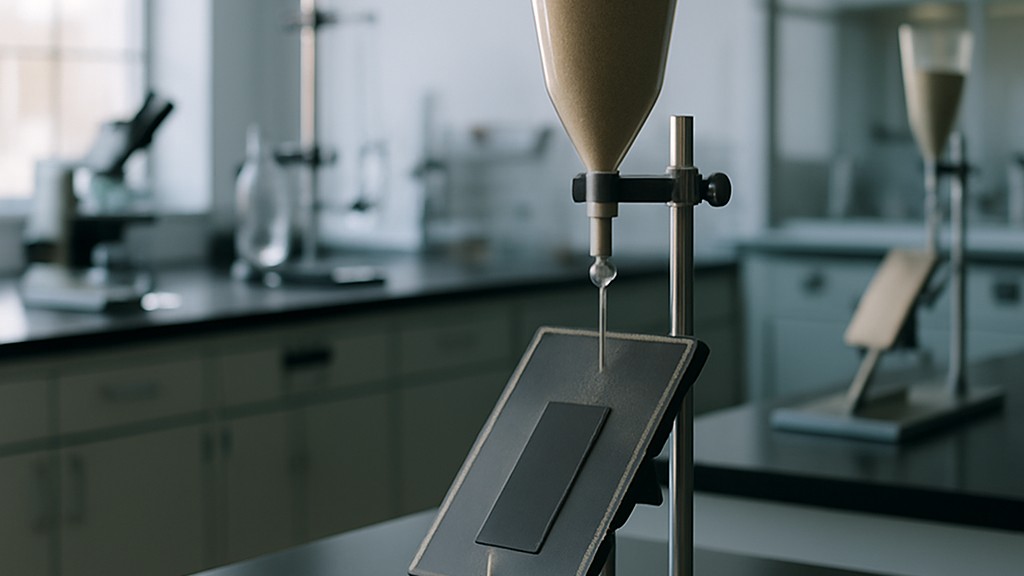
In the test, an abrasive is dropped onto a coated panel through a guide tube from a predetermined height until the substrate becomes visible. The amount of abrasive per unit film thickness is reported as the wear resistance of the coating on the panel. Silica sand or silicon carbide may be used as specified.
In the world of materials science and engineering, the durability of protective coatings is of paramount importance. Organic coatings such as paints, varnishes, and lacquers are widely used to protect surfaces from environmental wear, corrosion, and mechanical damage. However, one of the most common types of degradation these coatings experience is abrasion caused by friction, impact, or the abrasive action of abrasive particles. Standard test methods are essential for measuring and comparing this resistance. This is where ASTM D968 provides a reliable framework for evaluating how well coatings resist abrasive forces, helping manufacturers, engineers, and quality control professionals make informed decisions. This standard ensures consistency across industries such as automotive, marine, construction, and consumer goods.
ASTM D968 standard includes two basic test methods for evaluating the abrasion resistance of organic coatings applied to hard, planar surfaces such as metal or glass panels. The basic principle is simple yet effective: simulate real-world abrasion by allowing the abrasive material to flow from a fixed height onto the coated surface in a controlled manner. The amount of abrasive required to wear away the coating to the substrate is a direct measure of its durability.
This standard applies to organic coatings on flat, hard surfaces. It focuses on abrasion from falling particles rather than sliding or rubbing motions (covered by other standards such as ASTM D4060 for Taber abrasion).
This standard emphasizes safety by requiring users to establish appropriate health practices and adhere to legal limits, as abrasion testing can generate dust and particles.
This standard uses two different methods, each using a different abrasive and producing different wear rates. This duality allows testers to choose the method best suited to their coating type or application needs:
Both methods utilize a standard testing device, such as the falling sand abrasion apparatus described in the standard. This device includes a funnel, flow regulator, and collection tray. The panels are preconditioned to ensure repeatability (e.g., at 23°C and 50% relative humidity). Abrasion resistance is calculated according to the formula provided in the standard. Higher values indicate superior resistance. For example, a floor covering may require 200-500 L/mil to meet the quality requirements under Method A.
Abrasion resistance is a critical performance indicator for pavements in harsh environments. Poor abrasion performance can lead to premature failure, increased maintenance costs, and safety hazards, such as the fading of a road sign from tire and sand abrasion.
As specified in this standard, silica sand (Method A) provides greater discrimination for some coatings, while silicon carbide (Method B) offers faster testing. Both provide similar rankings but have different absolute scales.
The main industrial applications of this standard are:
Beyond compliance, the ASTM D968 standard also aids formulation development. Coating chemists use it to optimize resin types, fillers, or crosslinkers for improved durability. It's also an integral part of quality assurance, impacting product certifications and warranties.
As a result, the ASTM D968 standard stands out as a cornerstone for evaluating organic coatings, combining laboratory precision with real-world reliability. By measuring abrasion resistance, it empowers industries to develop durable, long-lasting solutions.
Our organization, which has been serving for many years and meticulously following global developments in science and technology, employs a skilled team and extensive infrastructure to conduct testing, measurement, and analysis in a wide range of areas for businesses across all sectors. In this context, we also provide testing services in accordance with ASTM D968 Standard Test Methods for Abrasion Resistance of Organic Coatings by Dropping Abrasives.
To get an appointment, to get more detailed information or to request an evaluation, you can ask us to fill in our form and reach you.

