

The coefficient of friction (COF) is a dimensionless number defined as the ratio between the frictional force and the normal force. Materials with a COF value of less than 0,1 are considered slippery materials. The COF depends on the nature of the materials and the surface roughness.
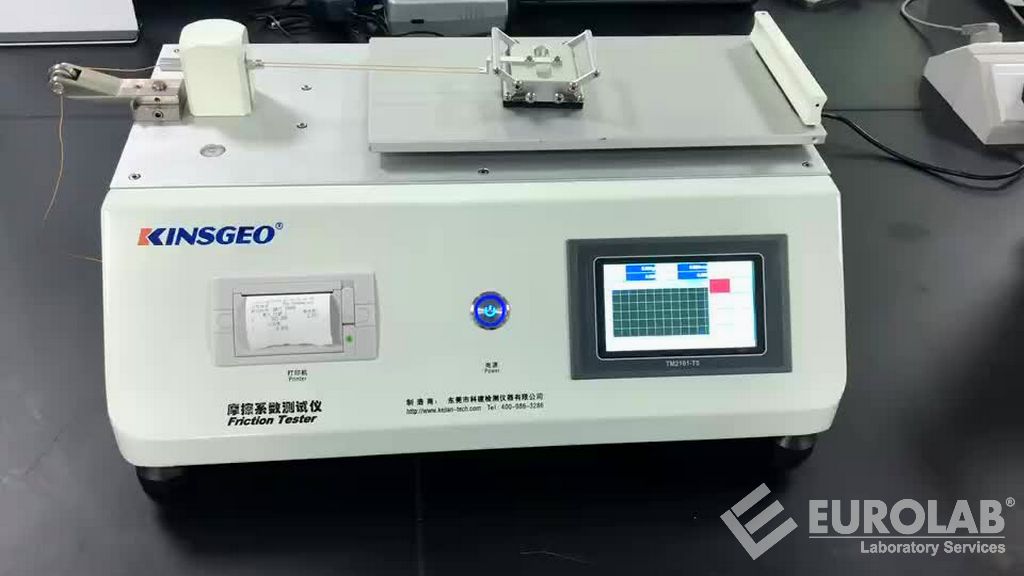
The ASTM D1894 standard, generally developed by the American Society for Testing and Materials (ASTM), defines the most widely used test method for COF measurement (ASTM D1894-14 Standard test method for static and kinetic coefficients of friction of plastic film and coating). This test method involves determining the initiation and sliding friction coefficients when the plastic film and sheet slides on itself or on other materials under specified test conditions. This method allows the use of a fixed sled with a movable plane or a movable sled with a fixed plane. Both methods give the same coefficients of friction values for a given sample. During testing, the polymer sample is dragged across a stainless steel plate under dry or wet conditions, thereby measuring the frictional force. The normal force in this test is equal to the gravitational force of the weight.
In short, the coefficient of friction is a measure of the amount of friction available between two surfaces. When a coefficient of friction is found, the resistance to movement between two surfaces of similar or different materials is calculated. The strength of this friction force depends on the materials pressing against each other. For example, a steel bar glides over a layer of ice much more easily than it does on a concrete slab. In these examples, the steel-on-ice combination has a much lower coefficient of friction.
In pipes, it is common to study two types of coefficients of friction: static and kinetic. The coefficient of static friction is a measure of the amount of friction that exists between two surfaces at rest. This coefficient of static friction must be overcome for motion to occur. The coefficient of kinetic friction is a measure of the amount of friction between moving objects. Essentially, the coefficient of friction differs between moving and stationary objects. For the most part, objects that don't move tend to experience more friction.
Our organization also provides friction coefficient testing services with its trained and expert staff and advanced technological equipment, among the numerous test, measurement, analysis and evaluation studies it provides for businesses in various sectors.
To get an appointment, to get more detailed information or to request an evaluation, you can ask us to fill in our form and reach you.

