

Tensile testing is a destructive testing process that provides information on the tensile strength, yield strength, and ductility of a metallic or plastic material. With tensile analysis, the force required to break a composite or plastic sample and how long the sample has stretched to that breaking point are determined. Here are a few standards commonly referred to in tensile analysis:
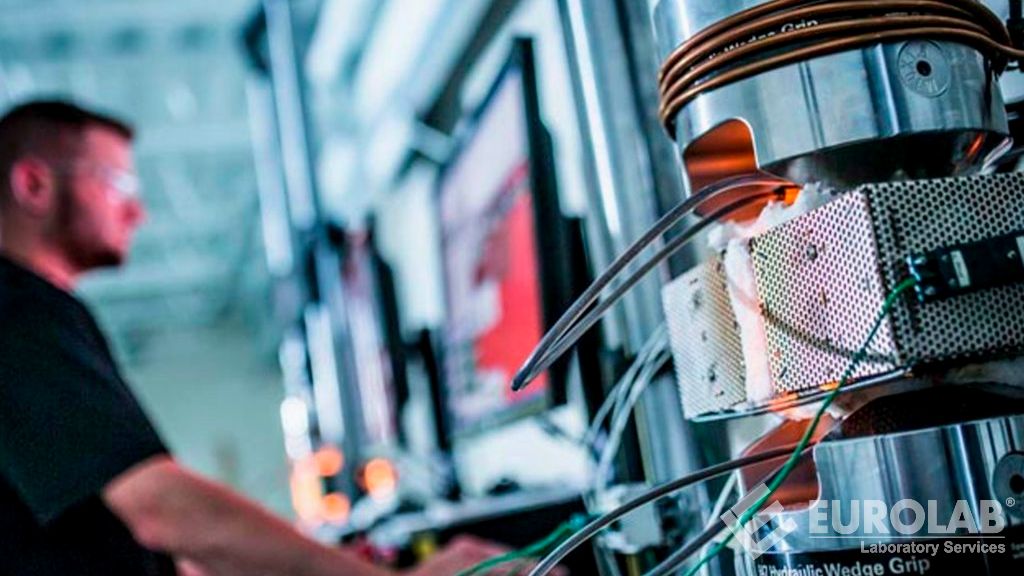
The tensile analysis also gives results as tensile strength, tensile modulus, tensile stress, percent elongation and yield elongation, percent elongation and elongation at break.
Tensile tests are performed mainly to determine how a material behaves under tensile load. In a simple tensile test, a sample is generally pulled to the breaking point to determine the ultimate tensile strength of the material. The amount of force applied to the sample and the elongation of the sample are measured throughout the test. Material properties are usually expressed in terms of stress (force per unit area) and strain (percentage change in length). To obtain the tension, the force measurements are divided by the cross-sectional area of the sample. Strain measurements are obtained by dividing the change in length by the initial length of the sample. These values are then displayed on a graph called the stress-strain curve. Test and measurement procedures vary depending on the material being tested and the intended application.
Advanced laboratories perform accurate and reliable tensile testing of metals, plastics, textiles, adhesives, medical devices and many other products and components.
In research and development, tensile testing is crucial for selecting suitable materials. These tests are conducted to verify that materials meet minimum strength and elongation requirements. The use of unsuitable materials is extremely important in terms of material damage and human health. In short, tensile tests are performed to determine the characteristic mechanical properties of metals.
Our organization also provides tensile analysis services with its trained and expert staff and advanced technological equipment, among the numerous test, measurement, analysis and evaluation studies it provides for businesses in various sectors.
To get an appointment, to get more detailed information or to request an evaluation, you can ask us to fill in our form and reach you.

